Ugh...sorry I was away for so long. The holidays took their toll on me. Lots of wine, lots of food, lots of shopping, lots of wrapping, lots of other crap.
I spent close to a week at my parents' house in western Maryland. It wasn't all that bad, except for a bit of cabin fever after a while. It's set in the middle of a wild landscape of rock outcroppings and twisted trees, and from the kitchen windows you can spot a 200-year-old mansion, reportedly home to several ghosts and a secret room, cursed so that anyone who enters it dies. And a few hundred yards from the back door is the unmarked grave of a Union soldier. And the house is built on the site of a colonial brick foundry, of which almost no trace remains. Across the road are the ruins of a burned-out barn, and down the road a short way is a cemetery. In the other direction is a funeral home.
No wonder I grew up the way I did. When hearses and funeral processions are regular occurrences, it has an effect on you.
So let's see. I saw a cool movie, LET THE RIGHT ONE IN, a Swedish-language vampire film, that's all the rage right now. Everything the critics are saying is true; it absolutely rocks. I saw it on a quiet Sunday night at DC's Avalon Theater. It was very cold and windy that night, and I had parked my car a couple of blocks away. The cold and wind didn't bother me; I loved them. But it was great to be walking down a quiet residential street, everyone's at home, the lights were on...it was one of those moments that's the ultimate winter memory.
And like I said, the movie rocks. An arty horror film that doesn't forget it's a horror film. There's some real arty material there, but there's also quite a bit of genuine gruesomeness and creepiness, and the final note is unsettling.
And avoid TWILIGHT. I am personally boycotting anything of that ilk.
I'm also working on an anthology, GHOSTS FOR CHRISTMAS, which is perfectly seasonal. And some other stuff. I'll be posting some stuff later.
I'm also trying to figure out what to do for New Year's Eve, and also preparing for a black-tie pre-inaugural gala in a couple weeks. (I actually bought a tuxedo today, for pity's sake.)
So stay tuned....there's more coming up...
Monday, December 29, 2008

Thursday, December 11, 2008
Dust & Corruption Goes Christmas Shopping
Yes, there's stuff out there for folks like me.
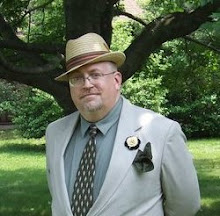
Actually, this is just an excuse to run a cool picture that was taken of me. I dropped by the Craft Mutiny Booty Market last Saturday, and one dealer, Kelly Rand, had the neatest pillows, embroidered with little bloodstains. They're about ten different kinds of wrong, so I just had to have one. Plus they're amazingly comfy. So after buying a few gifts, I treated myself to a pillow, and was photographed and briefly interviewed for the Hello Craft blog. So, for my readers who don't know what I look like, here I am, cuddling my Christmas pillow.

Ain't I just the cutest?
Actually, this is just an excuse to run a cool picture that was taken of me. I dropped by the Craft Mutiny Booty Market last Saturday, and one dealer, Kelly Rand, had the neatest pillows, embroidered with little bloodstains. They're about ten different kinds of wrong, so I just had to have one. Plus they're amazingly comfy. So after buying a few gifts, I treated myself to a pillow, and was photographed and briefly interviewed for the Hello Craft blog. So, for my readers who don't know what I look like, here I am, cuddling my Christmas pillow.

Ain't I just the cutest?
Wednesday, December 10, 2008
Short takes: More Clark Ashton Smith
I'm plowing through my Arkham House edition of A RENDEZVOUS IN AVEROIGNE, a candybox of Smith stories. There's a selection from each of his created worlds, plus a random section of non-mythos stories. Nicely, I can skip about half of it after my recent readings.
Of most interest are Averoigne selections. Averoigne, for the uninitiated, is a mythical region of medieval France, haunted by witches and demons and what have you. You know, the usual Smith dark stuff.
Anyway...
First off is "The Holiness of Azedarac." The title character is the bishop of the city of Ximes, and is in reality a diabolical sorcerer using his holy office for all sort of unholiness. (It's broadly hinted that he's actually immortal, and this is just his latest disguise.) Brother Ambrose has been sent by another bishop to investigate, and is rushing off with his report when one of Azedarac's servants slips a potion into his drink at a wayside inn, which doesn't kill him, but projects him 700 years into the past, where he's nearly sacrificed by druids. However, he's rescued by a pagan sorceress....
While it's mostly about Ambrose, the title actually has a function. The story's crowning irony is that Azedarac's holiness is a sham, and even after Ambrose returns (albeit a generation after he left), he finds that Azedarac is now regarded as a saint. And Ambrose ends up returning to the past, shedding his holy orders to live happily with the pagan sorceress.
Thus we have what appears to be a theme of the Averoigne stories, the battle between Christianity and paganism, with Christianity almost always coming out on the losing end in one way or the other. In "The Holiness of Azedarac," all Christian piety is a sham, and even the most sincere believer ends up abandoning his faith for earthy pleasures.
Next up is "The Colossus of Ylourgne," in which we have another unholy sorcerer, Nathaire, swearing vengeance on Averoigne's ecclesiastical community for various reasons, summons newly-dead corpses to a remote castle and using them to construct a corpselike giant, into which he projects his own soul. He despoils the various churches in Averoigne until another sorcerer, Gaspard du Nord, foils him with a clever plot.
Again, there's a strain of anticlericalism here, as the church is helpless and ineffectual in battling the giant, and only another sorcerer can defeat the menace. And he's the only sorcerer left alone by the church afterward.
After that is "The End of the Story." Law student Christophe Morand is traveling and takes shelter in a remote monastery, where he befriends a jovial monk whose has an extensive book collection. He finds a bound manuscript that the monk warns him not to read, claiming it will lead to his destruction. Kinda like the cursed video in RINGU, he just HAS to read it. It tells the story of a knight who disappeared while exploring the ruins of the Chateau des Faussesflammes, which just happens to be nearby, although the manuscript is incomplete, not telling just what happened to the knight. Naturally, Christophe is curious and goes to the Chateau the next day, and in the catacombs finds a lovely grove inhabited by a beautiful woman...
Of course, things are not as they seem, and Christophe is at first rescued by the monks. But...in the end, he cannot resist the call of the pagan enchantress, and goes to her, a triumph of pagan earthiness over Christian piety. Also, the book-collecting monk has his own share of culpability. He shows Christophe the manuscript, and if not for that Christophe would never have gone to the Chateau. The monk's collection is also eyebrow-raising; a complete manuscript of Sappho, odes by Catullus, an unknown dialogue of Plato, an Arabian work on astronomy that prefigures Copernicus, and the "somewhat infamous Histoire d'Amour," of which there are two known copies, the rest destroyed upon publication. Obviously, this monk's studies are hardly of the approved variety! Brother Hilaire is obviously an unwitting enabler of the dark forces in the Chateau, and perhaps a long-distance puppet?
The last story in the section, "A Rendezvous in Averoigne," is well-written but ultimately shallow fluff about lovers on the run who end up taking shelter in the Chateau des Faussesflammes and being menaced by vampires. (Presumably this takes place long before the events of "The End of the Story" but who knows?) Everything's dealt with quickly and easily, so it's entertaining, but without the depth of the others.
The "Atlantis" section has three stories that are OK fantasies, with good twists of irony, but just not very noteworthy aside from that. No real common theme unites them except for the irony. "The Last Incantation" has a sorcerer summoning a dead love, only to find her less beautiful; the irony being that he failed to summon up his own youth, so he could see her with young eyes. "The Death of Malygris" has the same sorcerer apparently dying, and his rivals taking almost absurd precautions, waiting years before they finally venture in...only to be felled by a final booby trap. "A Voyage to Sfanomoe" gives us two brothers, scholars and scientists, who flee a sinking Atlantis in a homemade spacecraft and land on Venus...where, while exploring Venus' fields of flowers, they are transformed into plants themselves. Nice stuff, well-written, but lacking a certain oomph.
I can skip over the "Zothique" and "Hyperborea" sections, leaving only the grab-bag "Lost Worlds" part which I started today. I'll report on that later...
Of most interest are Averoigne selections. Averoigne, for the uninitiated, is a mythical region of medieval France, haunted by witches and demons and what have you. You know, the usual Smith dark stuff.
Anyway...
First off is "The Holiness of Azedarac." The title character is the bishop of the city of Ximes, and is in reality a diabolical sorcerer using his holy office for all sort of unholiness. (It's broadly hinted that he's actually immortal, and this is just his latest disguise.) Brother Ambrose has been sent by another bishop to investigate, and is rushing off with his report when one of Azedarac's servants slips a potion into his drink at a wayside inn, which doesn't kill him, but projects him 700 years into the past, where he's nearly sacrificed by druids. However, he's rescued by a pagan sorceress....
While it's mostly about Ambrose, the title actually has a function. The story's crowning irony is that Azedarac's holiness is a sham, and even after Ambrose returns (albeit a generation after he left), he finds that Azedarac is now regarded as a saint. And Ambrose ends up returning to the past, shedding his holy orders to live happily with the pagan sorceress.
Thus we have what appears to be a theme of the Averoigne stories, the battle between Christianity and paganism, with Christianity almost always coming out on the losing end in one way or the other. In "The Holiness of Azedarac," all Christian piety is a sham, and even the most sincere believer ends up abandoning his faith for earthy pleasures.
Next up is "The Colossus of Ylourgne," in which we have another unholy sorcerer, Nathaire, swearing vengeance on Averoigne's ecclesiastical community for various reasons, summons newly-dead corpses to a remote castle and using them to construct a corpselike giant, into which he projects his own soul. He despoils the various churches in Averoigne until another sorcerer, Gaspard du Nord, foils him with a clever plot.
Again, there's a strain of anticlericalism here, as the church is helpless and ineffectual in battling the giant, and only another sorcerer can defeat the menace. And he's the only sorcerer left alone by the church afterward.
After that is "The End of the Story." Law student Christophe Morand is traveling and takes shelter in a remote monastery, where he befriends a jovial monk whose has an extensive book collection. He finds a bound manuscript that the monk warns him not to read, claiming it will lead to his destruction. Kinda like the cursed video in RINGU, he just HAS to read it. It tells the story of a knight who disappeared while exploring the ruins of the Chateau des Faussesflammes, which just happens to be nearby, although the manuscript is incomplete, not telling just what happened to the knight. Naturally, Christophe is curious and goes to the Chateau the next day, and in the catacombs finds a lovely grove inhabited by a beautiful woman...
Of course, things are not as they seem, and Christophe is at first rescued by the monks. But...in the end, he cannot resist the call of the pagan enchantress, and goes to her, a triumph of pagan earthiness over Christian piety. Also, the book-collecting monk has his own share of culpability. He shows Christophe the manuscript, and if not for that Christophe would never have gone to the Chateau. The monk's collection is also eyebrow-raising; a complete manuscript of Sappho, odes by Catullus, an unknown dialogue of Plato, an Arabian work on astronomy that prefigures Copernicus, and the "somewhat infamous Histoire d'Amour," of which there are two known copies, the rest destroyed upon publication. Obviously, this monk's studies are hardly of the approved variety! Brother Hilaire is obviously an unwitting enabler of the dark forces in the Chateau, and perhaps a long-distance puppet?
The last story in the section, "A Rendezvous in Averoigne," is well-written but ultimately shallow fluff about lovers on the run who end up taking shelter in the Chateau des Faussesflammes and being menaced by vampires. (Presumably this takes place long before the events of "The End of the Story" but who knows?) Everything's dealt with quickly and easily, so it's entertaining, but without the depth of the others.
The "Atlantis" section has three stories that are OK fantasies, with good twists of irony, but just not very noteworthy aside from that. No real common theme unites them except for the irony. "The Last Incantation" has a sorcerer summoning a dead love, only to find her less beautiful; the irony being that he failed to summon up his own youth, so he could see her with young eyes. "The Death of Malygris" has the same sorcerer apparently dying, and his rivals taking almost absurd precautions, waiting years before they finally venture in...only to be felled by a final booby trap. "A Voyage to Sfanomoe" gives us two brothers, scholars and scientists, who flee a sinking Atlantis in a homemade spacecraft and land on Venus...where, while exploring Venus' fields of flowers, they are transformed into plants themselves. Nice stuff, well-written, but lacking a certain oomph.
I can skip over the "Zothique" and "Hyperborea" sections, leaving only the grab-bag "Lost Worlds" part which I started today. I'll report on that later...
Friday, November 21, 2008
MONKEEWRENCH by P. J. Tracy

In rural Wisconsin, an elderly couple is found murdered, their bodies propped up in praying positions in a church. In Minneapolis, the partners of a computer game development firm are horrified when a serial killer starts bumping off locals in the style of the murderer in their newest game, Serial Killer Detective.
This is basically an enjoyable thriller in the read-it-and-forget-it school. It's got some of the requisite People With Dark Secrets, Tormented Main Characters, and Brutal Evil Killer. It's cliched, to be sure, but it moves at a brisk pace and it plays enough with some of the genre elements to keep from being too tiresome.
It benefits from some pretty gruesome scenes and a perverse twist when it's found out that the most likely suspect is a hermaphrodite. The novel starts off very grotesque and horrific, but toward the second half becomes more of a police procedural. There are a few weaknesses, though. The identity of the killer is telegraphed a bit far in advance, and quite a few characters lack dimension. But there's quite a bit of humor to leaven the gruesomeness.
Still, if you're looking for a fun read, you could do worse. As I said, it's in the read-it-and-forget-it school.
Thursday, November 20, 2008
Pass the Punch
Just got home from another gruesome play....Dog & Pony DC's "PUNCH: That's the Way We Do It."
It's a live-action Punch & Judy show. No, really. Never thought that sort of thing could happen, eh? It's about 37 different kinds of wrong, but outrageously entertaining, if it doesn't give you the heaves.
There's a four-person cast: Josh Drew as clown/narrator Joey, the brawny Dan Van Hoozer as Punch, Niki Jacobsen as Judy and later as the doctor, and Lee Liebeskind as the policeman, the executioner, and later the Devil.
It's all totally batshit crazy, although sometimes shocking. It's funny to see puppets or cartoon characters beating each other up, but when it's suddenly actual human beings beating each other up....well, it still can be funny, but you're not as comfortable about it.
Screaming slogans like "Eat! Fuck! Kill!" over a soundtrack of punk-rock tunes, and ending in a general melee, flailing in a pool of blood at my feet (literally, at my feet), this was a memorable evening out.
Unfortunately, it closes Saturday night, so DC area folks only have a few days left to catch it. It's playing at Flashpoint DC, near the Chinatown metro stop, so make an evening of it. Tickets are $15, and there's free (!) Pabst Blue Ribbon for the taking.
It's a live-action Punch & Judy show. No, really. Never thought that sort of thing could happen, eh? It's about 37 different kinds of wrong, but outrageously entertaining, if it doesn't give you the heaves.
There's a four-person cast: Josh Drew as clown/narrator Joey, the brawny Dan Van Hoozer as Punch, Niki Jacobsen as Judy and later as the doctor, and Lee Liebeskind as the policeman, the executioner, and later the Devil.
It's all totally batshit crazy, although sometimes shocking. It's funny to see puppets or cartoon characters beating each other up, but when it's suddenly actual human beings beating each other up....well, it still can be funny, but you're not as comfortable about it.
Screaming slogans like "Eat! Fuck! Kill!" over a soundtrack of punk-rock tunes, and ending in a general melee, flailing in a pool of blood at my feet (literally, at my feet), this was a memorable evening out.
Unfortunately, it closes Saturday night, so DC area folks only have a few days left to catch it. It's playing at Flashpoint DC, near the Chinatown metro stop, so make an evening of it. Tickets are $15, and there's free (!) Pabst Blue Ribbon for the taking.
Monday, November 17, 2008
CLOSET LAND, from Molotov Theatre

On a cold, windy November evening, this play is a great choice.
CLOSET LAND, by Radha Bharadwaj, is an intense two-person play. In an unnamed country being ruled by a totalitarian dictatorship, a nameless woman (played by Jessica Hanson) is under arrest. She's a children's book author, and is being accused of hiding inflammatory political messages in her books, to indoctrinate the young and alert adults to resistance activities. Her interrogator (Alex Zavistovich) plays all sorts of games with her, physically and mentally, in order to get her to sign a confession. She maintains her innocence even as dark secrets are revealed...and the interrogator may be more than he seems.
It's a chilling, effective play. The torture scenes are handled with a certain amount of subtlety, with cuts to black or sound effects standing in for various events, although some are pretty much up-front. And, depending on your frame of mind, there's a certain ambiguity. Is it all really happening? Is it all in her mind? Is the interrogator really who he claims to be? Or is he only using his knowledge of her past to trick her? Is she really a subversive? Or is she being turned into a subversive by the interrogator?
The acting is uniformly good. Jessica Hansen brings a lot of determination and vulnerability to her role as the author, while Alex Zavistovich exudes a bland, jovial complacency...until the mask comes off.
Performed in the back room of 1409 Playbill Cafe (1409 14th St NW, Washington DC), this is subtler in its approach to violence than some other Molotov fare, and also more overtly political. Still, seek it out. Molotov Theatre is waiting for you.
Saturday, November 15, 2008
QUANTUM OF SOLACE
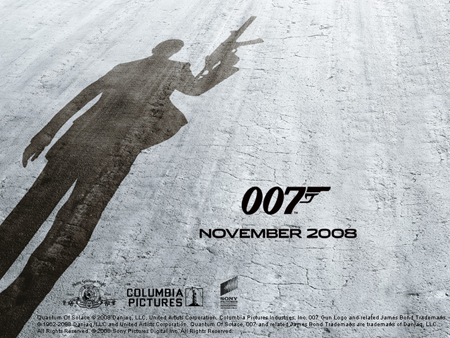
OK, so I'm a James Bond fan. Have been since I was a kid. They've varied in quality, sometimes quite remarkable, sometimes almost painful.
I loved, loved, LOVED the last film, CASINO ROYALE. It had just the right mixture of action, intrigue, suspense, and character development to absolutely thrill me. I saw it three times in theaters. I pre-ordered the DVD from Amazon...and am now kicking myself since the Special Edition just came out.
I was quite interested to see where they went with the next one. I admit....I groaned, loudly, when I heard the announced title. Good grief, not QUANTUM OF SOLACE!!!! For those who don't know, it's one of Ian Fleming's short stories about Bond, actually quite a good one but devoid of any real action or intrigue; it's basically Bond hearing a story about a dysfunctional marriage and pondering how normal life can be more dramatic than his own. (The story uses the phrase to indicate a tiny amount of comfort.)
But c'mon...using that for a title? In this day and age? Holy crap. What the hell were they thinking? Some of my fears about public reaction to it were justified, as it seems most of the public who weren't fans of the literary Bond either had no idea what it meant, or thought the movie would deal with space travel or time travel (thanks a lot, QUANTUM LEAP), and critics used terms like "forbidding" and "pretentious" when describing the title.
Still, I hoped the movie would be good. I really did. I wanted to like it.
But alas. I am SO disappointed by QOS.
There's lots of action, to be sure, but most of the action scenes are so over-edited that it's hard to keep track of what's going on, or who's doing what to who. In the opening chase scene, for instance, Bond's car loses a door, and I have no idea how, because the editing is so frantic that it's almost impossible to make out. This has been pointed out by many critics and fans, and I went in feeling actually fairly skeptical that it could be so bad...and it was. It was just all wrong.
I guess some of the blame for that can be laid on the shoulders of director Marc Forster, who has never directed an action film before. Yup. He's good when it comes to exploring emotions and relationships (I thought his work with FINDING NEVERLAND was exceptional), but he was so out of his element with a Bond film. He seemed to be aping the style of the MATRIX films (which I detest, btw), and the Bourne series (which I think are OK) with the shakycam work and the frenetic editing. He often seems to be afraid of pulling back and just letting the camera sit and watch, so we can see for ourselves what's going on.
The plot is OK...Dominic Greene, who hides behind a facade of environmental charity, is really part of a vast criminal network called Quantum, and is plotting to seize control of Bolivia's water supply and reap billions. Really, not all that bad a plot, esp. when you consider the concern in the scientific community about a potential water crisis in the real world, with parts of the world potentially becoming uninhabitable due to water shortages. It's a little spooky. But the film fails to focus enough on the plot; it's really secondary to the real plot. Bond is out for revenge on the criminal network that deceived the woman he loved in the last film, and drove her to commit suicide.
Now, I thought, since they called it QUANTUM OF SOLACE, we'd get some real exploration of Bond's feelings as he went after the villains. There is some, I'll admit...but not enough. It often seems perfunctory, especially coming from someone like Marc Forster. That sort of thing is his bread and butter; he SHOULD have done better with it.
The REAL emotional link in this film is the prickly relationship between Bond and his boss M, negotiating their trust for each other and dependence on each other. In fact, a much more appropriate title would have been A MATTER OF TRUST or something along those lines, as that's really as much a theme in this film as Bond's search for comfort. Early in the film, M is betrayed by her own bodyguard, and is angry over her trusting a traitor, even though there was no reason to doubt him, as they find out. M doesn't trust the CIA. Bond gives trust in Mathis. The CIA doesn't trust Bond. There's even issues of trust among the villains. It's everywhere in this film, and deserved more playing up than what it got. Even the film's final scene is more about trust than solace.
There are some good parts. The scene at the performance of Tosca, where Bond eavesdrops on a conference of Quantum officials, works well. There are flashes of nice scenery in Italy and Bolivia, although they're not used to best advantage. I did like the final bit with Bond confronting Vesper's lover Yusuf, who had played her and abused her trust. (See? Trust again!) Agent Fields' tripping of a henchman, followed by a wide-eyed "So sorry!" The imagery in the opening credits scene is often quite clever.
But when it goes wrong, it goes very wrong. There's a lot more that's wrong. The horrible theme song from Jack White and Alicia Keys. A henchman who's more of a buffoon than a menace. A confrontation between Bond and Greene that lacks any real heft or impact. Gemma Arterton's negligible role as Agent Fields (we never actually hear her first name, but she's listed as "Strawberry Fields" in the credits, which had my friends gagging). A few overobvious homages to past films, that started to seem forced and clumsy. Bond's inexplicable ability to overhear a conversation several hundred yards away (the prelude to the big boat chase in Haiti...how the hell did he know what Greene had planned for Camille?) And the absence of the phrase "quantum of solace" from the film, and an accompanying explanation, that would help clue audiences in as to what the hell it all means.
In fact...a bit of trivia...the title was not settled on until the film had been shooting for a week or so. Not long after that we heard that the evil organization was called Quantum. Ah ha, I said, they must have named that after they figured out the title. No no no, said some other Bond fans, they had that figured out all along, really! But in the movie, the organization is not referred to as "Quantum" until almost the end...in fact, that's the first time we heard the word used in the movie at all. Even if they had named it before choosing the title, it really looks like it was a last minute piece of retrofitting.
Well, I'm hoping the next one will be better. Ever since they rebooted the series with CASINO ROYALE, I've expected a few missteps and miscalculations as they find their way and redefine the series. I don't miss some of the slapstick comedy or overabundance of gadgets or cheesy one-liners that had come to dominate the series and turn it into a parody of itself. I do kinda miss the old opening gunbarrel visual, the presence of Moneypenny and Q (but please, don't bring back John Cleese, I hated him as Q), and some other bits, and I hope they come along. But I really think they lost their way somewhat with this film. It's not quite as bad as some reviews make it out to be (MOONRAKER, DIE ANOTHER DAY, YOU ONLY LIVE TWICE and LIVE AND LET DIE are the worst of the Bonds in my view, and QOS is better than them), but it's most definitely not a brilliant piece of art or the greatest Bond film ever. It's too confused and unfocused, the work of a director out of his element. Let's hope they fix what went wrong and get things back on track with the next film.
Subscribe to:
Posts (Atom)