Monday, August 15, 2011

Monday Night at the Cinema: Double Feature! With Intermission!

We're running through the summer rains, dodging the downpour as best we can. Thunder crashes overhead and we're hoping desperately that the power to the theater won't be knocked out.

The usher takes our tickets and we find our favorite places, all together, whispering and joking as others straggle in.


First up is what is regarded as the first horror movie ever made: George Melies' 1896 classic Le Manoir du Diable, or as it's known in English, The Haunted Castle.


And then it's an intermission! A dancer does her rendition of Loie Fuller's "Serpentine Dance!"


(That's actually not the real Loie Fuller, although it's commonly believed to be, but a student of hers reproducing one of her signature dances for Thomas Edison. Read more about Loie, she's a fascinating character.)

And finally, the second half of tonight's double bill: the 1912 version of Dr. Jekyll and Mr. Hyde!

(I had set off to find the 1908 version, the first American horror movie, but alas, it is lost and unavailable. So this will have to stand in.)

It's still raining as we leave, although not as hard, and the thunder is off in the distance now. We retreat to our favorite cafe, to sip coffee and absinthe, while discussing tonight's show, and making plans for further excursions...

Sunday, August 14, 2011

A Bit of Showing Off

Since I took a drawing class, I've bought a nice sketchbook and some good drawing pens, and when I wander around town, I've taken to doing more drawing. Sometimes I imitate Toulouse-Lautrec and do some sketching when I'm out at a club or burlesque show. Anyway, I'm rather pleased with this sketch I did on Friday in Lafayette Square, across from the White House, so here it is.

Maybe I'll be like those Victorians who went on "sketching holidays" to scenic parts of the world. I'd like that.

Saturday, August 13, 2011

Death is a Cabaret

A friend just purchased some postcards from this establishment, the Cabaret du Néant, which I had never heard of before tonight!

The Cabaret du Néant (meaning "Cabaret of Nothingness/Death") was a ghost show cabaret. It featured morbid and macabre theme throughout, with patrons sitting at coffin-shaped tables, and a show where a living person was seemingly transformed into a skeleton. (It's an old illusion frequently used at carnivals in the U.S., usually with a mad scientist turning a beautiful woman into a gorilla or something similar.)

Anyway, when it's a dreary Saturday night and I'm at home because there's damned little going on that interests me, and I'm trying to watch my pennies anyway, the idea of the perfect watering hole for all the gentleman adventurers and lady adventuresses who follow this blog, a place to gather and joke and laugh and enjoy a macabre show, sounds delightful. Somewhere in a parallel universe we're all happily gathered there...

Here's a video honoring the cabaret...

Thursday, August 11, 2011

Out this month: Anthony Eglin's GARDEN OF SECRETS PAST

Anthony Eglin, whose books I've covered previously here, was kind enough to contact me and let me know he's got another book coming out, and to thank me for the coverage I've given him. I was most flattered and delighted to receive not only his thanks but some press materials for the new book. I was hard on his third book, but I did like the idea and I thoroughly enjoyed the first two and like his characters and overall oeuvre, so I feel no qualm about doing a little plugeroo here.

In the garden of a country estate, an ancient monument holds a cryptic secret. For two centuries its chiseled inscription has baffled the world’s cleverest minds. 

When the dead body of a man is found nearby, another mystery is revealed: in his pocket is a scrap of paper bearing a sequence of letters, thought to be a code. With the police investigation stalled, retired Professor, Lawrence Kingston, is hired to conduct an independent inquiry. 

Before long he is chin-deep in the treacherous undertow of a centuries-old family feud, entangled in another murder by poisoning and veiled threats on his own life. 

To solve the secrets of the past and the crimes of the present, he must delve into the minds of three eminent 18th-century Englishmen, to fathom what role each played in the age-old mystery, then decipher a complex code found hidden in the walls of an old manor house. 

In Eglin’s fifth novel, the line between historical fact and fiction is blurred ingeniously as we follow the erudite Kingston into an England of the past and its dangerous present.

This all sounds like roaring good fun, so I'm going to have to hunt it down. As you can tell from the photos I take, I do have a fondness for grand gardens, and this sounds like it has all the right gothick touches that I liked so much in the first two books.

Plus, let's be honest:  Eglin has proven himself to be quite the good fellow. Since he's cool enough to reach out to me like this, he deserves our business. I'll be hunting down a copy and we'll see how it goes...and never fear, dear readers, I will be honest.

Sunday, August 7, 2011

D&C's DC: A Visit to Hillwood

It's been entirely too long since I've done one of these, so I'm going to make up for some lost time.

The Hillwood Estate is one of the more interesting, off-the-beaten path sites in DC. It was the home of Marjorie Merriweather Post, heiress to the Post cereal fortune, founder of General Foods, and with one-time husband E. F. Hutton the developer of Birdseye Frozen Foods. When she was married to Joseph Davies, the U.S. Ambassador to the Soviet Union during 1937 and '38, she lived in Russia and used her sizable fortune (she was, after all, the wealthiest woman in America) to purchase tons of Imperial Russian jewelry and treasures that would have otherwise been destroyed and melted down. These treasures were later kept in her DC home Hillwood, where she lived from 1955 to her death in 1973; with rare foresight, Miss Post (she resumed her maiden name after her fourth and last divorce) intended her home to be a museum after her death, and had hired a private curator and security experts.

It's a fascinating spot to visit, located in a ritzy residential neighborhood, very quiet and not the easiest place to reach by public transport (but it is possible). Security is very strict, and unsurprisingly so; the treasures are staggering and include a crown and a Faberge egg, and photography is forbidden inside the museum. (You'll have to check out the official website, or visit the place yourself.

But, when I was there, I took copious photos of the grounds and gardens, which are quite impressive...

Outside the main building.

An intriguing urn outside the house.

The equally intriguing entrance to the gardens. That ivied arch promises so much...

Perhaps the most aristocratic, and Frenchest, sphinx you'll ever see.

Inside the parterre garden, very French and very formal.

Diana! Goddess of the hunt! And probably a reflection on Post's independent spirit.

Some of the lovely roses.

 Post's ashes reside in the base of that pillar, which is planted in the middle of the rose garden.
 An honest-to-goodness putting green!
 Post's "Friendship Walk" concludes in an overlook with four pleasant statues.
 The Japanese Garden occupies a steep hillside; this is looking down from the top.
 A pagoda in the Japanese garden, which also has quite a few Chinese influences. Asian garden, perhaps? Is "Oriental" too out of fashion?
 Kwan Yin peeks out from the Japanese garden.
 Ack! A lotus pond! Look out for murders!
 This path leads to Post's private pet cemetery.
 A most distinguished-looking lion overlooks the Lunar Lawn, the site of many glamorous garden parties in Hillwood's heyday.
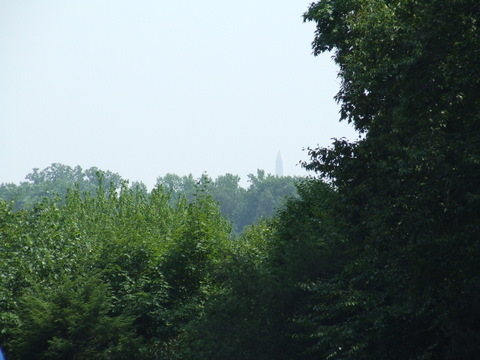
 Through the humid summer haze, you can just make out the top of the Washington Monument from the Lunar Lawn. An interesting reminder of the ideals of democracy, as seen from the portico of someone who lived like royalty.
 An interesting astrological lamp near the Lunar Lawn.
 And there's a greenhouse, full of orchids....
...and bonsai!

Touring Hillwood leaves one with all sorts of odd feelings. Post was criticized for taking so much of Russian cultural heritage out of the country, but you can't argue that by doing so she was preserving it for future generations. (Many priceless Russian treasures are now undoubtedly irrevocably lost, unless sitting in the vault of some Bondian collector villain.) And while I'm no fan of the Bolsheviks, it's easy for me to understand why there was a revolution when I see the wealth and glitter the upper classes bedecked themselves in, paid for with the sweat and blood of the workers. Of course, if it wasn't for the wealthy patrons, would great art exist? One of the great unanswerable questions. And while Post lived like royalty, she gave freely to many charities and intended from the start to leave Hillwood to the public as a museum.

Hillwood is still a great place to visit; they actively reach out to the local gay community (using the slogan "Where fabulous lives!") and have a number of gay-oriented events, as well as hosting other eccentric get-togethers, like the Seersucker Social that was organized by the local group Dandies & Quaintrelles. Admission is $15 for adults but when you consider the value of the collection that's actually pretty cheap.

When I wrote about Tudor Place, I compared it to a gracefully-aging old lady, clinging to her ways but keeping pace with the times. Hillwood is an exuberant grand dame who practically overwhelms you with her fabulousness, and leaves you feeling a bit enervated but also quite impressed. Both these ladies are worthy of a call when you're in town.

Judge Dee: A Short Case from Han-Yuan

Back to China! I should have covered Dee's one short story from that period, but forgot, so here it is.

"The Murder on the Lotus Pond" is a mixture of two cases, actually. One is the murder of an elderly poet in his pavilion on a lotus pond; the other is of the robbery of a treasury courier. Both cases are solved cleverly by the use of some decoy interviews with beggars, a very nice stratagem.

It's also nice in describing the poet's home, a small country house with a charmingly overgrown garden, and an appealing character in the poet's wife, Agate, a former courtesan with a noble character.

A nice little story, and part of the "Judge Dee at Work" collection.

Tuesday, August 2, 2011

The Phantom Recital: The Ruins of Ys

Our European holiday continues, and we're making a stopover on the wild coasts of Brittany.

Our group has checked into an inn in a fishing village, and some go to the beach, some ramble the town, and I'm taking off to sketch on the headlands, and anyone who wants to join me is welcome.

In the evening, as we gather in the inn's dining room to share experiences, a well-dressed gentleman comes by. Oh, we are the Americans he's heard about? He lives in the mansion near the town, won't we do him the honor of being his guests tomorrow night? We accept, enthusiastically.

We dress in the best we brought with us, and the evening is lavish. Wonderful food, good conversation, our host and his household are gracious and welcoming. He tells us legends of Ys, a sort of French Atlantis, a city off the coast that was flooded when a mysterious stranger convinced the princess Dahut to open the gates of the dike that kept the sea away from the city. That stranger was the Devil, and the opened gates destroyed the city...

Our host invites us into the parlor where he plays the piano for us...


Strange visions flood our minds; we all see sunken cities, artifacts of the long-deceased lying around, the skeletons of ancient ships, artifacts from all over the ancient world. It's a strange, surreal experience.

Would we like to go on his yacht in the morning? Why, yes, of course, we all say....and what adventures await us?

Megaliths at Carnac, in Brittany.
Brittany is on my list of Places To Go, and everything I've read is that it's a lovely place with a folklore and culture uniquely its own. Ys is a real legend, one that's been recycled and retold numerous times, and inspired not only the Debussy piece above, but also an entire opera by Edouard Lalo. I've always been intrigued by the stories and folklore of the region; every so often you can come across a piece by Anatole la Braz, who was a doctor who collected Brittany's bizarre folklore, which makes for vivid and memorable ghost stories. Breton music has all the familiar elements of Celtic music, but with its own twists. And last year, doing a little research, I found out my family name may very well be Breton as well. This may be Fate.