Monday, May 31, 2010

A MASTER OF MYSTERIES by L. T. Meade and Robert Eustace


I'm a skeptic. Yes, that's right, while I enjoy reading horror stories and supernatural tales and "true" ghost stories and all that, I'm a big-time skeptic. While part of me would love for ghosts and psychic powers and suchlike to be real, I know that the evidence just isn't there, at least to satisfy me. And that's why I love this book so much.

Elizabeth Thomasina Meade Smith, aka L. T. Meade, (1854-1914) was a prolific author of children's novels that are largely forgotten today, but also wrote a number of mystery stories that are still read a century later. With Dr. Clifford Halifax, she co-wrote "Stories in the Diary of a Doctor", and with frequent collaborator Robert Eustace, she co-wrote a number of episodic novels/short story collections, including THE SORCERESS OF THE STRAND and THE BROTHERHOOD OF THE SEVEN KINGS (both of which I'll be reviewing in the future) and this collection, first published in 1898.

The titular "Master of Mysteries" is John Bell, a professional investigator of supernatural mysteries. He's not a believer; he's firmly convinced that such phenomena are hoaxes and the work of mortal evildoers, and of course, he's always right. He deals with the upper class, at least in the stories presented here (and I guess they're the only stories he's in). He's a distant precursor to the Scooby-Doo gang. He's also frank about the thankless nature of his job, and how he's exposed to ridicule, because society thinks nothing of the superstitious but looks down its nose at those who try to prove superstition false. (Still fairly true today, even in the age of shows like MYTHBUSTERS.)
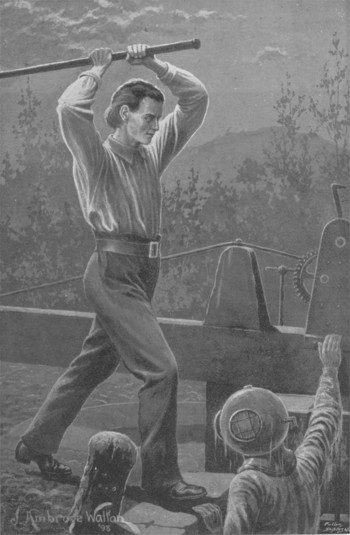


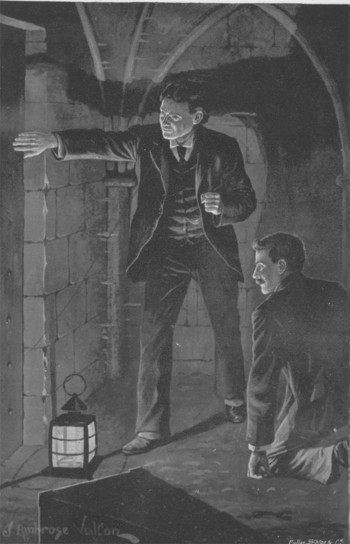
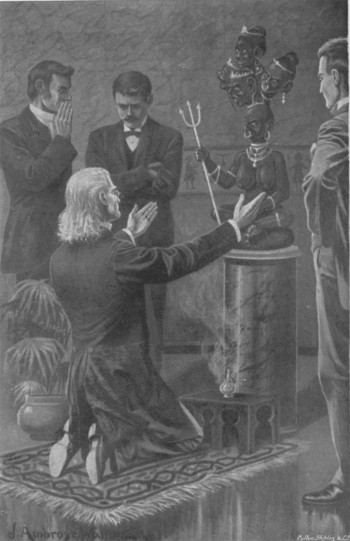
"The Mystery of the Circular Chamber" has Bell investigating a supposedly haunted room in a remote rural inn. "The Warder of the Door" is an ancestral curse that Bell must break. A series of mysterious deaths is the center of "The Mystery of the Felwyn Tunnel." A ghost that steals diamonds, and a seemingly invisible boat, are featured in "The Eight-Mile Lock." "How Siva Spoke" tackles a seemingly talking idol, and "To Prove an Alibi" is a return to haunted-room territory, with echoes of Wilkie Collins.


Bell is very much a typical detective; he examines the scene, questions the witnesses, uses disguises, and applies his knowledge and education. While he's capable of being scared, he doesn't let himself be carried away by fear. He's a great stalwart character, full of Victorian assurance and rectitude, but not so full of himself as to be a prig or an oaf. Still, he's not horribly interesting (we find out little of his inner life) and he could have used some fleshing out.

Still, that aside, this is a fun collection. Meade was a very straightforward writer, never too flowery, and remains readable. (I strongly suspect Eustace was there to provide medical and scientific input; he later collaborated with Dorothy Sayers for her non-Wimsey novel, THE DOCUMENTS IN THE CASE.)

There's reprints of this out there, but why bother? It can be downloaded for free from Project Gutenberg, illustrations and all.

SHADOWS BEND by David Barbour and Richard Raleigh


This is a book I had for quite a while, and I'd heard quite a bit of hype about it. It's a fictionalized teaming of H. P. Lovecraft and Robert E. Howard, battling Cthulhoid menaces, and while it's interesting in some ways, it fails at being either exciting or horrific.

It opens with Lovecraft arriving in Cross Plains, TX, to see Howard, and many of his early scenes are done as fish-out-of-water comedy. Lovecraft, the stuffy New Englander with British affectations, doesn't fit into rural Texas of 1935! He's in a panic, and has to see Howard. Turns out H.P. has been given a kachina doll with possibly evil powers, and the two need to head to California to meet up with Clark Ashton Smith (who has a possible copy of the real "Necronomicon") for them to consult.

On the way, they latch on to an Ivy-League educated prostitute, Glory, and they're pursued on the way by amorphous beings who are unacquainted with the English language and seek to destroy.

It's got an interesting concept, to be sure, and the characterizations are well-done. We get both men's good and bad points, their learning and artistry along with their prejudices and neuroses. The most appealing character in the book is Clark Ashton Smith, presented as a very centered and sane person, at peace with himself and his life. But sometimes it doesn't ring true, especially at one point where Howard refers to his "girl," Novalyne Price, who I think by this time had broken up with him and was involved with someone else. (I'll have to watch THE WHOLE WIDE WORLD again...) There's also a reference to Howard creating "Red Sonja," who really was a product of 70s comic books with a name taken from a minor character in a Howard historical story. But outside the Big Three, the characterizations are fairly flat. Glory never really comes to life, and seems more of a plot device than anything else. An aged Native American shaman is almost offensively cliched.

And the interactions between the two lead characters are what made it readable to me, because the actual plot is so lumbering and meandering that there's little real menace and excitement to it. There's some secret in the kachina that Lovecraft and Howard have to take to some location in the Southwest to prevent the Old Ones from coming back. That's pretty much it. There's a halfway clever angle of Lovecraft being perturbed about how what he had considered his fictional creations turn out to be real and telepathically transmitted to him in dreams, but more could be done with it. And all peters out in the end, rather anticlimactically.

There's too many inaccuracies about the real-life characters, and too much dullness in the plot, to make this worthwhile. A sad misfire, because I can tell they really wanted to do something special.

Sunday, May 16, 2010

The Video Shelf: DIVA


OK, long ago I promised my next Video Shelf post would be about Fritz Lang. Well, yeah, I've dragged my feet about that, but then news came out that a complete cut of METROPOLIS had been found and would be made available, so what the heck, I'm going to delay that and instead do one of my favorite films of all time, Jean-Jacques Beineix's DIVA.

DIVA, which came out in '81, was significant for me because it was my first exposure to foreign film (aside from Godzilla and Hercules films seen on Saturday afternoons). I was in high school, and it played on Maryland Public TV, dubbed, but still a thrill. It was an introduction to an entirely new worldview, and fueled the dreams of the kind of life I wanted to live.

DIVA, based on a novel by "Delacorta" (really Daniel Odier), has two converging plots. One is about opera diva Cynthia Hawkins (real-life opera singer Wilhelmina Wiggins-Fernandez) who refuses to make recordings. One night, she gives a grand performance at a concert, and is secretly taped by a lovestruck fan, Jules (Frederic Andrei), a postman. He manages to meet her in her dressing room, and unnoticed, impulsively steals her gown. Meanwhile, a prostitute, Nadia, is running away from a pair of hired killers, and slips a cassette tape into Jules' mailbag, a tape that names police detective Saporta (Jacques Fabbri) as the real head of Paris' vice rings. The gangsters manage to figure out Jules has the tape, and meanwhile, Taiwanese record pirates, who saw that Jules was taping the concert, are after him for the recording. Jules has a chance meeting with sexy young shoplifter Alba (Thuy An Luu), and then meets her middle-aged boyfriend, con artist Gorodish (Richard Bohringer), who become his guardian angels.

What follows is a madcap adventure full of cross and doublecross and triplecross, and one of the most exciting chase scenes ever filmed.


But the action isn't the only feature. It's also a very picturesque and romantic film. It's a vision of Paris that in the early 80s was very edgy, but today is sweetly nostalgic: of artists and bohemians living in industrial lofts and cramped apartments, everyone free to have their own obsessions and eccentricities, free to find their own cool, and as one critic said, "everyone cool with everyone else's cool." There's disreputable streets and sleazy clubs, but also gorgeous concert halls, opera houses, and one very memorable scene, Cynthia and Jules (by now with a budding romance) taking a predawn walk through Paris' monuments...


As a lonely, alienated teenager, a young gay man not yet at terms with it, let alone out of the closet, going to a rough-and-tumble high school in a western Maryland farming community, DIVA was a symbol of how I wanted to live, and my head was often full of images of running away to Paris, or New York, or some other great city to live a life of eccentricity and adventure.

I sacrificed some of that after college, working at a corporate job for several years after college, but I did manage to move to Washington, and while life hasn't quite turned out the way I hoped, I realize that in many ways, I am the cool eccentric bohemian I'd hoped to become, although I don't have a nifty loft (of course, those have all been snapped up by the yuppies and are outside the grasp of the impecunious sorts like myself) or the dashing adventures I'd hoped for (there's still time, I'm not too old yet!). I did manage a French-class trip to Paris in high school, and I still dream of going back. Paris has always been a sort of spiritual home for me, and let's be honest, the alternate universe that Dust & Corruption inhabits is very much like early 20th-century Paris. (With frequent excursions to London and Monte Carlo....)

DIVA has flash and style to spare; when it first came out, it was criticized for being TOO stylish, but age has been kind to it and it compares favorably to all-flash-no-substance films that come out today. Its edginess has been blunted by time, however, and now it's sweetly nostalgic.

But still, a film that celebrates passion and art, where love triumphs and evil is defeated, and that successfully balances plot AND artistry, is something for D&C fans to watch and cherish. Rent it, buy it, gather your friends together and pop some champagne corks. This is required viewing.

Tuesday, May 4, 2010

May's Musical Interlude


This is a clip from the film DIVA (1981), one of my all-time favorites. This actually gets some of the plot going...the singer is a world-famous diva (played by real-life opera star Wilhelmina Wiggins-Fernandez) who refuses to make recordings...except that one of her biggest fans, Jules (Frederic Andrei), secretly records what is probably her greatest concert, and is seen doing so by Asian record pirates. Of course, there's more going on in the film, and I'm going to blog about it later, but in the meantime, enjoy the aria.

Friday, April 30, 2010

Happy Walpurgisnacht!


It's May Eve, Walpurgisnacht! Go out and indulge in wild revelry, or stay home with a good scary book or movie.

And it's Dust & Corruption's second birthday! We're only getting bigger and better!

Thursday, April 29, 2010

DEE GOONG AN, translated by Robert van Gulik


This book, and others in the series, are probably unknowingly beloved by all the purveyors of Chinese cuisine in my area, because whenever I reread one of van Gulik's novels, an overwhelming appetite for pot stickers and lo mein overtakes me.

Robert van Gulik was a Dutch diplomat who spent long periods of time in Japan and China, and even served here in DC at the Dutch Embassy. (I may have to swing by there, as a sort of pilgrimage.) He wrote several books on Chinese art and culture, but what he's best remembered for is the long-running series of mystery novels set in T'ang Dynasty China, featuring Judge Dee.

Dee was based on a real Chinese official, Di Renjie (630-700), who had a long illustrious career and eventually became one of the empire's top officials. And Dee was almost a folk hero in China, with many fictional works written about him, including this one.

DEE GOONG AN is an anonymously-written novel from the 18th century, about three fictional cases solved by Dee, and van Gulik translated it in the mid 20th. In his introduction, it's obvious he's read a number of Chinese detective novels, but found this one to be the closest to Western ideas of acceptable detective fiction. Chinese detective novels tend to ramble on and on for volumes, reveal the murderer at the beginning (viewing the puzzle as a chess game between the villain and the hero), and feature heavy supernatural content, including testimony from ghosts and household objects, even with the judge being baffled and aided by dreaded Judge of the Underworld, coming to the mortal world to claim the killer!

There is, however, enough difference in this book to make it interesting. There's three separate cases involved; in this book, they're "The Double Murder at Dawn," "The Strange Corpse," and "The Poisoned Bride." At the beginning, we're given a cast list of the people in the tribunal and of those involved in each case.

In the book, Judge Dee is the magistrate of the district of Chang-Ping, and is aided by his elderly family retainer Hoong Liang, tough guys Mah Joong and Chiao Tai, who are former outlaws, and reformed con man Tao Gan. He first has to deal with a savage double murder among traveling silk merchants. Then, while chasing clues, he stumbles upon a dysfunctional family and suspects the dead father was murdered a year before. Later, a prominent family is in an uproar when a newlywed bride dies on her wedding night, from a mysterious poison.

Some of the traditional mystery stuff we're used to is absent. The killer in the double murder case takes a little bit to identify, and then the problem after that is finding him. The killer in the family case is almost immediately identified, but the issue is figuring out how it was done. And the poisoning case takes some work to figure out the who and how.

There's an interesting entr'acte, a little dramatic scene that reflects on some of the issues in the book. And there's some supernatural content, too. Dee is led to the grave of a murder victim by a ghost, and later the corpse gives a sign that it was the victim of foul play by closing its eyes. And at one point, Dee is sleeping in a temple and has a prophetic dream which gives several clues, but it could at least partially be credited to Dee's subconscious.

And one thing that's seriously cool about this, and the other Dee novels...it's actually illustrated! There's a few reproduction plates and several others done by van Gulik in Chinese style. It really helps in visualizing the characters and their milieu. (The cover picture above is an example.)

DEE GOONG AN is fun, if a teeny bit creaky in spots. There's a couple of elements that show up in van Gulik's novels later, but otherwise it's a good read.

I'm considering rereading the entire van Gulik series, probably in chronological order, instead of publishing order (two different things). Apparently there's another French-language series about Dee, from author Frederic Lenormand, but they're not available in English. And there's a newly-written collection from author Zhu Xiao Di, that I just got, so I'll probably throw that in as well. Look for them, sporadically, in between other projects.

Tuesday, April 20, 2010

Guest Post: : The Spooktacular Stories of Roald Dahl

Vagrarian here: I'm proud to introduce D&C's first guest blogger, Sara! I'm glad she wanted to come aboard, and I hope she'll come back soon. And now, let me hand the microphone over to her...

Roald Dahl is, of course, most popular for his excellent children's stories, including Charlie and the Chocolate Factory, James and the Giant Peach, Matilda, and The BFG. Many of his novels have been made into movies with great success. He was, by all accounts, one of the most celebrated children's writers of all time.


And yet what of his adult stories?

Most people are unaware that Dahl even wrote for adults, let alone that his work was any good. But it was—at least according to the judges of the Edgar Awards. Dahl won three of them: one for the collection Someone Like You, one for a story titled "The Landlady," and one for a Tales of the Unexpected episode based on his short story, "Skin."

The short stories are spooky writing at its best—twisted, macabre, and chilling in a way that stays with you for hours or even days after reading. Here are the best of the best.

"Lamb to the Slaughter" is my personal favorite Dahl story. It's found in the anthology Skin (along with the fantastic title story) and features a violent murder with a particularly interesting weapon—a frozen leg of lamb. After using the leg to get rid of her husband, the main character roasts and serves it to the police officers who arrive to investigate the crime. Does it get any better than that?!

"The Landlady" sounds a bit boring in summary—a young man takes up a room at a boardinghouse that's run by a strange lady—and yet is riveting in tone and character. As the reader grows more and more unsettled, the story clamps like a vice grip and becomes ever more captivating. You can listen to "The Landlady" here and find it in the anthology Kiss, Kiss, among others.

"Royal Jelly" rounds out my trio of recommendations, and it can also be found in Kiss, Kiss. I don't want to give away the twist to this one, so I'll just give you the basics: Albert and Mabel are new parents of a little daughter who is born frail and ill. Mabel frets constantly about the baby being underweight and growing dangerously sick until Albert tries slipping a bit of royal jelly into the baby's bottle. The jelly seems to do the trick . . . at first.

Though these are a few of Dahl's most standout stories, all are truly brilliant and deserve a good read. You can find most of them in the anthologies Kiss, Kiss, Someone Like You, The Umbrella Man and Other Stories, Skin and Other Stories, Switch Bitch, Tales of the Unexpected, and The Roald Dahl Omnibus.

This post was contributed by Sara Bimmel, who writes about Halloween costumes over at StarCostumes.com.