Showing posts with label Hitchcock. Show all posts

Tuesday, May 31, 2011

Again, Three More from Hitch

I've been hitting the AFI Silver, catching more of their Hitchcock retrospective. Here's what I've seen lately...
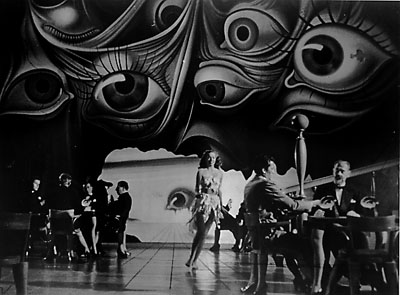
Some of Salvador Dali's design for SPELLBOUND's dream sequence.
SPELLBOUND (1945) has psychiatrist Ingrid Bergman becoming infatuated with the incoming chief of the posh institution where she work. Dr. Edwardes (Gregory Peck) is handsome and suave, but also has some eccentricities, and it's not long before she figures out that he's not really Dr. Edwardes...but he has no real idea of who he is. The puzzle of his real identity leads them to the discovery of a murder...

It's a good thriller, and loaded up with a lot of psychoanalytic content. Everything depends on psychology in Ben Hecht's script. It's also technically interesting; there's a weird, memorable score by Miklos Rozsa, and many experimental visuals, including the final confrontation where we see from the murderer's viewpoint the hand holding the gun, and the final explosion into color.

I don't think he needs help changing a tire...

Of course, the BIG deal is the dream sequence designed by Salvador Dali, where many clues to the murder are coded in bizarre imagery. It's arresting and unforgettable, worth the price of admission alone.


Next was THE PARADINE CASE (1947), a film not often seen, and there's reason why. It's a mess. Sexy Alida Valli is arrested for the off-screen murder of her blind war-hero husband. She hires top British barrister Gregory Peck (yes, that's right, Gregory Peck as a Brit, barely attempting an accent), who is married to perky Ann Todd but finds himself falling for Valli. And then he develops a defense for trying to pin the murder on the husband's devoted valet, played by a young Louis Jourdan...

OK, it's obvious the leads are miscast, except for Todd, who does quite a good job as the faithful yet confused wife. Joan Tetzel is also quite good as Todd's best friend, the daughter of one of Peck's associates. There's also good supporting turns by Charles Coburn as Tetzel's father, Charles Laughton as a wisecracking judge, and Ethel Barrymore as his beleaguered, ignored wife. Hitch had wanted Greta Garbo for the Valli role, Laurence Olivier or Ronald Coleman for the Peck role, and Robert Newton for the Jourdan role, but producer David O. Selznick interfered with production left and right, rewriting the script and recutting the movie and insisting on his "discoveries" being featured.

Sadly, the finished product has all sorts of story problems and ends up being fairly dull. I dozed a few times in the theater, a rarity for me.

Most recently was 1946's NOTORIOUS, featuring the memorable pairing of Ingrid Bergman and Cary Grant. Bergman is the daughter of a convicted Nazi criminal, and there's very discreet hints that she's known as a promiscuous, hard-drinking party girl. (Almost too discreet!) Federal agent Grant coaxes her into being a spy for Uncle Sam, taking her to Rio de Janeiro where she's to meet and romance another Nazi, Claude Rains. In order to get secrets from him, she ends up marrying him, causing trouble with her budding romance with Grant, but later stumbles on a big secret...

NOTORIOUS is a slick, well-made film, moving quickly and with good performances by the cast. Bergman is especially radiant as tramp making good, then finding herself in over her head. It's also interesting for an early glimpse of a destructive mother/son dynamic (seen in various spots in Hitch's work), as Rains' Nazi isn't half as evil and venomous as his manipulative mother (Leopoldine Konstantin), who very much seems to be the real brains of the outfit. The ending is a bit vague, but we're given enough clues to know what's going to happen, and there's enough finality that much else isn't needed. Still, Bergman and Grant are a great team (they reunited 12 years later for the sophisticated Stanley Donen comedy INDISCREET, which I suddenly want to see again), Rains and the rest of the supporting cast are good, and it's well-paced, and a suspense essential.

More on the way...

Tuesday, May 17, 2011

At the Cinema: Hitch's SABOTEUR


This comes between two of his better-regarded films, SUSPICION and SHADOW OF A DOUBT, but SABOTEUR (1942) is worth checking out.

Defense-plant worker Robert Cummings has a run-in with a mysterious fellow employee named Fry (symbolism!), and shortly after that a bomb goes off setting fire to the factory. Cummings hands a fire extinguisher to his best pal...but it's been filled with gasoline, and the friend perishes in the blaze. Cummings is called in, but when nobody named Fry shows up on the employee list, and they start suspecting him of sabotage and murder, he has to go on the run to clear his name and find out who's really behind it all.

SABOTEUR is very clearly a rough draft of the romantic-comedy-chase-thriller that Hitch perfected with NORTH BY NORTHWEST, with the man falsely suspected, the icy blond girl, and the locations spanning most of the country, both ending with a dizzying climax on a major American landmark. (In NBNW it's Mount Rushmore; in SABOTEUR it's the Statue of Liberty.)

Look in the lower left-hand corner...yeah....
One interesting aspect is how Hitch shows different segments of American society reacting. The masterminds of the sabotage ring are wealthy American plutocrats, not sneering foreigners, who welcome a totalitarian government as a way of increasing their own wealth. Rank-and-file Americans automatically believe what they're told by authorities, make snap judgements based on appearances ("You look like a saboteur," sneers one character to Cummings), or are so complacent they refuse to believe the people they look up to are traitors. The only truly good people who believe in his innocence are society's outsiders, in the form of a gentle blind hermit and a troupe of circus freaks. It's tempting to see this as a jaundiced view of Americans, and also as a warning to us all that the real enemies of freedom aren't just foreigners, but the wealthy ruling class themselves, thinking only of their own wealth and power. It's almost Socialistic.

It's big and sprawling, and there's dangling plot threads, but when all's said and done it's good fun. And while NORTH BY NORTHWEST works on Cold War paranoia, SABOTEUR plays off wartime fears of spies and sabotage. See it and be thrilled.

Tuesday, April 26, 2011

At the Cinema: Hitch's REBECCA

My latest foray to the AFI was for Hitchcock's 1940 film REBECCA, his first film upon coming to Hollywood and also the only one of his films to win a Best Picture Oscar. Hitch was nominated, but didn't win.

This flick is great fun. It's really a Gothic romance (which would later inspire a storyline on "Dark Shadows") but the moodiness and exceptional visuals make it stand out. It's also interesting to note that at the time it was considered a huge leap forward technically, with exceptional editing, cinematography, and special effects. (Kind of like AVATAR today, except for, you know, a story that doesn't have you rolling your eyes at every cliche. Yes, I thought AVATAR was technically stunning but a total loss in the story department.)

There's neat touches; while Joan Fontaine is too beautiful for the role of the spinster narrator, she does manage to sell the character's sense of being lost in an alien world, and of her chronic low self-esteem. She's easily intimidated and is always comparing herself to Max de Winter's first wife and tries hard to be like her...of course, a good deal of this is Max's fault. With all his brooding, it's easy to believe that he's still in love with Rebecca, and doesn't sufficiently communicate to his wife that he loves her the way she is and doesn't want another Rebecca.

The script has Max making a big deal about his new wife's youth, and all through the movie, when she's moving through his huge house Manderley, doorknobs and latches are constantly at a very high level, almost with her chin, as if giving the illusion of a child in a grown-up world.

Now, one HAS to address the issue of Mrs. Danvers (Judith Anderson), who is one of the great all-time screen villains. As the housekeeper who is fanatically devoted to the memory of Rebecca de Winter, it's often speculated that she was a lesbian and in love with Rebecca. However, through all her sabotage of the narrator and even urging her to kill herself, it never comes across as the product of sexual passion. Instead, I get the feeling that Mrs. Danvers either had a parental obsession with Rebecca, and viewed her as some sort of daughter, or viewed Rebecca as sort of a wish-fulfillment figure, wanting to be Rebecca herself (or someone very like her). Her increasing madness and eventual conflagration don't strike me as someone who's in love, but someone so devoted that she'd do anything to protect her idol's place in the house, even in Mr. de Winter's memory. (If you want lesbian subtext, check out THE UNINVITED.)

It's still a great film, and worth watching. There was also a BBC miniseries in the 70s with Jeremy Brett and Joanna David that was remarkably faithful to the novel and was my first introduction to the story when it aired on PBS' MYSTERY! And the novel, by Daphne du Maurier, was a huge bestseller and is still in print, and easily found in libraries and used book stores. But the movie works not only as a Gothic chiller but as a study of low self-confidence and self-esteem, and a great example of Hitch's genius.


Wednesday, March 30, 2011

Three More from Hitch

OK, I've been bad. Work's been kicking my ass. Having new responsibilities is great but after a while I find myself whimpering about how I don't want to stay late yet another day...I wanna go hooooome....

But, in the meantime, I caught three more old Hitchcock films at the AFI.

The first was his earliest film that still exists in a complete form, 1927's THE LODGER: A STORY OF THE LONDON FOG.


Based on a novel by Marie Belloc Lowndes (who I didn't realize until recently was Hilaire Belloc's sister), it's the story of a Jack the Ripper-style killer, The Avenger, who has London in the grip of terror. A man knocks on the door of a house advertising rooms for rent and takes one, but the landlady and her family begin to suspect that he's got a hideous secret...

The tough part of it is that I've heard "The Lodger" adapted for radio, and this version is radically different from the versions I've heard. One, with Peter Lorre in the title role, had him revealed at the end as the murderer; another ended ambiguously, with the lodger taking off and disappearing with nobody ever being sure if he was the killer or not. But Hitch's version has the lodger being a good guy, a poor tormented soul whose sister was the first victim of the killer and is trying to track him down.  What gets me is that the real identity of the killer, and his motives, are never revealed; we're told in a throwaway remark at the end that he was caught. The REAL story is about the suspicion that surrounds the poor guy.

OK, so I wasn't satisfied with the story totally, and I wanted to kick Ivor Novello's ass (he was so frail and neurasthenic in the starring role, I couldn't believe the heroine was falling for him), but it's overflowing with visual style.

There are lots of neat little visual riffs, like the above truck that represents the scanning eyes of the press.  Or the flashing sign reading "TO-NIGHT GOLDEN CURLS," which references the killer's fondness for blonds. At times it's reminiscent of the experimental shorts by Man Ray and others.

Is it worth watching?  Yeah, but it's more about style than story, a time when Hitch's vision was just beginning to gel.  (There's a fabulous essay on it over at Cinema de Merde; check it out.)

Next up was YOUNG AND INNOCENT from 1937, originally released as THE GIRL WAS YOUNG.


I missed the first few minutes, thanks to being behind schedule, but this is a ripping good yarn (based on A Shilling for Candles by Josephine Tey) of a man falsely suspected of murder and trying to clear his name, and sucking a well-intentioned gal into his wake. And there's tons of lovely British scenery as they tool around all over the place in her jalopy. The acting from the two leads, Nova Pilbeam and Derrick de Marney, is quite solid, and one can see this as the blueprint for his future comedy/romance/thrillers that featured an innocent man accused of a horrible crime.  The killer's identity is telegraphed far in advance, so the real challenge for the viewer is figuring out where he is and what he's doing. An actress is found dead on the beach, and a man she'd had business dealings with is seen running from her body; he's innocent, of course, and manages to give the cops the slip while recruiting the help of a policeman's daughter.  I will alert the sensitive that there is a scene of musicians in blackface; didn't bother me, but some might object.  But after all, these were different times.

The third was a silent cut of BLACKMAIL, with life music by the Alloy Orchestra. I've already talked about this movie, but I will say that Alloy's accompaniment was exceptional.  It was good scoring in that it was inobtrusive; it complemented the action well and was also very melodic and enjoyable.

AFI starts up the second part of their Hitch retrospective on April 23rd; we'll see what comes up next.

Monday, February 21, 2011

Two More by Hitchcock

Over the weekend I saw two more early Hitchcock films...


On Saturday it was the 1934 version of THE MAN WHO KNEW TOO MUCH, which is the only film that Hitch remade on his own. In some ways I prefer the original, as it lacks the presence of Doris Day, who I find grating, but the remake did flesh out the plot a bit more at the beginning.

Opening in snowy St. Moritz, we're shown the vacationing Lawrences, Bob (Leslie Banks), Jill (Edna Best), and daughter Betty (Nova Pilbeam), and family friend Louis Bernard (Pierre Fresnay). Jill is a crack shot, which comes into play later. One evening, Jill and Louis are dancing when he's shot through the window. Dying, he manages to gasp out a message to Jill, and while Bob is finding a message hidden in the handle of Louis' shaving brush, Betty is kidnapped and the Lawrences are sternly informed to stay quiet or she will die.

Returning to London, they're contacted by a government official...the guy's from the Foreign Office, and Louis was One Of Our Men (I just LOOOOVVVVE these old days of gentlemen spies working for the Foreign Office...). While the Lawrences are at first reluctant to get involved, he impresses on them that the scheme is afoot to assassinate a foreign leader, and it could very well lead to another war.

Bill eventually sets off on his own with a friend, finding a clue at a dentist's office, and finally spotting gang leader Abbott (Peter Lorre, in his English-language film debut), and eventually following them to a crackpot church of sun worshipers.

Both films have the famous Albert Hall scene, with the same music (the "Storm Clouds Cantata" from the film's composer Arthur Benjamin, which Bernard Herrmann lovingly recycled for the remake). However, the aftermath is different; in this version, there's a savage police siege and shoot-out at the villain's church lair. This scene was inspired by the 1911 "Siege of Sidney Street" that was a shootout between police and criminals on the streets of London (with all sorts of political undertones). And Jill's expertise with firearms comes in very handy...a parallel with the remake, because in both films it's the wife's talents that save the child's life. (The remake makes more of a point that the wife's talents and career have been subsumed by her marriage and not allowed to come into play, something not really played up by the original.)

It was a lot of fun; I enjoyed it, especially the St. Moritz scenes (I'm a sucker for snowy alpine scenery). This was from a time when Hitch's recognizable style was truly beginning to come together.


Sunday was NUMBER 17, from 1932. It's technically cruder than MAN, by leaps and bounds, and has undeniable story problems, but there's quite a bit about it that I like. It opens with a man standing outside a vacant house (the "number 17" of the title) and seeing a light moving, and going in to investigate. The light is from a sailor who's seeking a place to crash for the night, but the presence of a seeming corpse on the top landing creates tension between them. More people show up...the daughter of a policeman who had snuck into the house earlier, and a trio of suspicious characters who seem to be having some sort of rendezvous there. It seems there was a daring robbery of a famous necklace, and it's hidden somewhere in the house. The gang plans to recover the necklace and hop a nearby train to start over on the Continent (implicitly, Germany, which must have seemed unpatriotic at the time).

The scenes in the house are fabulous; Hitch was having fun with the play of light and shadow, and I just loved that set. It made me want to skulk about with a candle, in a vast empty house, on a bleak windy day. But the characters are underdeveloped; we never know exactly who or what these people are. Were they ALL involved in the theft of the necklace? Were only a few of them? Why is the hero so determined to save the life of the deaf/mute woman who isn't really deaf/mute?

In the second half, it suddenly shifts tone and becomes a frenzied chase thriller. The criminals hop on a train, which races across the countryside and eventually is out of control after the villains knock out the engineer (why would they do that?). Amusingly, the hero hijacks a tour bus and races after them (the reactions of the passengers is beyond precious). It all ends in a big conflagration that's a bit out of synch with the beginning of the movie, but oh well.

A big problem is the speeded-up nature of the fight scenes and the train chase; it looks clunky and dated. The atmosphere of the early scenes in the old house are great, though, and I found myself relishing them immensely.

Interestingly, it's based on a play. And I found that it's a film Hitchcock didn't want to make and later in life actively hated. His reluctance shines through, but his skill with some parts is undeniable. Maybe that's why it's so technically crude?

It's fairly obscure Hitchcock, not shown often. Catch it if you can and see what you think.