Showing posts with label mystery novels. Show all posts

Friday, March 14, 2014

Death on Milestone Buttress, by Glyn Carr

The thought of a mountain-climbing themed mystery has potential interest. I grew up in the hill country of western Maryland, and while we always called them "mountains" they were no real challenge to climbers. Let's be honest, they're hills. But I have some happy memories from my youth of clambering over rocks and pausing to look at views. So I'd thought I'd give this a try.

Shakespearean actor Abercrombie Lewker ("Filthy" to his friends...yes, Filthy Lewker, get the groaning overwith now...) has wrapped up a tour, and his wife is going to stay with a pregnant friend, so he decides to take off for a climbing vacation in Wales. On the way, he meets pretty Hilary Bourne, a novice climber who's seeking a break from her dreary job in the city. They're both staying at a guesthouse near Tryfan, a real mountain in what is now Snowdonia National Park. (The park was established in 1951, the same year this was published.) They share the guesthouse with an interesting family and their friends, and tension abounds. There's a glowering minister, his long-suffering wife, his repressed daughter, and some friends including a nuclear scientist and his assistants.

There's no end of interpersonal tensions and intrigue; Raymond, one of the assistants, has a roving eye and seems unpopular with the overall group. Finally, he takes Hilary on a climb, even though she'd much rather be with Michael, the other assistant. Raymond attempts to take liberties; she rebuffs his forcibly, including giving him a head butt, which I loved. But then he goes over a ridge, and she hears a yell....and when she climbs over, he's dead from an apparent fall.

But he was an experienced climber, and they're on Milestone Buttress, a part of the mountain that's easy to climb and mostly used by novices. It was drizzly that day, and some fog did come up; did he slip? Or was it...murder?

Well, of course it was. Hilary and Lewker team up to figure out who did it; she's horribly afraid Michael was responsible, and the others in the group are her friends and it pains her to think one of them may be a killer.

It's pretty entertaining, actually. Almost half the book is build-up to the murder, and you get a good idea of the tensions in the guesthouse group. And it's also a look back to attitudes of yesteryear, when membership in the British Communist Party was not all that unusual (the USSR was a threat, to be sure, but the British hadn't forgotten their alliance in defeating Hitler), and an unmarried girl losing her virginity was a catastrophe. This is also a sort of variation on the locked-room mystery, with the "locked room" being a remote physical location. Clues are fairly provided, and the mountain-climbing scenes are nicely done, as well as the overall descriptions of the mountains.

Glyn Carr was the pseudonym of author and mountaineer Showell Styles, who had already written three thrillers about Lewker in the 40s, under his own name. One supposes the earlier books were forgotten or he felt they weren't worth remembering, so he just recycled the character, with a few references to a Secret Service background, and proceeded on a new career for him as a mountaineering detective. There's 15 Carr/Lewker books in all, from 1951 to 1969

It's all good fun, and makes me want to breathe clean mountain air again. It's in print, from the good folks at Rue Morgue Press, so go check it out.

Tryfan, in all its glory. Looks like a challenge, doesn't it?

Wednesday, January 29, 2014

THE DREAM DOCTOR by Arthur B. Reeve

I'm fond of Reeve's Craig Kennedy stories, not because they're well-written (they're OK, if sometimes clunky), but for the verve with which Reeve gloms on to every scientific fad, even if it was disproven five minutes later. His works end up having a steampunk air to them that's fascinating.

Again, The Dream Doctor (1914) is made up of a series of unconnected cases, and is really a string of short stories put together as a novel...but at least this time has a framing story of Kennedy's Watson, the reporter Jameson, tailing him for a solid month just to see how many cases he deals with. It's also got a slightly interesting structure, in that the cases don't neatly begin and end with chapter openings and closings, but will end and start midchapter. OK, that's not all that revolutionary, but I did say it was slightly interesting.

The Dream Doctor opens with the mystery of a wealthy stockbroker, who falls dead on the street after leaving behind a cryptic letter that some say is a suicide note. His wife claims to have had a premonition in a dream of his death. It's through the examination of several typewriters, and examination of the wife's dreams (done in Freudian style, as if Freud's ideas were a one-size-fits-all proposition and psychology was an exact science) that Kennedy spots the culprit. Then an actress is found dead in a beauty parlor; the cause is not evident, but there are weird glowing spots inside her mouth. It appears she was killed by a phosphorus-tainted enveloped that she licked; but who did it and why? It takes use of a "rayograph" (to detect forgeries) and a "string galvanometer" (a primitive device for recording electrocardiograms) to reveal the killer.

A string galvanometer. I'm glad my cardiologist doesn't use one.
In his next case he comes to the aid of a diplomat who's being threatened by a Balkan terrorist group who wants to keep "American dollars" out of Europe and not incite wars. The solution involves a bizarre telephone that connects through a light bulb (?!??!) and poisoned wallpaper. Then a wealthy art collector is worried about threats to his private museum. For some reason green objects, and green only, were being stolen, but now other things are being swiped. He nabs the thief with a sort of primitive electric eye called an "optophone" and some outdated ideas about absinthe.

An optophone.
Next up, another millionaire (Kennedy moves in only the best circles, you see) calls up; it seems his cook has been stabbed to death in the kitchen. Kennedy at once realizes it's not a normal stabbing, but was done with " a Behr bulletless gun" which apparently fires a knife blade into the body. Kennedy can't touch a mystery that doesn't have a bizarre method of murder...or that doesn't require esoteric equipment to solve. He uses a then-new-to-the-public sphygmomanometer, or what we know today as a blood pressure reader, and some spurious-sounding "blood crystal analysis" to uncover the culprit. The Kennedy is called on to investigate the death of an actress who was the scion of a prominent family but who had been estranged from her clan. She had a drug problem, and Jameson is suspicious of a "queer-looking Jap" that hangs about (oh, that early-20th-century racism!). We also find out Kennedy can be depended on to engineer a truce in a Tong war. There's some basic ballistics involved here, and some exotic "narcotic bullets" that carry a dose of morphia to knock people out with only a slight graze. Of course, someone is not who they seem to be, and a major drug ring is smashed as a result.

Next up is a rash of jewel thefts being pulled by a slick gang of shoplifters. He uses a telegraphone again (he used one before), basically an old-school method of wiretapping, and a galvanometer to test suspects' skin conductivity to catch the thieves...one of whom is a real kleptomaniac more deserving of pity than censure. Then we have his investigation into the murder of a scientist who was on the verge of perfecting synthetic rubber. This ends up being the most bizarre motive and crime I've seen in a while; the murderer is afflicted with sleeping sickness after a bite from tsetse fly, and has dosed on poisonous medications so much he needs to replace his blood with someone else's! It's straight out of a horror film with Lionel Atwill and George Zucco, and makes little sense.

Then a bomb is sent to the district attorney's office; it doesn't go off, but is a scare. The DA's office is involved in a war against a local vice lord, and the safe assumption is that they sent it. Kennedy sets out to uncover the criminal's identity, a chase leading from a seedy cabaret to an underground bomb factory, and he uses a now-common device, a thermopile, and a hydraulic ram to solve the mystery. After that, Kennedy is contacted by the Navy when secret documents are stolen. (And announced in the paper, one of the most unbelievable things in this book.) It turns out the papers were dealing with new work in "telautomatics" or what we today would call "remote-controlled drone ships". Kennedy uses an audion, an old-style wireless wave detector, to nab the culprit.

This mild-mannered object is an audion.
Jameson himself approaches Kennedy with a new case; his paper has received an anonymous note questioning the death of a young banker so soon after his family bank collapses. On the tail of that comes word that his mausoleum had been broken into, and a blackmail note is sent to his widow. What's going on? A Crookes tube and spectroscope to uncover the truth...a story so bizarre and unlikely the denouement is unintentionally funny. And finally, a man is imprisoned for murder, and his wife begs Kennedy to prove his innocence. A fish-eye lens peephole, like in so many apartment doors, comes in handy, especially when connected to a camera, and Kennedy uses an ultraviolet lamp as well to detect a forged will.

A Crookes tube. That would make for a cool lamp.
So, how was it? Enjoyable, if cockeyed and often contrived. Everyone turns to Kennedy when there's a problem, and he's simultaneously a private eye for the wealthy and a top government agent, it seems. It's entertaining, and sometimes preposterous, although seeming to lack the courage of its own preposterousness at times, if that makes sense.

The Dream Doctor is easily available from multiple sources as a free or low-cost ebook. Used copies are out there, but can cost the earth.
Sunday, January 26, 2014

A Couple of Recent Reads

Getting some reading done lately...and here's two samples from the bookshelf.

I came across Frank Tallis' A Death in Vienna in the local library and was intrigued. It's first in a series set in Vienna of the early 1900s, a setting I've always found fascinating. And it didn't disappoint.

Max Liebermann is a psychologist, a student of Freud, and something of a maverick in his focus on talk therapy for patients rather than crude electrotherapy or other discredited treatments. He's friends with Oskar Rheinhardt, a police detective, who calls his friend in to help him when a young medium is found dead. She's posed as if it were a suicide, and shot in the chest...but there's no bullet. And the room is locked from the inside. It's a classic locked-room mystery with a twist in the setting and characters. Which of the medium's regular clients could be responsible?

Lots of cool atmosphere here, and the descriptions of Old Vienna are fun. Oskar applies the latest police methods, and Max applies the latest psychological ideas, and are a great team. The story is great classic detection; the medium is revealed as a fraud, and they dip into the issues of fake mediums of the era. And there's echoes of the quiet firm step of the Nazi party coming down the line, with some characters being openly anti-Semitic. We get a lot of the character's inner lives, with Oskar coping with his anniversary, and Max getting engaged...but by the end appears to be having second thoughts.

My only complaint is that I wish we knew more about how the two became friends...but maybe that comes in a later book. This is a series I definitely want to read more of...this one left me craving strudel and Strauss, so maybe I can whip up some treats and play some waltzes next time I dip into it.

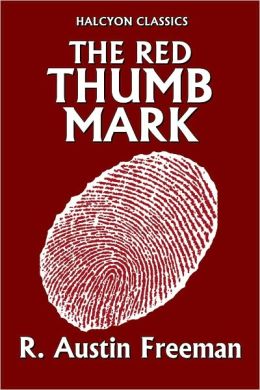
The Red Thumb Mark (1907) is R. Austin Freeman's first novel, and the work that introduced pioneering medical detective John Thorndyke. It spends a bit of time establishing characters, and is inevitably narrated by Thorndyke's Watson, Dr. Jervis. Thorndyke was a very new type of character, really. He used his medical knowledge and all the latest knowledge, and was also written with style and verve. Thorndyke was also a very handsome man; R. Austin Freeman's way of thumbing his nose at the then-current literary habit of having heroes and detectives being unattractive or even rather ugly. (Sapper's Bulldog Drummond was described in the books as a fairly ugly man, although he was played by the dashing Ronald Coleman in film.)

Young Reuben Hornby has been accused of theft form his uncle's gold and silver business; most damning is a bloody thumbprint that is unmistakably Hornby's, even though he claims innocence. It's up to Thorndyke and Jervis to figure out how it happened, and find evidence that the thumbprint is faked....and how?

There are debits in this novel, partly because the crime itself is a bit dull, and really, this is something that could be a longish short story and sometimes feels padded. Problems with plotting aside, it's well-written and with good characterizations, and the final courtroom confrontation, when it's revealed how the thumbprint was faked, is exciting and excellent reading. I definitely want to read more of these.

More coming up....

Wednesday, October 30, 2013

THE MEMORY OF BLOOD by Christopher Fowler

It's the opening-night cast party for "The Two Murderers," a gruesome new play on the London stage, and it's at the ritzy penthouse of producer Robert Kramer. Of course, there's all the usual conflicts and rivalries in the company. But things take a gruesome turn when Kramer's infant child is thrown out the window of the locked nursery...and seemingly done by a life-sized Punch figure.

Naturally, given the big names involved and the bizarre nature of the crime, detectives Bryant & May, and the rest of the Peculiar Crimes Unit are on the case. And it leads them into all sorts of theatrical bizzarerie, including Punch and Judy shows and the Grand Guignol. Also, a young lady helping Bryant on his memoirs dies suddenly and strangely; was it an accident or murder? Is it associated or not?

I have to admit...I started reading this, then had to put it aside for a while. I didn't like the murder of a baby. I've read novels that have the murders of children and sometimes it's done for sheer lurid shock value. But, after a break, I made myself pick it back up and finish it. And I have to say...the murder of the child makes sense. Not only is it a reference to Punch and Judy shows (which does figure in the plot and you'll learn a bit from reading this), but it also makes sense in the murderer's plot. So even though it may strike some as distasteful, it serves a purpose.

And there's further murders, mostly following in the classic theatrical madman fashion. And the deepening mystery around a young transcriber's death. And more looks into some byways of English history and culture, like a visit to Brighton and a horror sculptor's studio.

Despite my initial distaste for the story, I ended up enjoying this a great deal. I did get a chill down my spine at hints that the next book would be the last in the series. In this book several simmering subplots near resolution, and there's even a passing reference to going out with a bang. Eeep.

So yeah, this is on the Required Reading shelf, with the rest of the Bryant & May series. And the next one is waiting in the wings.

Monday, January 21, 2013

THE JUDAS PAIR, by Jonathan Gash

I read this long, long ago, and had to hunt it down again to revisit it. I'm glad I did.

The Judas Pair is the kickoff to Gash's series about Lovejoy, a roguish antiques dealer who's sort of the Harry Flashman of the vintage-goods set. He's sometimes involved in shady deals, almost always has multiple affairs going on, often with married women, is always broke, and has an odd semi-psychic ability to identify real antiques; in the book's slang, he's a "divvy."

As it kicks off, Lovejoy is asked to locate the "Judas Pair," a set of dueling pistols that are regarded as a myth. However, the client insists they're real...and responsible for the death of his brother, who had bragged of finding them, and then was found shot in the eye, dead, the pistols missing.

Gash (pseud. of John Grant, a doctor) peppers his book with tons of legit info about antiques and how to identify them...although annoyingly this is mostly on British antiques and may not apply to those of us in the States where stuff like this doesn't always migrate. (Still, there's always Ebay...) The fictitious pistols were made by a real-life gunsmith Durs Egg, and Gash gives us a portrait of the whole culture of dueling pistols and how they function and feel in the hand. But we also have Lovejoy in all his flawed glory; he's scrabbling around, experiences grief and terror, gets pissed off, even suffers a nervous breakdown in the course of the story. But he's very intuitive and figures out the secret of the pistols at the right time.

I followed the Lovejoy series for a while, then got away from it, but I may go back. I remember some books had wonderful, exquisite plots, like The Vatican Rip or The Sleepers of Erin, but others were almost plotless and meandering, like Moonspender. One novel, Jade Woman, was a bit lacking in plot, but its depiction of Hong Kong was mesmerizing and worth the purchase price alone.

And, heck, I'm into antiques. It runs in the family; my mother used to collect salt dips but now goes for vintage textbooks. My father's vast collection of flatirons, ranging from Colonial-era pieces to the early days of electric irons, is notorious in their area and their basement is a museum of vintage laundry processing. Even my brother-in-law was bitten by the bug and now deals antiques on Ebay; I had a great time with him over the holidays looking over his recent acquisitions, like some china cats and an advertising case for dyes, with many original dye packets intact. In addition to my growing collection of antiquarian books, I've got a small collection of cigarette cases (I had a thing for those in high school), and in my mature years have developed an eye for porcelain, glassware, and prints. So Lovejoy's right up my alley.

A note: Lovejoy was the basis of a TV show that ran for a while in the UK and showed here on A&E for a while. I was never crazy about it, and some folks I knew disliked it as well. Don't judge the books by the TV show; they're much better.

Thursday, October 18, 2012

THE SEANCE by John Harwood

I read Harwood's first book The Ghost Writer a number of years ago, and just ate it up. It was horrific and eerie and had some devilish twists, including a truly fiendish murder scheme. I'm not sure how I missed this until now, but when I happened on it at the library I snatched it up.

The Seance opens in 1889 with narrator Constance Langton giving some of her life story; her sister died as a young child, and her mother never recovered and spends her life grieving. Her father grows ever more distant as the mother's mental health declines, eventually leaving the family altogether. Constance hears of spiritualists, and takes her mother to a seance, hoping that even faked contact with her dead daughter will give her comfort and help her out of her horrible depression. However, things take an unexpected twist and her mother dies.

Constance (who has become convinced he was adopted, feeling like an outsider in her own family) moves in with an uncle, and sleepwalks through her life, feeling numb and uninvolved in anything. (Perhaps her mother's depression has rubbed off on her? Harwood may be hinting at a family tendency toward clinical depression...) However, she is contacted by a solicitor, and it turns out she's had an unexpected inheritance: brooding Wraxford Hall, a crumbling mansion with a dire history of mysterious deaths and disappearances.

The narrative is taken up by other people at this point, as Constance reviews a packet of papers given to her. First up is solicitor John Montague, a frustrated artist who created an amazing painting of Wraxford Hall but then found his talent had deserted him. Through him we learn of some of the house's history, and how young Felix Wraxford died in a fall from the gallery in 1795, and his father Thomas mysteriously disappeared thirty years later. Another owner, Cornelius Wraxford, disappears himself in 1858, and the house is inherited by his nephew, doctor and mesmerist Magnus Wraxford. And through it all are tales of a ghostly monk haunting the woods around the house, alchemical experiments in the house, and a bizarre steampunk-y apparatus hooked up to a strange suit of armor that may or may not be some sort of eternal-youth machine.

Next up is Eleanor Unwin, an unfortunate young lady being raised in a toxic household by an unloving mother and self-absorbed sister, but who may have mediumistic abilities after a fall down the stairs in 1866. (Or are they just the aftermath of head trauma?) Through a series of events, she ends up the bride of Magnus Wraxford, although an unhappy one. And then one night in Wraxford Hall, she seems to be set up to play the role of a medium in some sort of experimental seance...but by the time the sun rises, one person is dead, Eleanor and her child have vanished, and before a week is over, Magnus himself disappears as well.

When Constance picks up the narrative again, she is determined to solve the mystery, and wonders all the time if she's not really Eleanor's daughter Clara, now grown. Is Eleanor dead? If not, where is she? What about Magnus? Was the charred body found in the armor really his? What of the other disappearances?

The answers to most of the questions is provided (annoyingly, a few minor ones are left dangling, but not to the extent that it ruins the book) in some pretty harrowing scenes in the old house, including a hair-raising seance. It was a brisk, exciting read, reminiscent of Wilkie Collins but with definite modern sensibilities. Harwood sticks close to the social conventions of the period, to the point that he's obviously being rather critical of them.

The characters are pretty well-drawn; the female ones may be annoying in that they're much less self-determined than modern ladies, but naturally they're products of their time and also struggle against the constraints placed on them. A character introduced late in the book is all too obviously the Love Interest but at least Harwood fleshes him out enough to keep him from being too annoying.

Published in 2008, The Seance is highly recommended, a fun read dripping with atmosphere and menace, and a great read for October.

Sunday, August 26, 2012

THE BURNING COURT by John Dickson Carr

One of Carr's more famous works, The Burning Court uses the notorious Marie de Brinvilliers case as a springboard for a modern murder.

It's 1929. Publisher Edward Stevens is on his way from New York to his weekend cottage in the Philadelphia suburbs, eager to join his wife Marie. He's got the manuscript of a book on poisonings by true-crime author Gaudan Cross to go over, and he's struck by a chapter on a Marie D'Aubray, who had committed some poisonings in Canada in the 1800s, and he's struck by the resemblance between the portrait of Marie D'Aubray in the book and his own wife...whose maiden name happens to be D'Aubray.

Things get even weirder when he gets to the house. Marie is behaving oddly, and Stevens is visited by his neighbors. Miles Despard, the patriarch of a local family, died recently but his family now suspects it was poison, and are seeking to prove it. Will Stevens help them break into the Despard crypt so they can retrieve the body?

There are all sorts of weirdness going on in this tale. Miles last drank out of a silver cup, and a cat that sampled it died. A servant claims to have seen a woman in old-fashioned dress in Miles' room, and leaving by a door that no longer exists. Marie went missing from a costume party that same night; could she be involved? And Miles' body is missing from the crypt; why?

Sound fun? Well...I'm sorry to say that it's not. The Burning Court's reputation seems to lie more on its ideas than its actual execution. It's a horrendously SLOW novel; the only real action takes place during the break-in of the crypt and the final scene at the end. Other than that, it's mostly people sitting around talking and discussing things that happened off-stage or in the past. Conversations go on for several chapters.

It does go for the Gothick atmosphere but sometimes seems a little silly. Carr really goes for the Despards as Lords of the Manor, but that all seems tone-deaf when you remember the story is set in Pennsylvania. There really is a tone of the Ye Olde English Country House about all this. There's also some intriguing set-up with characters who are descendents of those involved in the original de Brinvilliers case, or having the same name, all showing up; could this be spectral revenge? Talk of deceased criminals coming back as "the non-dead" rather than simply undead is amusing as well.

But the talkiness and sluggishness of it all is deadly, and the last-second appearance of Gaudan Cross in the last quarter of the book to act as deus ex machina and explain everything is fatal. He's utterly uninvolved with the story up until then, but shows up to a rational , earthly solution to the case.

I will give it credit for having a coda that shows that while the murder was earthly, there really WERE supernatural forces at work in the story, with horrors to come for some characters...but it hardly saves the rest of the book.

Would I recommend it? Not really. There's just too much turgidness here to make it exciting for the modern reader. Carr was an inconsistent author, and while he sometimes had great ideas, his execution could be dreadful.

This is the last Carr I'll be reading for a while...onward and upward!

Sunday, March 25, 2012

BELOW SUSPICION by John Dickson Carr

The latest in my dip into Carr, Below Suspicion (1949) is actually quite an engaging story, if marred by some of Carr's usual flaws.

Womanizing lawyer Patrick Butler takes on the case of Joyce Ellis, who's accused of murder. It turns out that Ellis was the companion of elderly and hypochondriac Mildred Taylor, and that Mrs. Taylor died of antimony poisoning under mysterious circumstances. While it's possible that Mrs. Taylor took the dose accidentally, it seems unlikely, but the first part of the book is spent with Butler getting her acquitted of the murder.

Then..lovely Lucia Renshaw is also accused of murder by antimony poisoning, this time of her husband, a vile domineering creature whom she was on the verge of divorcing. Is there a serial poisoner on the loose? Who is it, and how are they doing it?

Horning in on the case is Dr. Gideon Fell, a detective that Carr introduced in 1933's Hag's Nook and continued to write about through 1967. Fell is a corpulent man who walks with two canes, wears a cape and a hat, and is very much based on G. K. Chesterton, both in appearance and personality. This is Fell's 18th appearance, so he's very much in the groove and readers are supposed to know who he is. (It should be noted that Fell is an amateur who gets called on by the police, something that's rather laughable today.)

The story holds up fairly well, and includes a visit to a raffish nightclub behind a blank door in a bad neighborhood that reminds me of stories I've heard of exclusive cocktail lounges that can only be accessed through the phone booth of a cheap hot-dog stand. (Really, there's one like that in New York.) It was also interesting looking at the timing of a murder by comparing taxis and public transport. Another interesting aspect was the postwar setting, a time when Merrie Traditional England was segueing into Modern England.

To its debit, it has the narrative leaps that one comes to expect from Carr, and one of his failings at a storyteller. Characters will suddenly KNOW things and make all sorts of logical leaps, and the reader can't figure out how those folks were able to guess all that stuff. It's not as bad as in some other Carr I've read, but it almost always happens.

The solution is fairly nifty, though. (MILD SPOILERS) It turns out that one of the murders was an accident that occurred in the midst of committing another. (END) It's something you don't come across often and it all makes sense. And there's some good Gothick atmosphere, as the plot involves a cult of Satanic witches whose covenstead must be invaded. That in itself is rather interesting; often the titles of Carr works promise all sorts of Gothick terrors, but the stories end up being mundane. Below Suspicion has a mundane title but the plot actually has some of the Gothick terrors that others are missing. I'll have to see if this crops up in other Carr works.

Below Suspicion is worth reading if you happen on it at the library or your favorite used book store, but I'm not going to make this Required Reading.

Friday, January 28, 2011

THE WEAVER AND THE FACTORY MAID by Deborah Grabien


I somehow found out about this author recently, and got the first in her series from interlibrary loan.

THE WEAVER AND THE FACTORY MAID is set in contemporary England. Hero Ringan Laine (folk musician and historic preservationist) receives a lovely cottage as payment for a restoration job, and upon moving in discover that the cottage, and a nearby barn (which Ringan hopes to convert to a studio) are haunted...and it turns out the specters are the subject of a ballad Ringan and his group have performed...

How is it? Well, Grabien's grasp of setting is great, and the ghostly scenes are ghostly enough, but overall...it left me cold. As a ghost story it's fairly average but as a mystery (which it's supposed to be) it's really flat. Much is spent on introducing the characters (which include his girlfriend Penny, who manages a theatrical troupe, and his benefactor, Albert) and describing the cottage and environment (near Glastonbury), and establishing the haunting, that there's not much real oomph. The characters don't succeed much in uncovering the ghosts' secret; in the end, the ghosts themselves tell the mortals who they are and how to put them to rest.

But for me, the biggest issue is that there's no plot in the mortal world to act as a counterpoint. Even a murder is revealed as solved the minute it's uncovered. Among my guilty pleasures are the gothic romantic suspense works of Barbara Michaels, and she always has some sort of human drama going along with the ghost story, whether it's solving a murder or other crime, or simply negotiating a rocky path to romance. That's something that's lacking here. Laying the ghosts is hardly essential; Grabien presents them as being more nuisances than actually menacing. It would have been more pressing if the ghosts had been possessing people, or if the real murderer remained to be discovered. There's no Big Secret to be uncovered here, no threat to the living to be dealt with.

However, it seems this did successfully kick off a series, and I'm sufficiently intrigued to be motivated to check out the others. Given some more fleshing-out of the stories, this could be a fun series. (There's five of them, and Grabien appears to have moved on as the last one came out in 2007.) So in the future I'll be checking them out...

Wednesday, March 31, 2010

SNOBBERY WITH VIOLENCE by Colin Watson


I've never read any of Colin Watson's mystery novels, but I can tell by this book that he's a canny observer of early 20th century crime fiction, and its audience. And that's part of the book's interest, as it's subtitled "Crime Stories and Their Audience."

Watson takes us from Conan Doyle's idealized Victorian world to the introduction of A. J. Raffles, the seminal "gentleman burglar" whose exploits were regarded as sporting adventures rather than crimes, and his attacks on opponents as being more akin to tackles on the playing field than violence against his victims. Interestingly, Watson later draws a connection between Raffles and James Bond, reflecting that both operate outside the law, are very gentlemanly, and their adventures are seen as more sporting than brutal, no matter how violent they are. And given the new popularity of James Bond video games, I can say that Watson was reading it right.

He also dips into William Le Queux (who in THE GAMBLERS flattered his readers while offering escapism..."Need I describe the wonders of Paris to you? I think not."), "Sapper" and his Bulldog Drummond series (clicking with between-the-wars jingoism expressed by some at the time), Edgar Wallace and his crank-em-out thrillers (a reproduced cartoon of the period has a bookseller asking a customer, "Read the mid-day Wallace, sir?"), and Sydney Horler's hang-ups with manliness.

And then there's a look at the "Golden Age" of detective fiction, and then he examines attitudes toward Asians and foreigners in general, attitudes toward servants and lower classes, women, English villages a la Christie, amateur detectives, style and bohemianism, and automobiles and daredevil behavior. He ends with two chapters, the first looking at Leslie Charteris' "The Saint" and how the character's longevity (developing from a near-clone of Bulldog Drummond to a stylish adventurer-detective) is due to his adaptability to the changing times. And the very last is about James Bond, who represents a turning point from traditional British tropes to an American-influenced violent realism. (Yeah, despite the Raffles-ish "sporting" style.)

Watson's real strength is looking at how this early crime fiction was a product and reflection of its times and in many cases, of the author's attitudes and hang-ups, ranging from Sydney Horler's anxieties about masculinity to Sax Rohmer's seeming horror of anything Asian. It's eye-opening and informative.

SNOBBERY WITH VIOLENCE was published in 1971 and reprinted a few times, but now is out of print. I borrowed a copy through interlibrary loan, but I'm probably going to prowl Abebooks to find my own copy. There's too much fun stuff here, and anyone reading it will be scribbling down titles for books to look up. (Alas, Le Queux's THE GAMBLERS is out of print and not available as an ebook...annoyingly, as I'm looking for info about Monte Carlo.)

Sunday, September 7, 2008

A Quick Look at Anthony Eglin

After a wild week getting my first bifocals and being looked over by an ophthalmologist (yup, glaucoma all right, and I'm on two different eye drops, one in the morning and one at night), and hurricane Hannah passing through yesterday (albeit rather unimpressively), I'm finally relaxing on Sunday night with a glass of a sprightly Gascon white by the laptop, Bartok on the stereo, and windows open to the buzz of crickets outside.

I don't garden. It's hard, having a small urban apartment, to garden, and even if I had a house, would I? I don't know. I slaved away quite a bit in my parents' garden, taking care of vegetables I didn't eat (I still abhor okra and bell peppers) or flowers I didn't care about (for a while, my mother had a passion for gloriosa daisies, a flower I found quite unattractive and still do). I do enjoy strolling through other gardens locally, like lovely National Arboretum, or Kenilworth Aquatic Gardens, or nearby Brookside Gardens. A few years ago a friend and I had a great time visiting Longwood Gardens in Pennsylvania, and I keep meaning to go back at some point. I'm enchanted with the the idea of a garden, but I'm not sure I want all the work that goes with it. And currently there's no way in hell I could afford a gardener, even if I had the space.