Thursday, April 30, 2009

Happy Walpurgis Night!

Tonight is May Eve, Walpurgisnacht...or as some call it, "The Other Halloween."


It's a night for pagan wildness, darkness and debauchery, madness and morbidity! So go out there and have some fun! Or just stay home and read a good shuddersome book, or watch an appropriate movie.

May is coming....springtime is here, azaleas are in bloom, pollen is freakin' everywhere, and heat is coming. So let's get ready for another sinister summer!

Tuesday, April 28, 2009

Montague Summers' THE SUPERNATURAL OMNIBUS, Part One

This will be a multi-part review, because there's so much here to cover...


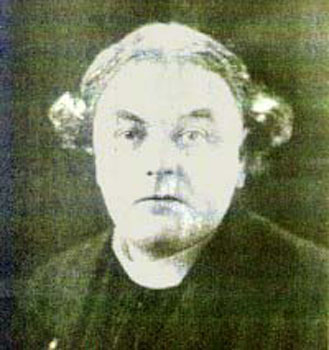
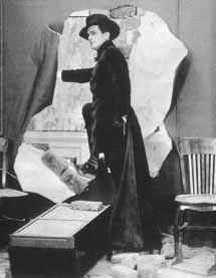
Montague Summers is one of those rare pieces of work that only come around every hundred years or so. Born in 1880 to affluent parents, he studied to be an Anglican curate, then shifted into teaching and writing, then converted to Catholicism and dubbed himself "Reverend" although sources conflict as to whether he was ever truly ordained. He was most famous for his works on occultism, witchcraft (including the first English translation of the MALLEUS MALEFICARUM) vampires, werewolves, and gothic literature. He was also known for his self-conscious eccentricity, going about in black priest's robes, soft fingers dripping with jeweled rings, clutching a huge black portfolio with "VAMPIRES" etched on the side in huge red letters. He purported to believe in everything he wrote about, and claimed that all witchcraft was evil. Nevertheless, he was rumored to have been friends with Aleister Crowley, to have participated in occult rituals, and to have been gay and/or a pederast. (That photo makes him look like someone's Aunt Gertrude, but never mind.) He's just one of those folks you're never sure what to make of.

Anyway, THE SUPERNATURAL OMNIBUS is his personal selection of significant stories, and they reflect him in many ways. I managed to get hold of a "complete" edition, which included a number of stories that weren't reprinted in American editions for many years.

Summers' introduction is rather interesting; he's simultaneously erudite and smirking, taking a wryly humorous overview of the development of the ghost story in literature, from ancient times to medieval manuscripts to modern times. There are moments when his tongue seems so firmly in cheek that I was left wondering just how genuine all his belief truly was...but I guess we'll never know for sure. He drops lots of tantalizing titles of obscure gothic works that left me drooling, including THE PRIORY OF ST. CLAIR, OR, THE MURDERED NUN and THE SKELETON CLUTCH, OR, THE GOBLET OF GORE. The latter is supposedly by Thomas Preskett Prest, author of the infamous VARNEY THE VAMPYRE, OR, THE FEAST OF BLOOD, which I made all the way through a few years ago and am not particularly inclined to revisit just yet.

I jumped around a bit through the first section, "Stories of Hauntings and Horror," mainly because there were stories there I'd read too many times before, or were things I planned to read later for this blog and review on their own or as part of their author's work. So, here's a few quick mini-reviews...

"Narrative of the Ghost of a Hand," by J. Sheridan le Fanu. An excerpt from his novel THE HOUSE BY THE CHURCHYARD, this is a nifty, atmospheric little tale that strongly resembles modern stories of poltergeist hauntings.

"An Account of Some Strange Disturbances in Aungier Street," also by Le Fanu. Not quite as compact and tidy as the last one, but still an entertaining story of a haunted house that kept making me think of Bram Stoker's "The Judge's House," and led me to wonder if there was an influence there.

"Man-Size in Marble," by E. Nesbit. I skipped this one, having read it too many times before. Then there was the aforementioned "The Judge's House" by Stoker, ditto.

"Thurnley Abbey" by Perceval Landon, has one of the most gruesome ghosts I've ever encountered in literature, a mummified corpse that flops into bed with the narrator. Yuck!

"The Story of the Spaniards, Hammersmith," by Kate and Hesketh Prichard, is something I'm saving for later. Amelia Edwards' "The Phantom Coach" is an old favorite; a man lost in a snowstorm ends up catching a ride on a moldering coach. Not great, but a good story to read in winter, with loads of atmosphere.

"Brickett Bottom," by Amyas Northcote, is a chilling tale of a house that may or may not be there...and what may happen to those who chance to go in. Memorable for its ambiguity.

Mary Elizabeth Braddon's "The Cold Embrace" is a tale of spectral vengeance that I've seen a million times; same with the next tale, Amelia Edwards' "How the Third Floor Knew the Potteries."

Rosa Mulholland's "Not to Be Taken at Bed-Time" is a nasty tale that honestly doesn't belong in this section, as it deals mostly with witchcraft. Old Coll Dhu is a lonesome recluse in Ireland who finally meets the local lord's daughter and falls in love. Naturally, she spurns him, and he commissions a local witch to fashion a love charm, with appalling results.

The next two tales, "To Be Taken with a Grain of Salt," and "The Signal-Man," are by Charles Dickens, a writer I simply do not like, so I skipped them. Yes, I don't like Charles Dickens. I know that's heresy to some. Live with it.

"The Compensation House" by Charles Collins is a sad tale of a man tormented by guilt, and haunted by a friend's ghost; the next tale, Amelia Edwards' "The Engineer," is quite similar. Neither is particularly frightening; Edwards' story is unfortunately rather pious and moralistic even though it's got a better, more modern style.

"When I Was Dead" by Vincent O'Sullivan is a minor classic, a first-person narrative of a man who, well...the title says it all. He's presented with an unusual situation and refuses to accept the reality of it. Short, but it sticks with you.

"The Story of Yand Manor House" by Kate and Hesketh Prichard is something I'm saving for later. Following that was another Vincent O'Sullivan piece, "The Business of Madame Jahn," which I didn't like; for some reason, I read it twice and both times forgot almost immediately that I had read it. Either it's totally unmemorable or so hideous and traumatic that my brain is wiping out the memory automatically. My bet is on the former but you never know.

Two by Vernon Lee, "Amour Dure" and "Oke of Okehurst," are being saved for later. Braddon's "Eveline's Visitant," a tale of spectral revenge with hints of marital infidelity, is another overly familiar tale; same is true of "John Charrington's Wedding" by E. Nesbit, which is quite good, but anthologized often.

Roger Pater's "De Profundis" is an interesting tale, told from the viewpoint of a Catholic priest with clairaudient abilities, who I'm told was the star of a series of stories. It's not that brilliant a tale (the ghost of a nun accidentally reveals some unorthodox practices in a convent), but the milieu is interesting, and I may see if there's a reprint out there somewhere.

Winding up the first section is Wilkie Collins' "The Dream Woman," one of those classic tales of fate foretold by a prophetic dream. Hardly anything new, but Collins could tell a tale.

OK...I'll be starting the second part, "Diabolism, Witchcraft, and Evil Lore," which has a lot of tales I've never heard of, so I'm looking forward to it. Oh, but it has le Fanu's "Carmilla," another one that's been anthologized to death, but hopefully I'll be able to examine it by itself some day.

So that's all for the moment...stay tuned for Part Two!
Wednesday, April 15, 2009

A WATERY GRAVE by Joan Druett


OK, yeah, I know, it's been a while. I had reviews to write for magazines (namely Scarlet and Van Helsing's Journal) and I still have a book to review for Amazon, plus I've been dealing with allergies (tree pollen is my bugaboo), coping with a bug, floored by Natasha Richardson's passing, driven nearly mad by work issues, coping with a temperamental car, etc. And I've been dealing with a dreadful crisis that struck on Easter weekend....I ran out of absinthe. And trying to find a source for it around here is a pain.

(Note on the Amazon kerfuffle...if you haven't heard about it, consider yourself lucky. Personally, I think it's a tempest in a teapot, and I find the "glitch" explanation totally plausible, considering some of the things I have to deal with at work. I have every intention of doing business with them in the future. I encourage cool heads and rational, skeptical thinking in situations like this, and refraining from witch-hunts and hopping on the outrage haywagon simply because it's fashionable.)

This book was a random selection at the library, but it turned out to be fun. Joan Druett is known as a nautical historian, and some refer to her as a "distaff Patrick O'Brien." This is the first in a mystery series (so far, four books), featuring linguist Wiki Coffin.

Now, what makes this series interesting is the milieu. Wiki is half-Caucasian, half-Maori, and has traveled over a lot of the 19th-century world. And in this novel, he's setting off with the (real-life) United States Exploring Expedition, which left Virginia in 1838 to explore and map as much as they could. In addition the usual naval crew, there were artists, naturalists, botanists, astronomers, taxidermists, a mineralogist, and a philologist. Six ships set out, but only one returned four years later (one was sent back because it was too slow, one shipwrecked, one was sold into the opium trade, and two vanished with all hands). The specimens collected on the expedition formed the backbone of the Smithsonian Institution (something near and dear to the hearts of us Washingtonians).

Anyway, Druett's series adds a seventh ship, and a few fictional characters, including linguist Wiki Coffin. As A WATERY GRAVE opens, Coffin is in Virginia, and witnesses a bizarre event as a boat is shot at on a river. Turns out the boat had a corpse in it, and Coffin is initially accused of the crime. He's cleared, but the local law enforcement is convinced the real criminal is part of the expedition...so Coffin is deputized to find out who's responsible.

Now, I have to admit...the mystery's kinda creaky. I saw a lot of things coming that Wiki Coffin took for freakin' ever to figure out. And the final solution was not much of a surprise to me. But...the setting is just fascinating, and Druett's studies in nautical history make it all ring true. And all the scientific and cultural stuff just makes it all the more interesting for me. I just love the concept of the "citizen-scientist," research-minded regular joes who participate in various studies and track blooming flowers or bird appearances or meteors or whatever. (I had a great time a couple weekends ago at the Naval Observatory's open house here in DC, where I actually saw Saturn's rings through an amateur 'scope, and am seriously considering getting my own.) The historic setting, scientific discussions, and overall realism more than make up for the plot weaknesses.

So, if you enjoy a good historical and like to immerse yourself in a new setting, give Druett's work a try. I've already picked up a couple of her other books (thanks to ultra-cheap library book sales) and am looking forward to more adventures...

Coming up: Montague Summers, Sherlock Holmes, Poe, Poe, and more Poe!

Sunday, March 22, 2009

Exclusive: William Patrick Maynard's THE TERROR OF FU MANCHU!


Bill Maynard was kind enough to approach me about his new book (his first!), THE TERROR OF FU MANCHU, which is the first authorized Fu Manchu novel in 20 years, ever since Cay Van Ash's THE FIRES OF FU MANCHU. Not only is this a fun book, but it's exciting for yours truly to do his first exclusive pre-publication book review. (I've checked, there doesn't appear to be any other reviews out there yet, so this is the first!)

And who is Fu Manchu? If you don't know...well, he's a Chinese mastermind created by Sax Rohmer (real name: Arthur Sarsfield Ward), in a pulp series that began in 1912 with the short story "The Zayat Kiss" and continued in a series of stories and novels that lasted until 1973 in the posthumous collection THE WRATH OF FU MANCHU. (Rohmer passed on in 1959.) Rohmer reportedly based Fu Manchu on rumors he heard of a Chinese crimelord operating in London's Limehouse district, but went far beyond that by making Fu Manchu an operative of a secret organization, the Si-Fan. In the novels, the Si-Fan started off planning to drive all Europeans out of Asia, but gradually evolved into a desire for world domination. Despite the racial implications (as fond as I am of the series, I freely admit they can be a little racially insensitive), Fu Manchu became an extraordinarily popular character, appearing in movies, radio shows, and comic books, and influenced the creations of other characters, ranging from comic-book villains like the Mandarin or Ra's al Ghul to Ming the Merciless to James Bond's nemesis Dr. No.

Fu Manchu employed all sorts of bizarre weaponry. In the original Rohmer novels, it ranged from cats with poisoned claws, primates trained to strangle, and poisonous caterpillars to mutated fungi, custom-made diseases, and suspended-animation drugs. Later in the series he developed sci-fi gadgetry like a disintegration beam, force fields, and flying saucers!

The forces of Good in the novels were represented by Fu's inconquerable enemy, Sir Denis Nayland Smith, who was assisted by a series of "Watsons" who would narrate a book or two before retiring into married life with whatever exotic beauty they'd rescued. (And they generally had come-hither names like Karamaneh, Ardatha, Fleurette, Rima, etc.)

Anyway...

THE TERROR OF FU MANCHU takes place in December of 1913. Dr. Petrie, Smith's first "Watson", is visiting an old friend, Rev. Eltham, who had been featured earlier in the series. This time, however, Petrie is shocked to discover that Eltham has cast aside his sacred calling and joined a mysterious group called The Brotherhood of the Magi, and is consorting with a mysterious beauty named Ursula Trelawney...who is hinted to be the reincarnation of Madame Blavatsky.

Of course, soon the deaths start, and Smith and Petrie confront their enemy, Fu Manchu, who is aging but still capable and intelligent. (Rohmer had Fu Manchu discover a youth-revitalizing potion in the fifth novel, 1932's THE MASK OF FU MANCHU.) Petrie scrambles from London to Paris and back, and it soon becomes clear that it's not just Evil vs. Good but Evil vs. Evil vs. Good. And just trying to figure who's on what side is half the fun.

Naturally, those familiar with the Fu Manchu series may raise an eyebrow at some of the things I describe. Fu Manchu involved with esoteric sects and Theosophy? Actually, it's something I always half-expected to emerge in the series. Rohmer touched on psychic phenomena in the F-M books, but outside the series he was very obviously interested in the occult. Other works ranged from the non-fiction survey of the occult, THE ROMANCE OF SORCERY (1914), to various supernatural-horror short stories, and one of my favorites of his nonseries novels, BROOD OF THE WITCH QUEEN (1918), which reads as an attempt to create a series around a supernatural villain. So really, the introduction of occultism into a Rohmer pastiche is nothing shocking at all.

There's also lots of nods to Rohmer's other works, including Gaston Max, a French detective featured in a quartet of novels, and who crossed swords with an unnamed Fu Manchu in THE GOLDEN SCORPION (1918). There's a wink to knowing readers as Rohmer's psychic detective, Moris Klaw, is given an oblique reference (he appeared in 1920's THE DREAM DETECTIVE). And even non-Rohmer creations show up, with mentions of Fantomas and Les Vampires. (And if Bill hadn't sent me the manuscript before I wrote the Video Shelf article a few weeks ago, I'd have suspected something.) And there's probably any number of other references that slipped by me. And one character borrows a name from a mutual friend, no longer with us, and I can assume that wherever Richard is, he's having a good chuckle over his namesake.

Now, granted, this isn't great lit-ra-choor. At his best, Rohmer was pulp, so I don't expect much more from a pastiche. TERROR has a few faults that I found, mostly in the language (Petrie says "nice to see you again" at one point, which looks a little too modern to my eyes, and there's a few other moments like that; not major, though). TERROR is much more sexually frank than anything Rohmer wrote (but then again, this is supposedly a "suppressed" memoir of Petrie's), and some musings on religion and belief seem a bit obvious...but overall, TERROR is still a ripping fun read. Maynard manages to sidestep some of Rohmer's weaknesses (sometimes his plots could get muddled, and he was often frightfully snobbish and flat-out racist), which is much to his credit.

And no, I'm not saying that because I hope to get him to write for this blog at some point. I enjoyed TERROR thoroughly, and look forward to whatever Bill comes up with next. (If there's an absinthe-swilling red-headed aesthete of profound depravity in his next book...I'll have a good laugh.)

TERROR OF FU MANCHU is coming out next month from the good folks at Black Coat Press, so click on the link to the right there for more info about TERROR and other books they publish. And I'll add a link for The Page of Fu Manchu for those who want to learn more about Sax Rohmer's works.

Until next time, my friends...

Tuesday, March 17, 2009

Happy St. Patrick's Day

I am totally unprepared for this holiday, totally. If I had been thinking, I'd have prepared some remarks about Lady Wilde, or Herminie Templeton, or some reviews stories by J. Sheridan Le Fanu or Rhoda Broughton....but I didn't.

Hell, I didn't even prepare any remarks about DARBY O'GILL AND THE LITTLE PEOPLE, one of the handful of Disney films I can stand.

So anyway, have a beer, caterwaul "Danny Boy" at the top of your lungs, and enjoy the evening. And look out for leprechauns.


And if you're home and reading this (obviously, you are), click on the link to the Irish Journal of Gothic and Horror Studies, there to the right. Go ahead, it's worth checking out. I mean it.

I'll be back later with more fun stuff.

Sunday, March 15, 2009

A Few Thoughts

Not very long ago I was lounging in the bath, reading Arthur Quiller-Couch's ON THE ART OF WRITING, and came across a great quote...

"What do I argue from this? I argue that until we can bring more intellectual freedom into our State, 'joy in the widest commonalty spread,' upon you, a few favoured ones, rest an obligation to see that the springs of English poetry do not fail. I put it to you that of this glory of our birth and state you are the temporary stewards. I put it to the University, considered as a dispenser of intellectual light, that to treat English poetry as though it had died with Tennyson and your lecturers had but to compose the features on a corpse, is to abnegate high hope for the sake of a barren convenience."

Now, I've got nothing against arranging the features on a corpse (especially if I can make him stick his tongue out at the next of kin), but this really stuck with me. Literature should be a living thing. I know I focus a lot on the works of authors of the past, but I know that I (and by extension, you) shouldn't be exclusive about it. The present has a lot to offer and even when we think about the past, we have to remember the old saying, "What is past is prologue." The past shouldn't be ignored, but it shouldn't be idolized as the pinnacle of achievement. Rather, it should function to inspire current generations to try their hand, to maybe do one better, to reach higher and farther.

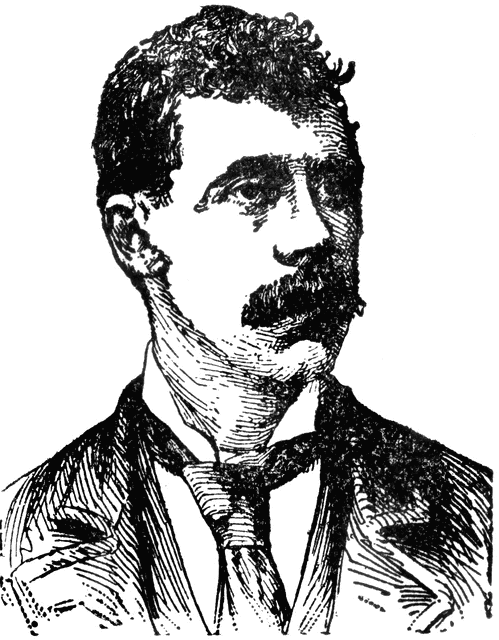
Here's Q in his younger days:


Handsome devil, eh? Q (as he was known) was also quite the ghost-story writer; look up stories like "The Laird's Luck" and "Roll-Call of the Reef" to sample his work. He was also a prominent poet, editor of the famous OXFORD BOOK OF ENGLISH VERSE, and a prominent literary critic and educator. ON THE ART OF WRITING is a collection of lectures he delivered from 1913 to 1914, and while sometimes dense has its moments of light. He was a big influence on one my personal muses, Helene Hanff of 84 CHARING CROSS ROAD fame. So if you're of the creative kind, get out there and create something new!

Monday, March 2, 2009

The Video Shelf: Louis Feuillade

This will be the first in an ongoing series, featuring inspirational films to be found on video and DVD...although sometimes with a little effort.

Louis Feuillade will be the featured filmmaker this time around. Born in 1873, to a family of wine brokers in Lunel, France, Feuillade worked in the family business but wrote on the side, eventually becoming a full-time journalist, but found the work unrewarding financially. In 1905 he became a screenwriter for the Gaumont film company. Two years later he became a director. In his lifetime he wrote 800 screenplays and directed 700 of them (most of them shorts), and up until 1913 he made about 80 a year. He then started making feature-length films, and then became a pioneer of the serial format.


One of his earliest serials was not really one big project, but a series of five shorter chapter plays, but put together they're known as FANTOMAS (1913-14). Based on the series of novels by Marcel Allain and Pierre Souvestre, they chronicle the adventures of supercriminal Fantomas (Rene Navarre) as he's pursued by the somewhat-obsessed Inspector Juve (Edmond Breon) and feisty journalist Jerome Fandor (Georges Melchior). Fantomas is no sympathetic Robin Hood, Arsene Lupin, Raffles, or Simon Templar...he's a fiend. Fantomas lashes out against everything that normal society values and holds sacred. (I've read that in the novels he does things like sneak into a department store to put razor blades in the shoes and acid in the perfume atomizers...eeek!) He has a mistress, Lady Beltham (he murdered Lord Beltham), who is simultaneously drawn and repulsed by him. Fantomas is a force of nature.

Feuillade's five Fantomas films (translated, they are Fantomas: In the Shadow of the Guillotine, Juve versus Fantomas, The Murderous Corpse, Fantomas versus Fantomas, and The False Magistrate) have Fantomas stealing jewels, murdering officials, blowing up houses in the midst of police raids, crashing trains to kill off a single witness, and doing other acts of flamboyant villainy that one usually associates with James Bond villains.

And it's stuffed with all sorts of great visuals. Feuillade loved tableaux that recalled artists ranging from Daumier to Vuillard, and he reined in the usual overdone histrionics of silent actors, with the acting ending up much more naturalistic than other films of the period.

Alas, FANTOMAS is not readily available in the US, unless you scrounge a copy from the "collector's" market, or at a convention. But it's worth finding. It's unbelievable fun.

In 1915, Feuillade brought out another serial....LES VAMPIRES!


LES VAMPIRES featured the struggles of crusading reporter Phillipe Guerande (Edouard Mathe) and his comical sidekick Mazamette (Marcel Levesque) to expose and end the activities of a criminal gang called The Vampires. They're not actual vampires, but they are ruthless and determined to not only line their own pockets but subvert society as a whole. They are forces of anarchy and disorder, corrupting even the highest levels of government. At first, the Vampires are just random thugs, but as time goes on, individuals, like the mysterious Father Silence, take center stage. But what really electrifies the serial is the introduction of vampirette Irma Vep (it's an anagram), personified by the slinky Musidora.


Musidora gave life to Irma Vep, bringing a unique combination of ferocity, sensuality, and vulnerability to the role. Irma could show up anywhere in disguise, and sometimes did. Her liberated eroticism simultaneously enticed and threatened. Musidora was a very physical actress who did all her own stunts, and her form, curvaceous yet athletic, encased in black tights, slinking down hallways, or in secret passages, or over a rooftop, became the film's top attraction.

LES VAMPIRES was filmed on the fly, with the director/screenwriter often seeming to make it up as they went along, tearing around the deserted streets of WWI Paris. This often lends a strange, surreal air to the goings-on, which helped make Feuillade's crime serials a big favorite of Surrealists like Bunuel and Andre Breton. And if one experiences a bit of deja vu while watching LES VAMPIRES, bear in mind that it was also an influence on Edward Gorey.

Available on an Image DVD, LES VAMPIRES starts off a bit slow (the first chapter, The Severed Head, is a bit of a clunker), but after seven fabulous hours, when reaching the climax in The Terrible Wedding, it's sheer Dust & Corruption bliss.

However, Feuillade's next project was a bit of a problem. LES VAMPIRES had encountered difficulties and was banned for a while because officials felt it glamorized crime. This was hard for a very moral man like Feuillade to take, and his next major serial was JUDEX (1916), which featured a mysterious crime-fighter.


Judex (Rene Creste) was a master of disguise, a brilliant inventor, and seemed to have hypnotic powers. He worked from his hi-tech lair inside a ruined castle. He went about in a signature cape. He was, in many ways, the great-grandpa of caped crusaders like Batman.

Judex, however, had a mission. Aided by his brother (Edouard Mathe again) and spurred on by his obsessed mother (Yvonne Dario), he was out to avenge his family's honor by capturing the unscrupulous banker whose machinations led to his father's suicide. But on the way he falls in love with the banker's beautiful daughter (Yvette Andreyor), deals with comically shifty private eye Cocantin (Marcel Levesque again), a mischievous orphan called the Licorice Kid (popular kid comic of the time Bout-de-Zan), and tangles with the banker's evil mistress Diana Monti (Musidora!), who's the real evil genius.

There's more plot and counterplot here, but it's less about protecting society from anarchistic criminals than it is about personal redemption. Judex and his mother learn along the way to lighten up, and some villains repent of their wicked ways.

The main weakness of JUDEX is the casting of the daughter's child; although we're told it's a boy, he's very obviously a little girl who's very taken with the Licorice Kid, and at every opportunity is throwing her arms around him and kissing him. Kinda weird, but you know those French.

All five hours of JUDEX are available in a set from Flicker Alley, beautifully restored and with a terrific musical score (including one motif I love, played during scenes of villainous plotting; it's simultaneously menacing and humorous). There's also a 60s remake by Georges Franju (LES YEUX SANS VISAGE) that I'm told is also quite good, but I haven't seen it yet.

Feuillade's work is great stuff; baroque crimes committed by bizarre criminals, who are often battled by crimefighters who are themselves fairly strange. There's no predicting what's going to happen next, and the visions of early 20th-Century Paris are seductive. The fourth wall is regularly broken; Fantomas will sometimes signal to viewers that he's aware the police are after him, and Mazamette sometimes winks to the camera as a joke comes off. These movie characters know they're in a movie, making the experience all the more wild. So run out and these flicks, dear readers. Lose yourself in Parisian delights, and dream of secret passages and daring criminals.


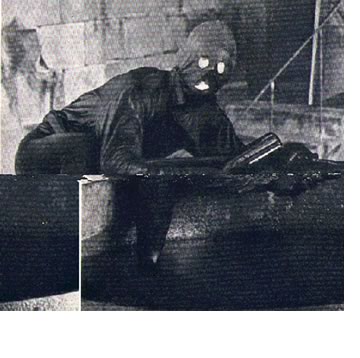
A video clip of LES VAMPIRES' famous ballet sequence...just before this, the dancer (who is the hero's fiancee) receives a gift of a poisonous ring from the head Vampire, who watches from the balcony.