Monday, April 4, 2011
THE CHINESE GOLD MURDERS by Robert van Gulik
OK, I'm finally getting down to reviewing the Judge Dee series. Don't sue me.
The Chinese Gold Murders is the third of the establishing quintet of Judge Dee novels, all titled The Chinese (four-letter-word) Murders. Although coming after two other books in the series, it's the first chronologically, and is missing the opening framing story found in the other four, which all open with an unnamed narrator learning the facts of the novel from a supernatural source.
The year is 663 CE, and young Dee Jen-djieh, only 33, sets off to his first appointment as a district magistrate. Accompanied by Hoong Liang, an elderly family servant, he encounters two highwaymen, Ma Joong and Chiao Tai, but impresses them so much with his strength of character that they reform and become his stalwart lieutenants. (I know, it's fairly cliched, but as these characters had already been established, they had to be given origin stories.) With his retinue established (a fourth lieutenant will be added later), he arrives at his post: the city of Peng-Lai, located across a gulf from Korea, near military grounds and a busy river. (There is a real Penglai in China, in the correct spot, as part of the city of Yantai, in the Shandong province.) And then Dee face three cases, as he does in most of the novels; sometimes they're completely separate, other times they're interconnected.
The book has many of the hallmarks of van Gulik's Judge Dee series; a map of the city in which it takes place, illustrations by the author, and a cast of characters at the beginning giving you a list of who's involved in what particular case. And they're also named: "The Case of the Murdered Magistrate," "The Case of the Bolting Bride," and "The Case of the Butchered Bully."
The first, "The Case of the Murdered Magistrate," is over how the previous magistrate, one Wang Te-hwa, was poisoned in his study, which was locked from the inside. And there's no apparent motive, either; was he on to something? In "The Case of the Bolting Bride," a newlywed woman, returning to the city after a visit to her family, vanishes. Was she abducted? or did she run away? Is she alive or dead? And "The Case of the Butchered Bully" is over the disappearance of an unpopular local, and how he turns up brutally murdered.
Now, what does gold have to do with this? Well, two of the cases are intertwined, but another ends up on a trail of huge smuggling operation involving members of the local Korean community and shady characters around town. And there's also a possible weretiger prowling outside the city, and the ghost of the dead magistrate showing up in the tribunal...or is it really him?
I'm very fond of this series as a whole, but this novel has two points of special interest for me. I first read it as a high-school student, after stumbling on one of the later novels at a used book store, and I loved the atmosphere and immersion in an alien culture. (In fact, the Dee series is often cited by sci-fi and fantasy authors as a perfect way to depict an alien culture in a way that's still comprehensible to the average reader, and they're recommended to many would-be sf/fantasy writers for that reason. I've also heard of them being read as part of college courses in Chinese history.)
The first point was a minor character, Tang, a haunted, insecure man who's a senior scribe of the Tribunal. In the course of the novel it's revealed that he's in love with another man, the chief clerk Fan Choong. Late in the novel he confesses his love for Fan to the Judge, who brushes aside the man's guilt over his attraction, saying, "We go as nature directs us. If thus two adults find each other, it is their own affair. Don't worry about that." And as a young man dealing with the early stirrings of his homosexuality, I needed to read that. And, in fact, they're words I remind myself of often as the years go by. In fact, there's pro-gay sentiments expressed here and there in the series, probably to make up for a less-than-enlightened character who shows up in an earlier book. (And remember, this was the late 50s and early 60s; these were radical sentiments for their time.)
Second, I have always been filled with a wistful fondness for the character of the dead magistrate. Van Gulik really makes sure that you get a feel for the kind of man he was, and it's someone who's very likable and sympathetic, if something of a slacker. There's a great scene where the Judge and Hoong investigate the old magistrate's library, and get a feel for him from his books. And I'm going to go out on a limb and quote the scene, I love it so.
"Well, Hoong, I have now a fairly clear picture of the murdered man's personality. I have glanced through the volumes with his own poetry; it is written in exquisite style but rather shallow in content. Love poems predominate, most of them dedicated to famous courtesans in the capital or other places where Magistrate Wang served."
"Tang made some veiled remarks just now, your honor," Hoong put in, "to the effect that the magistrate was a man of rather slack morals. He often even invited prostitutes to his house, and had them stay overnight."
Judge Dee nodded.
"That brocade folder you gave me a few moments ago," he said, "contained nothing but erotic drawings. Further, he had a few score books on wine, and the way it is made in various parts of the empire, and on cooking. On the other hand, he had built up a fine collection of the great ancient poets, every volume dog-eared and with his own notes and comments written in on nearly every page. The same goes for his comprehensive collection of works on Buddhism and Taoist mysticism. But his edition of the complete Confucian classics is in as virginal a state as when he purchased it! I further noticed that the sciences are well represented: most of the standard works on medicine and alchemy are there, also a few rare old treatises on riddles, conundrums and mechanical devices. Books on history, statecraft, administration and mathematics are conspicuous by their absence."
Turning his chair round, the judge continued.
"I conclude that Magistrate Wang was a poet with a keen sense of beauty, and also a philosopher deeply interested in mysticism. And at the same time he was a sensual man, much attached to all earthly pleasures - a not unusual combination, I believe. He was completely devoid of ambition; he liked the post of magistrate in a quiet district far from the capital, where he was his own master and where he could arrange his life as he liked. That is why he didn't want to be promoted - I believe Peng-lai was already his ninth post as magistrate! But he was a very intelligent man of an inquisitive mind - hence his interest in riddles, conundrums and mechanical devices - and that, together with his long practical experience, made him a fairly satisfactory magistrate here, although I don't supposed he was very devoted to his duties. He cared little for family ties; that is why he didn't remarry after his first and second ladies had died, and why he was content with ephemeral liaisons with courtesans and prostitutes. He himself summed up his own personality rather aptly in the name he bestowed on his library."
Judge Dee pointed with his fan at the inscribed board that hung over the door. Hoong couldn't help smiling when he read, "Hermitage of the Vagrant Weed."
I love that. It makes Wang come alive as a likable human being, and I've sometimes speculated about bringing him back to life for my own series of tales...or maybe not. He had his flaws but was self-aware, and his sharp mind and keen love of beauty have made him something of a role model for me. I just hope I don't end up like him.
The Chinese Gold Murders has my highest recommendation by default, because I consider the ENTIRE Judge Dee series to be Required Reading.
I'll be following the series in chronological order, so next up will be three short stories set during the Judge's time at Peng-lai.
Sunday, April 3, 2011
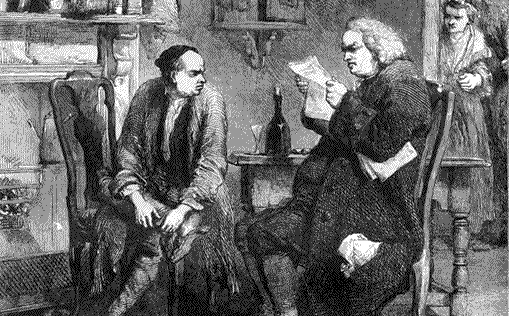
Lillian de la Torre's Sam: Johnson Stories, Part One
There's four books of de la Torre's stories featuring the Great Lexicographer as a detective. It's significant as being the founding volume of the historical-character whodunit; that is, a historical mystery featuring a real-life character from the past functioning as a detective. Now the genre is almost overpopulated with it; I've read stuff featuring Aristotle, Edgar Allan Poe, Davy Crockett, P. T. Barnum, Richard Burton, Algernon Swinburne, Jane Austen...the list goes on and on. But de la Torre came up with it in the 1940s and kept it going...at least in the Western world, as in Chinese literature such a tradition was already common.
For the newbies, Samuel Johnson (or Sam: as he's called; he actually wrote it that way) was a poet, critic, essayist, editor and lexicographer who lived from 1709 to 1784 and was the most prominent man of letters of his age, and many regard him as the greatest of all time. He wrote the first dictionary of English, edited an influential volume of Shakespeare plays, and was also an amazing wit and raconteur, something that came out with a biography written by his friend James Boswell, who carefully chronicled Johnson's life and conversation. He also detailed Johnson's health and habits so carefully that a posthumous diagnosis of Tourette's syndrome was reached; Johnson was prone to nervous tics and weird gestures, with odd vocalizations. And by all accounts, Johnson wasn't afraid to tackle criminals (including someone who picked his pocket), and took an active part in exposing the Cock Lane ghost fraud. He experimented in chemistry and, interestingly, with ceramic glazes. In other words, he had an active, curious intellect, a definite role model.
About the stories....they're in classic Holmesian style (and if you think about it, Doyle borrows from Boswell anyway) with the loyal friend/narrator recording the detective adventures of his best friend. They're written in 18th-century style, with the style and spelling/grammar quirks of period writing. And almost all of them contain actual historical characters, or thinly veiled versions of actual historical characters, or are based on real-life crimes or events.
First up: "The Wax-Work Cadaver," set in 1763, which is a great way to start off the volume. Boswell and Johnson go to visit Mrs. Salmon's famous wax museum, only to end up in a tangle of murder and mayhem. It's a fun story, full of detection and overtones of gothick horror, with bones inside wax statues and a grisly murder. And who can resist a murder in a wax museum? Wax museums seem to be made for murders.
"The Second Sight of Dr. Sam: Johnson" takes place during Boswell and Johnson's tour of Scotland and the Hebrides in 1773, and actually has chunks lifted pretty much directly from Boswell's account of the tour. While on the island of Raasay, they stumble on some odd happenings, which end up in a tragic death. It's probably the least of the series; the mystery depends on people overlooking some painfully obvious clues, like why an elderly woman who lives alone would be drying a wet pair of trousers by the fire.
"The Flying Highwayman" isn't specifically dated but seems to take place in 1763 or '64. It involves at least one real person, the blind magistrate Sir John Fielding (brother of novelist Henry Fielding, and who would later star in his own series of historical detective novels, written by "Bruce Alexander," pen name of Bruce Cook), and looks at the real contemporary problem of highwaymen. This time, a highwayman seems to appear and disappear at will, and is impossible to track down...until Johnson and Fielding join forces and nab the wrongdoer.
"The Mondobbo Ape Boy," also set during the Scottish visit of 1773, involves a bizarre real person, Lord Monboddo, an eccentric nobleman with many odd, loopy ideas, but whose ideas also prefigured the theory of natural selection and Darwin. While visiting the eccentric, two rough men show up with a naked boy, whom they claim is a wild boy they captured in a nearby forest. Monboddo is wild to take in the boy and use him as proof of his theories, but Johnson smells a rat...
Autumn of 1769 is the time of "The Manifestations in Mincing Lane," which is a fictional fantasia based on the real-life Cock Lane haunting that Johnson helped expose. De la Torre had a talent with atmosphere; this is a memorable tale, and the solution to it is just about every bit as grisly as the mystery that preceded it. What is the source of the knockings on the wall in an old house? Who is the phantom that appears? The final revelation seems unlikely but from what I've heard and read it's actually quite plausible.
Aaaaand we're back to Scotland of 1773, for "Prince Charlie's Ruby." Boswell and Johnson are staying in the home of the famous Flora MacDonald, a heroine of what was known as "the '45" to which Boswell and Johnson are played as being sympathetic. (Then again, this is during the reign of madman George III, so the Young Pretender was probably a viable alternative.) A mysterious visitor is revealed to be none other than the Bonnie Prince himself (who, it is rumored, really did slip back and forth from France to Scotland and England), who is in search of a fabulous ruby that was supposedly hidden for his future needs.
The holidays of 1772 give us "The Stolen Christmas Box," which sees Boswell and Johnson spending the Christmas festivities with Johnson's real-life friends the Thrales, especially Mrs. Thrale, another of Johnson's biographers, and whom Boswell disliked intensely. A valuable gem is stolen, and bizarre coded messages are found. Who is responsible? What is the importance of the messages? The ending is actually very unexpected, but only a minor fictionalizing of real events.
"The Conveyance of Emelina Grange" is yet another return to Scotland of 1773. Boswell and Johnson are called in to witness an ill woman signing a questionable document; they finally smoke out an imposture and abduction. De la Torre makes a claim for historical basis, but I can find nothing to back it up, except for it being based on the capers of a noted rakehellion Simon Fraser, who was the last man to be beheaded on Tower Hill.
The last story in the collection, "The Great Seal of England," is set in 1784 and is the first story published. Based on a real-life disappearance of the titular Great Seal, and including a number of political figures of the time, including Chancellor Thurlow. The Great Seal, a monumental responsibility and an object vital to the functioning of the Empire, is missing; who took it, how, and why? Other objects of value have not been taken, and it hasn't been ransomed. What was the purpose?
All told, it's good reading, even when it's not at its best, and certainly educates one about history and the notable figures of the 18th century. DR. SAM: JOHNSON, DETECTOR i's out of print, but worth seeking out. Highly recommended.
Saturday, April 2, 2011
At the Phantom Ball...
Everyone's gathered in the ballroom, dressed in their bohemian finery. The open dance and performances haven't quite begun yet, and latecomers are still trickling in, but as part of the opening entertainment, and to get the ball rolling, two of the best dancers show off a little while the rest sip their champagne or absinthe.
And that only sets the scene for a wild night...
I just had my first-ever tango lesson last night, as part of a weekend tango festival at the University of Maryland. My friend Barbara and I signed up for the "Tango Bootcamp" which taught us quite a bit in a short period.
And same-sex tangoing is nothing unusual. While it raises eyebrows in this country, hardly anybody bats an eyelash at two men tangoing together in South America. From what I gathered in the comments on YouTube, these two guys are actually brothers who are popular tango performers.
I'm thinking of investigating the local tango community and seeing what it's like. There's a small queer tango subculture out there, too, so we'll see if there's any of that in Washington....
Thursday, March 31, 2011
Two Untraditional Reads
Not untraditional in material, but untraditional in how I read them
I've been kind of a fan of Doherty for years; he mixes historical mystery with touches of gothic horror in a way that tingles my literary palate. This time he's starting a new series set during the Crusades and depicting the birth of the Knights Templar.
Now, it's kinda interesting but also misleading; the word "Templar" actually never appears in the text of The Templar and only in the author's notes is it made clear that this is about the birth of the Templars. It's mostly about a motley group of French aristocrats who set off on a pilgrimage for various reasons (and it casts a jaundiced eye on the Pope who gets it all started, and sometimes seems to be drawing a parallel with the anti-Islamic sentiment that's growing today), and of their adventures in various parts of Europe.
There's also kind of a mystery. Seriously, it's packaged as a mystery, but really it's a historical novel with a few mystery elements. Very little time is spent on the mystery plot, and it's hurriedly resolved at the end as almost an afterthought. Disappointing for Doherty, who's usually much better than this. I can't help but wonder if this was a rush job to cash in on the currently-stylish Templar trend.
I read this on my Kindle, and I can loan it to friends with Kindles, so if anyone wants to borrow it, drop me a message.
Next up was Cleek: The Man of the Forty Faces, which I didn't actually read, per se; I listened to it. It was a free download from Librivox, and so far the best audiobook I've listened to from them.
"Hamilton Cleek" is a dashing cat burglar with tons of panache, but in the course of the book's prologue, he falls madly in love with a beautiful, virtuous woman, and decides to reform in order to win her love. He's a master of disguise, since through some quirk of genetics he's been granted rubbery features that can be twisted around in different ways. He's also possessed of a criminal's phrenological profile (seriously, they make a point of that) but decides to make a name for himself as a private detective anyway. And ends up solving the most BIZARRE cases I've encountered in non-supernatural literature.
Make no mistake: this is hokum. But it's full-blooded, delirious hokum, having a ball with itself. It's basically a series of short stories strung together loosely into a novel, and characterizations are thin. Cleek is quite manly but also possessed of several aesthetic qualities, including a passion for flowers and gardens. He takes in a street tough named "Dollops" in as a servant/assistant, whose doglike fawning on Cleek sometimes borders on the nauseating. And at the last second, Cleek is revealed as the long-lost prince of a central European kingdom, Mauravania, which comes to figure in later books. (Yes, it started a series.)
It was written in 1910, just when things were starting to heat up, full of post-Victorian jingoism and suspicion of the Jerries. It's got all that late-Gilded Age glitter, of race meetings and gentlemen of leisure going abroad for months, and criminal gangs straight out of a Louis Feuillade serial. In other words, it's a lot of fun.
The Librivox version is well read by a lady named Ruth Golding who was obviously relishing the job. (On her site, she says, "Oh my, I did enjoy reading this!" I could tell, Ruth!) Her sense of fun comes through and I highly recommend this for your long drives or walks home from school or work.
So there's one book not very recommended unless you're into the Crusades, and another I recommend highly. Go to Librivox and go wild.
Wednesday, March 30, 2011
Three More from Hitch
OK, I've been bad. Work's been kicking my ass. Having new responsibilities is great but after a while I find myself whimpering about how I don't want to stay late yet another day...I wanna go hooooome....
But, in the meantime, I caught three more old Hitchcock films at the AFI.
The first was his earliest film that still exists in a complete form, 1927's THE LODGER: A STORY OF THE LONDON FOG.
Based on a novel by Marie Belloc Lowndes (who I didn't realize until recently was Hilaire Belloc's sister), it's the story of a Jack the Ripper-style killer, The Avenger, who has London in the grip of terror. A man knocks on the door of a house advertising rooms for rent and takes one, but the landlady and her family begin to suspect that he's got a hideous secret...
The tough part of it is that I've heard "The Lodger" adapted for radio, and this version is radically different from the versions I've heard. One, with Peter Lorre in the title role, had him revealed at the end as the murderer; another ended ambiguously, with the lodger taking off and disappearing with nobody ever being sure if he was the killer or not. But Hitch's version has the lodger being a good guy, a poor tormented soul whose sister was the first victim of the killer and is trying to track him down. What gets me is that the real identity of the killer, and his motives, are never revealed; we're told in a throwaway remark at the end that he was caught. The REAL story is about the suspicion that surrounds the poor guy.
OK, so I wasn't satisfied with the story totally, and I wanted to kick Ivor Novello's ass (he was so frail and neurasthenic in the starring role, I couldn't believe the heroine was falling for him), but it's overflowing with visual style.
There are lots of neat little visual riffs, like the above truck that represents the scanning eyes of the press. Or the flashing sign reading "TO-NIGHT GOLDEN CURLS," which references the killer's fondness for blonds. At times it's reminiscent of the experimental shorts by Man Ray and others.
Is it worth watching? Yeah, but it's more about style than story, a time when Hitch's vision was just beginning to gel. (There's a fabulous essay on it over at Cinema de Merde; check it out.)
Next up was YOUNG AND INNOCENT from 1937, originally released as THE GIRL WAS YOUNG.
I missed the first few minutes, thanks to being behind schedule, but this is a ripping good yarn (based on A Shilling for Candles by Josephine Tey) of a man falsely suspected of murder and trying to clear his name, and sucking a well-intentioned gal into his wake. And there's tons of lovely British scenery as they tool around all over the place in her jalopy. The acting from the two leads, Nova Pilbeam and Derrick de Marney, is quite solid, and one can see this as the blueprint for his future comedy/romance/thrillers that featured an innocent man accused of a horrible crime. The killer's identity is telegraphed far in advance, so the real challenge for the viewer is figuring out where he is and what he's doing. An actress is found dead on the beach, and a man she'd had business dealings with is seen running from her body; he's innocent, of course, and manages to give the cops the slip while recruiting the help of a policeman's daughter. I will alert the sensitive that there is a scene of musicians in blackface; didn't bother me, but some might object. But after all, these were different times.
The third was a silent cut of BLACKMAIL, with life music by the Alloy Orchestra. I've already talked about this movie, but I will say that Alloy's accompaniment was exceptional. It was good scoring in that it was inobtrusive; it complemented the action well and was also very melodic and enjoyable.
AFI starts up the second part of their Hitch retrospective on April 23rd; we'll see what comes up next.
Monday, March 7, 2011
Molotov's latest: "Morgue Story"
"Morgue Story" is the latest atrocity from DC's own Molotov Theatre Group; it's gruesome, tasteless, gory, vulgar, intelligent, sensitive, tragic, and overflowing with irony and its awareness of the omnipresence of death. It's like scratching the surface of a John Waters plot and Schopenhauer underneath.
It's the story of Ana Argento, a comic-book artist who chronicles the unlife of a zombie named Oswald, who's looking for a connection in unlikely places. There's also Dr. Daniel Torres, a coroner consumed by his religion, by his nagging mother, and by his inability to genuinely connect with real people. And there's Tom, the life insurance salesman with a tendency toward catalepsy, who keeps waking up in morgues or in ambulances and whose resurrections have ended careers and lives.
Interwoven are the Barman, a former medical student traumatized by one of Tom's resurrections; Dr. Samuel, a therapist who could probably stand some of his own treatment, and his wife, Martina, an ill-fated harridan who's probably a few steps shy of being in the "castrating bitch" category.
What happens? It's like a bedroom farce, only with arterial spray. There's savage humor galore, most memorably during an attempted rape scene; Dr. Torres is trying to force his attentions on Ana, but is taken aback when she suddenly wants to know about his favorite music and TV shows. But there's also times when the brutal Dr. Torres lets us see his confused, lost side. Alex Zavistovich has probably never been compared to John Waters' muse Divine before, but he shares the Baltimore drag queen's ability to simultaneously evoke pity and terror.
And, of course, it's dripping with bitter irony, of which the cataleptic life insurance salesman is only the tip of the iceberg. People also have a way of dying before they sign the papers! And death is all over the place, not only in the setting (chiefly in a morgue) but in the characters themselves and their professions. In one way or another, the three central characters all make a living off death, and it permeates their beings and influences their actions and choices.
Genevieve James strikes all the right notes (and all the right blows) as Ana, who embraces her weirdness, likes it in others, but is simultaneously tougher and more vulnerable than she realizes. Luke Cisiewicz brings a fatalistic jollity to Tom that works marvelously. Dave Gamble is a great mix of stolidity and sarcasm as Dr. Samuel, and Heather Whitpan made the most of her small role without being ridiculous and tiresome. Kevin Finkelstein is slackeriffic as the embittered barman.
But it's also a great way of seeing how far Molotov has come. Everything's really coming together and gelling well; they're really hitting their stride and functioning more smoothly as an ensemble. "Morgue Story" also symbolizes a coup for them; this is the English-language debut of the play, initially performed in Brazil by a Grand Guignol company there, and made into a movie, directed by the playwright, Paulo Biscaia Filho.
I have to admit; I was late to the show and missed the first few minutes, but had no problem catching on. (I was late getting there, thanks to a nosebleed that struck just as I was getting ready to head out, and then by the lack of parking in the area; I eventually had to say, the hell with it, and park illegally just to resolve the nervous breakdown I was close to having...) The door said "No Late Seating," but for once a dose of Not Getting Over One's Self struck and I thought, "Hey, it's me, they count on me being here, they won't care," and bless their black little hearts, they didn't care in the least. And after I was called to join the cast and crew in a toast; I'm no slouch in the boozing department but I have to confess that an Irish Car Bomb was just a teeny bit much for me. Next time I'm taking the Metro down, good and early, and going back for those first few minutes.
"Morgue Story" plays Wednesdays through Sundays until April 8, at 1409 Playbill Cafe (1409 14th St NW, Washington, DC); for more info and tickets, go to Molotov's page. See it, folks, you'll be glad you did. But don't wear your best clothes.
Sunday, March 6, 2011
The Phantom Ball: Hellblinki Takes a Turn
You met up with your friends, had an early dinner, and rushed off to get good spots at the club. You've met others there as well, all happy and excited. You exchange gossip and news, get your drinks, and then the lights dim and the band takes the stage...
I personally discovered Hellblinki recently during a show at the Red Palace...they were the opening act for This Way to the Egress, but in my own humble opinion they were the highlight of the evening. I got to exchange a few words with band members after the show, which was a real thrill. Check 'em out, you won't be sorry.
Subscribe to:
Posts (Atom)