Sunday, June 19, 2011

THE SCREAMING SKULLS by Elliott O'Donnell

Elliott O'Donnell is known today as a ghost-hunter; apparently in his day he was a journalist with a strong interest in ghosts and the occult, and he wrote a number of books on the subject.

This one is a collection of short stories describing various "true" hauntings that he'd investigated first-hand or otherwise researched in some way. While I seriously doubt any of them are really true, it's still an entertaining read.

Each of the stories is brief, something that might make a reasonable magazine article, so there's not always a lot of background, but O'Donnell's journalist creds show through as he makes the most of what he writes. He doesn't waste much time on purple prose and long descriptions.

Some of the tales, like "The Screaming Skulls of Calgarth Hall," are little more than retellings of popular ghost stories. This is also true of "The Legend of Cooke's Folly", "The Phantom Drummer of Cortachy", and "Pearlin Jean of Allanbank." No real investigation going on there, except perhaps for him cracking open a book or listening to someone else's tales of the haunting.

Some are those he claims to have investigated personally. One of my favorite tales from the book, "The Grey Horror," actually takes place in the US, and tells of a grisly ghost that supposedly haunted a dreary location in the Hudson River valley. It's a sort of grey ghoul that rose from a reportedly bottomless pit to roam the valley at night, especially focusing its haunting energies on an abandoned house. Of course, by the end the pit is filled in and the haunting ends, with no real explanation other than that it must be some sort of infernal elemental.

Another good one, "The Phantom Clock of Portman Square," is naturally about a house haunted by the sound of a ghostly clock that strikes thirteen...and then strikes again to indicate the number of days before death strikes a member of the household. Another tenant claims that upon sleeping in a haunted chamber, he has a vivid dream of being taken down to a chamber deep underground, where he meets the spirits of others who met their deaths because of the clock, and all now under the sway of some sort of half-human, half-animal entity that is sheer and utter malignance.

That's one of the fun things about O'Donnell; his ghosts aren't just the spirits of the dead, but also spirits that were never alive, "elementals," forces of nature themselves. (In other works he classifies them; he gave the term "Vagrarian" to a sort of wandering nature-spirit, and I liked it so much I've adopted it as my online moniker.)

But O'Donnell's descriptions of hauntings are vivid and sometimes almost cinematic. Murders are re-enacted and ghosts take on bizarre forms. Sometimes it gets a bit repetitive; there's two cases of ghosts of women drowning their unwanted babies. But the titles of the articles/stories are all wonderfully lurid: "The London Villa of Ghostly Dread", "The Man in Boiling Lead," "Ghosts and Murder," and "The Castle Terrors" all promise enjoyable shudders.

It's a good for bedtime, for the commute, or even the bathroom. The short, compact stories all have good shudders. Just take 'em with a grain of salt...if even half these stories are true, then we live in a world overflowing with supernatural terrors. And I haven't seen 'em.

Sunday Afternoon at the Movies

I'm back, after the madness of a few weeks, including insanity at work. This time, we're spending a steamy Sunday afternoon at our favorite theater...

After a filling brunch and good conversation, we head down the block and duck thankfully into the air-conditioned comfort of the theater...


First up is a short film from 1908, Le Spectre Rouge.


And for a bonus, here's a brief bit from the Lumiere Brothers...


Both are examples from that early era of filmmaking when folks were in love with the form and having far too much fun experimenting with the medium and what it could do. That recklessness can be found in so many of the experimental and avant-garde films of the early era, part of which makes them so enjoyable for me to watch.

OK, show's over, and there's some cool drinks waiting for us at the cafe down the street...

Friday, June 10, 2011

A Quick Note

I really turned it up last month, and it was my biggest month so far, 13 postings. (The significance of that number is not lost on me.)

I've been a bit slower this month so far. I've been distracted by a couple of things, mainly my niece's wedding. She graduated college (bachelor's degree in chemical engineering), and is about to go into the Navy (nuclear officer candidate), so in between she got married. Seemed like the thing to do.

I've also had some medical issues; an eye infection gave me a sleepless night and led to me madly scrambling around the DC area last Friday to find an ophthalmologist who was open. (Turns out to be minor and I'm much better.) Plus I'm now on cholesterol meds plus fish oil, which I was initially wary of but it turns out to be clinically proven to reduce triglycerides, so I'm going with it. And I've been trying to eat better, although I did indulge today in a food-truck sub.

I'm also taking a drawing class which just started Wednesday, so I actually have homework (five half-sheet drawings) to turn in, and I'll be working on those this weekend in between going to DC's gay pride festivities. And I'm also beginning to seriously think about what I'm going to do with my future; my office is going to be moving to Columbia MD or the BWI area at the end of next year, so I have a year and a half to decide if I'm going to stay with the job and commute, stay with the job and move, or find another job.

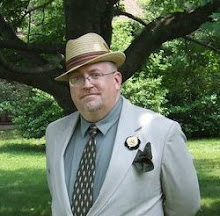
But never fear, I'm not abandoning you. I may slow down a bit this month but I'll still be around. In the meantime, here's a photo of me at my niece's wedding, in a vintage linen suit...

Thursday, June 2, 2011

A Phantom Recital

It's a warm summer evening; our little group has heard about this house, but have never ventured near. It's been standing empty for a number of years, a victim of a poor real-estate market and a bad reputation. It's in a nice neighborhood, and in its day must have been quite lovely, but now is shabby and rundown.

We pick our way through the overgrown garden in the back, trying to keep quiet lest we rouse the neighbors. The idea was just to get a peek, but as we get close, we stop dead in our tracks. In the window of the downstairs parlor, an eerie blue-green light is shining, and music is playing.


As it finally stops, the light fades, and we find ourselves able to move again. You fish a flashlight out of your pocket and shine it in the window, only to see this:

What, or who, made that music?
We hasten out of the garden, and make our way up the street to find a place where the lights are bright and the drinks are strong. None of us will forget that recital any time soon.

Tuesday, May 31, 2011

Again, Three More from Hitch

I've been hitting the AFI Silver, catching more of their Hitchcock retrospective. Here's what I've seen lately...
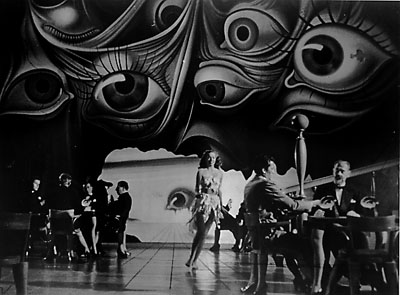
Some of Salvador Dali's design for SPELLBOUND's dream sequence.
SPELLBOUND (1945) has psychiatrist Ingrid Bergman becoming infatuated with the incoming chief of the posh institution where she work. Dr. Edwardes (Gregory Peck) is handsome and suave, but also has some eccentricities, and it's not long before she figures out that he's not really Dr. Edwardes...but he has no real idea of who he is. The puzzle of his real identity leads them to the discovery of a murder...

It's a good thriller, and loaded up with a lot of psychoanalytic content. Everything depends on psychology in Ben Hecht's script. It's also technically interesting; there's a weird, memorable score by Miklos Rozsa, and many experimental visuals, including the final confrontation where we see from the murderer's viewpoint the hand holding the gun, and the final explosion into color.

I don't think he needs help changing a tire...

Of course, the BIG deal is the dream sequence designed by Salvador Dali, where many clues to the murder are coded in bizarre imagery. It's arresting and unforgettable, worth the price of admission alone.


Next was THE PARADINE CASE (1947), a film not often seen, and there's reason why. It's a mess. Sexy Alida Valli is arrested for the off-screen murder of her blind war-hero husband. She hires top British barrister Gregory Peck (yes, that's right, Gregory Peck as a Brit, barely attempting an accent), who is married to perky Ann Todd but finds himself falling for Valli. And then he develops a defense for trying to pin the murder on the husband's devoted valet, played by a young Louis Jourdan...

OK, it's obvious the leads are miscast, except for Todd, who does quite a good job as the faithful yet confused wife. Joan Tetzel is also quite good as Todd's best friend, the daughter of one of Peck's associates. There's also good supporting turns by Charles Coburn as Tetzel's father, Charles Laughton as a wisecracking judge, and Ethel Barrymore as his beleaguered, ignored wife. Hitch had wanted Greta Garbo for the Valli role, Laurence Olivier or Ronald Coleman for the Peck role, and Robert Newton for the Jourdan role, but producer David O. Selznick interfered with production left and right, rewriting the script and recutting the movie and insisting on his "discoveries" being featured.

Sadly, the finished product has all sorts of story problems and ends up being fairly dull. I dozed a few times in the theater, a rarity for me.

Most recently was 1946's NOTORIOUS, featuring the memorable pairing of Ingrid Bergman and Cary Grant. Bergman is the daughter of a convicted Nazi criminal, and there's very discreet hints that she's known as a promiscuous, hard-drinking party girl. (Almost too discreet!) Federal agent Grant coaxes her into being a spy for Uncle Sam, taking her to Rio de Janeiro where she's to meet and romance another Nazi, Claude Rains. In order to get secrets from him, she ends up marrying him, causing trouble with her budding romance with Grant, but later stumbles on a big secret...

NOTORIOUS is a slick, well-made film, moving quickly and with good performances by the cast. Bergman is especially radiant as tramp making good, then finding herself in over her head. It's also interesting for an early glimpse of a destructive mother/son dynamic (seen in various spots in Hitch's work), as Rains' Nazi isn't half as evil and venomous as his manipulative mother (Leopoldine Konstantin), who very much seems to be the real brains of the outfit. The ending is a bit vague, but we're given enough clues to know what's going to happen, and there's enough finality that much else isn't needed. Still, Bergman and Grant are a great team (they reunited 12 years later for the sophisticated Stanley Donen comedy INDISCREET, which I suddenly want to see again), Rains and the rest of the supporting cast are good, and it's well-paced, and a suspense essential.

More on the way...

Judge Dee: THE CHINESE LAKE MURDERS

It's 666 CE (or AD, depending on your viewpoint), and Judge Dee has been assigned to a new post, as magistrate of Han-Yuan, a city in the mountains on the shore of a lake, without walls but close to the Capitol. Dee is unsure of being in a city without walls, but so far things seem quiet enough.

Until the city's leading citizens honor him with a banquet on a flower boat (a sort of floating restaurant/brothel), and the beautiful dancer Almond Blossom grasps a chance to whisper to Dee that she must speak to him later, and that a dangerous conspiracy was being plotted in that town. But before she can give Dee any information, she is drowned in the lake...

And then we're thrown into another full-blooded mystery/adventure with Dee and his retinue. Again, it's three cases, all connected in some way. "The Case of the Drowned Courtesan" is central; who killed Almond Blossom? Who could have overheard her whispering to Dee? And exactly what is the dangerous conspiracy? In "The Case of the Vanished Bride," a young bride is found dead the morning after her wedding, apparently from hemorrhage after having her hymen broken (rare, but as far as I can tell, not unheard of). Both are children of prominent citizens, and the kerfuffle is made worse when her coffin is opened at the Buddhist temple and is found to contain an unidentified man! And the groom? He vanished as well. Where are they? Finally, "The Case of the Spendthrift Councilor" centers on a former Imperial Councilor living in retirement in the city. He's quite old, seemingly becoming senile, but is also engaging in strange business deals where he's selling off lots of property at a loss. What's going on?

Also, there's something you find in a few of van Gulik's other works, a framing story involving the supernatural. In this case, an official who's involved in a fiendish conspiracy, and plagued with uncontrollable incestuous desires for his own daughter, goes to Han-Yuan and meets a beautiful courtesan who seems to be the answer to his problems...until she tells him a story that forms the story's narrative. Then she becomes a drowned corpse, and her spirit forces him to write everything down before his life ends. It's chilling. (And all of that is in the first chapter, so it's not much of a spoiler.)

Dee's retinue becomes complete in this novel; about halfway through, during an inspection tour of outlying villages, he and his assistants meet an itinerant swindler, Tao Gan, and save him from a pack of angry villagers. Out of gratitude, Tao reforms and pledges his loyalty to Dee, and plays an important role in resolving the mystery.

There's fights, plots, counterplots, passion, secret doors, hidden tunnels, crooked monks, and hints of fearsome supernatural creatures living in the lake. It all ends well, of course, although Dee barely escapes with his job and/or life.

This has always one of my favorite Dee novels; the setting is well-drawn and atmospheric, from the lake to the "Willow Quarter" where the brothels are, to the tribunal and the huge mansions where the wealthy live. And the menace that hangs over all of them.

Required reading, of course.

Sunday, May 29, 2011

Lillian de la Torre's Sam: Johnson Stories, Part Four


Let us return for one last time to England of the 1700s. The Exploits of Dr. Sam: Johnson, Detector is the fourth and last volume of stories dedicated to the adventures of the famous lexicographer, and while it's not up to the literary standards of the first volume, it's still got a lot of fun material and is a crackling good read.

So, case by case...

"The Kidnapp'd Earl" has Johnson brought in to aid young James Ansley, the heir to an earldom who was kidnapped and sold into indentured servitude so that a wicked uncle could claim the title. There's a wild trial, and finally proof of the heir's legitimacy via a wax figure of his grandfather. Not a very thrilling story, but the story it's based on, that of James Annesley, is stranger even than the story. James was really kidnapp'd by a wicked uncle, but never got to reclaim his title, as both he and his children died young leaving Uncle Richard the heir to the title. The case is also in Smollet's Peregrine Pickle and Scott's Guy Mannering, and is said to have partially inspired Robert Louis Stevenson's Kidnapped.

In "The Westcombe Witch," set in September of 1768, are in the south of England and end up encountering the rake Sir Francis Flashwood and his delicious daughter Fanny. Francis is said to have Black Masses in his strange estate, and Boswell, in search of a thrill, goes to join them one night and ends up in a bizarre situation. Johnson figures out that there's something else going on, though. Obviously, this is a fictionalized portrait of Sir Francis Dashwood and his Hell-Fire Club, but so heavily so that names had to be changed.

Looking less Satanic then like a jovial frat boy.

May of 1776 is the setting of "The Banquo Trap," where Boswell and Johnson are attending a performance of "Macbeth" starring their old friend David Garrick, who's gearing up for retirement and redoing his great roles one last time. However, in the middle of the performance, the actor playing Banquo's ghost turns up at the table gasping and dying. Johnson and Boswell dash backstage and delve into the stagecraft and interpersonal politics to find out who was responsible, and why. This story re-creates the theater milieu of the day, as well as a real performance of the play (unmarred by murder).

Also set in 1776, December this time, "The Spirit of the '76" is an entertaining what-if tale with Johnson being called in to aid with the kidnapping of a child...only it turns out that the child is the grandson of Benjamin Franklin, who was blown off-course on his way to France and is taking advantage of the situation to get hold of some gold and see an old friend. The meeting of the two is precious; although they shared many beliefs, such as the abolition of slavery, Johnson held the American colonists in contempt (once publishing a tract called "Taxation No Tyranny") and felt the Revolution was pointless. It all ends happily, with a guest appearance by Sir Francis Flashwood and a grudging acceptance that the Brits will have their hands full with "the spirit of the '76."

Love this grandiose portrait of Franklin...

"The Virtuosi Venus" is set in May of 1778, and concerns Johnson and Boswell attending a meeting of a society of art appreciators (including Sir Francis Flashwood again), only to discover that their mascot, a figurine of Venus discovered at Pompeii, has been stolen and replaced with a clever fake. Who took it? Whence came the fake? Where's the real one? Why did they do it? It's all uncovered by Johnson in an enjoyable plot. The Virtuosi are a fictional riff on the real-life Society of Dilettanti, and the Venus was not part of their treasures, but was inspired by a painting of the real Dashwood...


By Hogarth, this portrait of Dashwood parodies pious Renaissance paintings; the "Bible" is really an erotic novel and the image in the "halo" is of Dashwood's friend Lord Sandwich. The little Venus in the portrait inspired the story.
The last two stories are a sort of Omega and Alpha. "The Aerostatick Globe," set shortly before Johnson's death in 1784, which is an adventure about the competition to be the first person to fly a balloon in England. It quotes real dialogue about the possibility of airmail and military applications of flight (those folks back then were pretty sharp), and attempts to sabotage the efforts of Vincenzo Lunardi, a celebrated aeronaut of the time. It's all good fun but also fairly wistful, as the shadow of Johnson's declining health and coming death hang over it...but he did live to see the skies of Britain conquered.

The very last, "Coronation Story," takes place at the coronation of George III, on Sept. 22 of 1761, and has Boswell looking on in the company of a burly man whom he doesn't know but feels a certain kinship with. Another man sitting nearby excites some interest in the pair, and they realize it's the Young Pretender himself, come to observe, and can't help himself but disrupt the ceremony (which includes lots of real details like a stubborn horse and a huge diamond dropping out of the crown, which was said to be an omen of a great loss to the Empire). So the little group goes on the run to help the Pretender escape to France and stay a step ahead of the guards. In order that the secret be kept, they "part as strangers." Boswell and Johnson didn't meet for real until 1763.

This story is a cute bit of speculation, but has problems. We're expected to swallow that the two friends spend their lives pretending this little meeting never happened, and it also violates the continuity of the previous stories, because in "Prince Charlie's Ruby" from the first book, they are utterly thrilled to meet the Young Pretender...and there's no reason for the three of them to pretend it never happened.

Oh well, it's the last one of the series. The back of the paperback vaguely promises a fifth volume, but it never came to be. De la Torre was supposedly working on new things when she died in 1993, but as far as I know nobody's stepped up to complete them. Unfortunately, these four books are all that can be found these days of her oeuvre; her other works, like Elizabeth is Missing (an analysis of the Elizabeth Canning case), are hard to find. Grab 'em if you find 'em!