OK, I haven't been a very good correspondent. I'm trying to get caught up now and here's a few things I've read lately....
The second volume of her Henry and Emmy Tibbett series, Down Among the Dead Men is a solid if unremarkable mystery novel. Henry and Emmy are on holiday again, visiting some friends for a sailing vacation in the seaside hamlet of Berrybridge Haven. They get involved with the local weekend sailing community, get to know the locals, and hear a tale of a somewhat mysterious death that happened some time ago. But then there's some tensions, some strangeness, and another murder. Who did it, and why? It all wraps up nicely, if a bit sadly; it's a tale of a somewhat minor crime that snowballed into some bigger ones. It's a pleasant read, with well-drawn characters, a good plot, and a setting that reminded me of some of the waterside towns on the Chesapeake that I've visited. You can always count on Patricia Moyes.
Now THIS is a classic. Cornell Woolrich's The Bride Wore Black is simply amazing. A beautiful woman works her way into the lives of a series of men, and kills them all in various ways. It's sheer noir delerium, one of the great examples of dark pulp noir fiction out there. It inspired a Francois Truffaut film, starring Jeanne Moreau...but if you like the movie, prepare yourself, because the movie makes a substantial change to the story, changing the nature of the crime that started her spree, and a devastating final twist is cut that changed everything. I had read the novel first and found the movie disappointing....but I have friends who saw the movie first and found the book a disappointment, so your actual mileage may vary. I find the book superior and I'm glad I've managed to hang on to it all these years....I first read it as a high-school student back in the 80s, and I was pleasantly surprised to see I still had it when I moved.
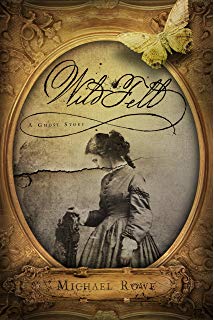
Michael Rowe's Wild Fell was simply infuriating for me. Parts of it are excellent, as it describes the narrator's boyhood and experiences that led to him buying an old house on an island on a lake in Canada. It goes fairly leisurely for a while, but I didn't mind, as there were hints of menace in the story and in a prelude about the house...but then in the last chapter everything seems cranked up to 11 and revelations come so rapidly that it's hard to keep track, and it's unclear if we're supposed to take them as literal truth or just lies. It reads as if the author had come to his page limit and had to wrap everything up in a hurry. If it had simply been bad, I could have wiped my hands and walked away, but in this case, Rowe has genuine grace as a stylist...but I felt his plotting needed work. A lot of work.
So, that brings me a few steps closer to being up to date...more to come....
Showing posts with label Patricia Moyes. Show all posts
Monday, January 21, 2019
Sunday, April 30, 2017
Two in the Mountains
Recently, I read two books back-to-back with somewhat similar settings, so I thought, why not review them together?
Dead Men Don't Ski is the first novel by Patricia Moyes, who started it while down with a broken leg (after a ski accident). Published in 1959, it's redolent of the kind of travel and lifestyle available to Britons abroad in the 1950s.
Scotland Yard Inspector Henry Tibbett is going on a ski holiday with his beloved wife Emmy, to the (fictitious) town of Santa Chiara in the Italian Alps. However, it's a working holiday; there's something suspicious going on at the place they'll be staying, and Henry's asked to keep an eye open for clues. The Albergo Bella Vista is indeed full of odd characters, but when the loathsome Hauser boards the ski lift (the only way to the hotel) at bottom a living man, and is dead when he reaches the top, the mystery kicks into full gear.
Everyone staying in the hotel has a secret...there's the Bright Young Things fresh from London, and the dour German family of Hauser's fiancee, and the stodgy British couple, and the glamorous Austrian baroness, and the dashing ski instructor. Everything moves at just the right pace, with descriptions of the town and the life people are leading done in great detail. The first couple of chapters detail the journey from London (train to Dover, a crossing over the channel, an overnight train to Innsbruck, a change to a local train to Chiusa, and then a local skier's special to Santa Chiara), and the hotel and townspeople depicted in loving detail. One is very conscious that this is just after WWII and it's still lingering in people's minds.
The conclusion is satisfying and enjoyable, and along the way there's good detective work (by both Henry and Emmy, who are an effective team) and some good characterizations. I found myself liking Colonel Buckfast, the male half of the stodgy British couple, and feeling compassion for him. But nearly everyone is likable here, and you enjoy the time spent.
This launched a long-running series that kept going until the late 80s, and I have them all...
Murder on the Matterhorn, published in 1951, is the second in a series of mountain-climbing-themed mysteries by Glyn Carr, featuring as detective a Shakespearean actor named Ambercromie Lewker, known as "Filthy" to his friends. (Get it? Filthy Lewker? Yeah, it's a bit too cute. Bear with me.) Lewker is off to Zermatt to spend a climbing holiday on the Matterhorn, and while there meets Leon Jacot, a former Resistance leader, now a wealthy sportsman who's going into politics. There's tensions and a death threat sent to Jacot, seemingly from an anti-communist activist group. (Jacot may be leaning toward Communism, which alarms some.) But then Jacot turns up dead one morning, seemingly after attempting an ill-advised solo climb up the Matterhorn in less-than-ideal conditions. Lewker, however, spots the body's condition and clues that he was suffocated, not killed in a fall, and investigates. Who is responsible? Were his political ambitions to blame?
Carr's knack for characterization is sometimes a bit lacking, but he knows his mountain climbing. (His real name was Showell Styles, and he was an accomplished climber.) His descriptions of climbing are his strength, and the plot holds up well. He does a decent job of describing Zermatt and the Swiss ambience, but he's not Patricia Moyes in that regard. (I love books with a good sense of place, and that's always a factor when I review books. Don't set a book in Hong Kong or Prague when you don't go out in the environment at all, and it might as well be Cleveland.)
It's also interesting to get into that early 50s mindset of anti-Communist paranoia, which was also a factor in his previous book, Death on Milestone Buttress.
It's not up to Moyes, who was a real wordsmith, but it's still enjoyable, and I'll probably read more in the series as I can find them....
Subscribe to:
Posts (Atom)