OK, I've been busy and distracted lately, but in a good way: I start a new job tomorrow! It came just in time; my unemployment ran out (you get six months here in Maryland) and what money I had was on the verge of running out, so if I didn't land a job when I did I'd be moving in with my mother and updating this blog from the local library. (She doesn't have internet.)
I won't go into detail about the new job but it's with a local stable company, involves research, is a temp-to-hire position through a famous temp company, but if they like me after about six months I'll be brought on permanently. The pay is less than I had been making but is right at the low end of what I'd prefer. (Considering everything else I'd been interviewing for was below that mark, sometimes significantly below, I think I'm lucky.)
So...what have I been reading lately?
Some of H. C. Bailey's works about Reggie Fortune are available as ebooks and I read the first one, after sampling some excellent tales. These are fun traditional mysteries from 1920, and while sometimes Reggie seems a bit too much like Lord Peter Wimsey (whom some simply can't stand), the stories tend to the darker than Wimsey's and could deal with intense obsessions, corruption, miscarriages of justice, and child abuse. The stories in this particular collection are a bit lighter in tone than some of later ones, but Bailey's elegant and sophisticated style are a joy to read and the mysteries can be genuinely nasty...although one is a bit comical. They do give an "origin story" as the first tale, "The Archduke's Tea," features Fortune accidentally embroiled in a mystery, with the police (and he himself) being surprised as his acumen in solving the case, leading him to be called in on others as the volume progresses. I can't wait to dip into more Fortune; this is damn good stuff.
Well, this is lurid, isn't it? This is the first in a series of collections of pulp tales by Paul Chadwick, about the adventures of reporter Wade Hammond, who becomes embroiled in some startling mysteries. The first story, "Murder in the Mist," is shockingly mundane, but the third story, "The Murder Monster," which the cover illustrates, is sheer pulp madness. There's a mad criminal called the Tarantula, a mesmeric mastermind, and a bizarre plot involving making people see skeletons. My favorite story, "Doctor Zero," had a mastermind using weird purple lights as murder weapons. This is good pulpy fun, as published in the magazines "Detective Dragnet" and "Ten Detective Aces" between 1931 and 1935.
Elizabeth Daly had been a big deal in the 40s, with Agatha Christie naming her as her favorite mystery author. This is her first book....and I wasn't thrilled. It actually took me three tries to read it, and when I finally did, I had the plot figured out easily. Henry Gamage (Daly's detective, a rare book expert) is vacationing at a seaside resort in Maine when an alarming death occurs, as a frail, ill man seemingly falls from a cliff. However, there's evidence that it might not have been an accident, and the death occurs literally hours after he inherited a fortune. There's a lot of meandering around a local theater company and a golf game, but I found it confusing and hard to follow, and the final revelation not much of a shock. I was very disappointed in this book but I have heard some very good things about her other novels, so I'll probably give her another try at some point.
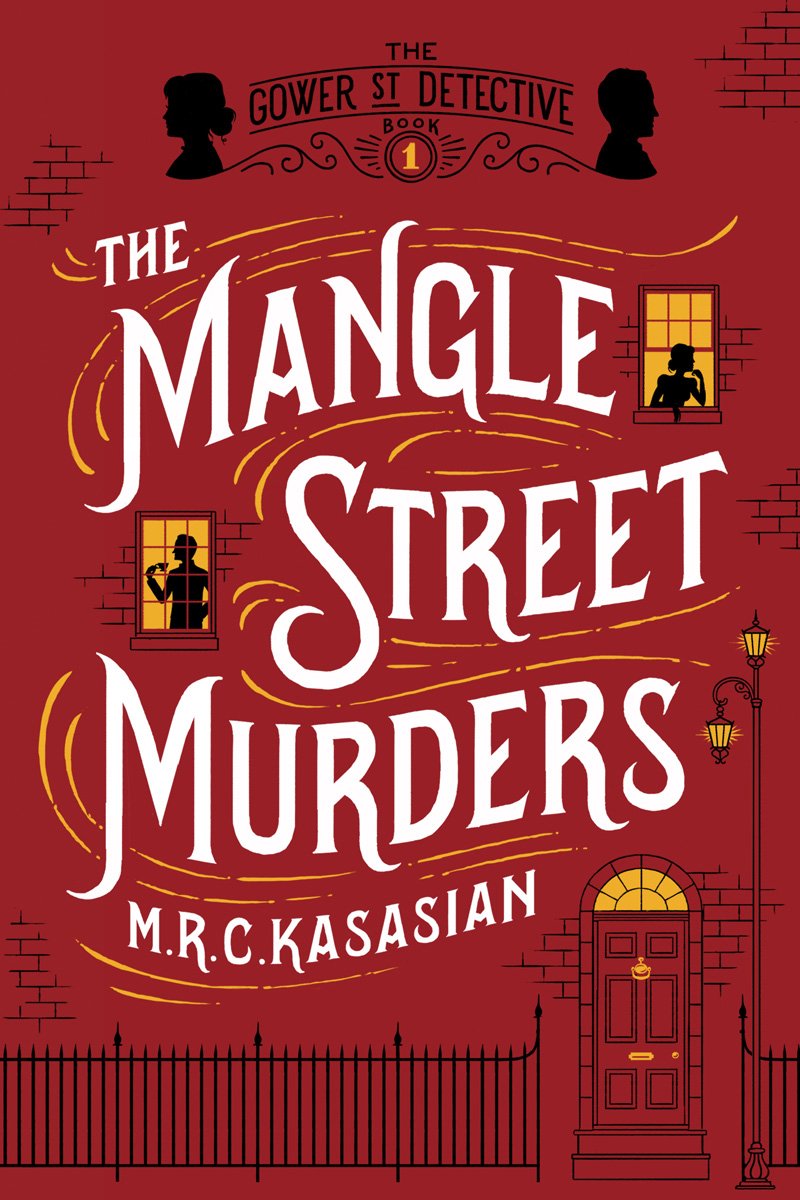
The first in a new series and while it was well-structured and well-written, I was rather annoyed with it as it's yet another one of those books set in Victorian times but with the characters not acting all that Victorian. Really, it seems to be endemic among those who write historical fiction these days to make their physical milieu well-researched and period-accurate but their character's attitudes and behaviors to be perfectly modern. But I digress...March Middleton, newly orphaned, goes to London to live with her new guardian, detective Sidney Grice, who is a flamboyant and well-known figure in the papers. Middleton finally convinces him to allow her to assist on a case, a seemingly sordid one involving a murder in a sleazy junk shop, but it ends up leading into rather strange Victorian noir territory. Not bad, but there were aspects of it I wasn't crazy about. Unsure if I'll continue down this road...
Well, there's some more, but that's enough for now. I need to get to bed and be ready for my first day of work tomorrow....
Showing posts with label historical mystery novels. Show all posts
Sunday, March 5, 2017
Saturday, November 12, 2016
THE TRUTH OF ALL THINGS by Kieran Shields
This was a random library find, and a good one.
It's Portland, Maine, in 1892. Deputy Marshall Archie Lean is called in when a grotesque murder takes place; a prostitute has been found gruesomely stabbed with a pitchfork through her throat and a bloody cross cut into her torso. Bizarre findings around the body point to some sort of ritual, and criminalist Perceval Grey, who is part Native American, is called in to look at the crime scene. He and Grey get along well and team up to find the killer.
This was a pleasant surprise, as the plot is steeped in the Salem Witch Trials, The murderer is obviously attempting some sort of black magic here, but what? The involves fortune tellers and spiritualists, and a medium who does seem to have real powers. Even though I'm a hard-nosed skeptic, I did enjoy how the story straddled the line between the mundane and the mystical.
The addition of supernatural gothic elements to a historical procedural mystery were very entertaining. The characters were also fun; Archie Lean is a father-to-be, rather old-fashioned, but with a sense of humor and of what's wrong and right. Perceval Grey is all science, young, exotic, and sometimes an exasperating stick-in-the-mud. There is a somewhat contrived romance that does take away from the story, but only in a very minor way.
There's a sequel I want to get to, but it seems the Lean and Grey series ended there; I saw a note on the author's page that his publisher had declined on a further story. Let's hope he find some one else to publish it, because I think Shields is on to something here.
It's Portland, Maine, in 1892. Deputy Marshall Archie Lean is called in when a grotesque murder takes place; a prostitute has been found gruesomely stabbed with a pitchfork through her throat and a bloody cross cut into her torso. Bizarre findings around the body point to some sort of ritual, and criminalist Perceval Grey, who is part Native American, is called in to look at the crime scene. He and Grey get along well and team up to find the killer.
This was a pleasant surprise, as the plot is steeped in the Salem Witch Trials, The murderer is obviously attempting some sort of black magic here, but what? The involves fortune tellers and spiritualists, and a medium who does seem to have real powers. Even though I'm a hard-nosed skeptic, I did enjoy how the story straddled the line between the mundane and the mystical.
The addition of supernatural gothic elements to a historical procedural mystery were very entertaining. The characters were also fun; Archie Lean is a father-to-be, rather old-fashioned, but with a sense of humor and of what's wrong and right. Perceval Grey is all science, young, exotic, and sometimes an exasperating stick-in-the-mud. There is a somewhat contrived romance that does take away from the story, but only in a very minor way.
There's a sequel I want to get to, but it seems the Lean and Grey series ended there; I saw a note on the author's page that his publisher had declined on a further story. Let's hope he find some one else to publish it, because I think Shields is on to something here.
Saturday, June 25, 2016
BAUDELAIRE'S REVENGE by Bob van Laerhoven
This was a random find at the library, but I found it enjoyable.
It's 1870. Paris is in turmoil, with the Franco-Prussian War and the populace's attempts to distract themselves from what seems like inevitable doom. Commissioner Lefevre, a lover of poetry and carnal pleasures, investigates a gruesome murder in a brothel, and finds the killer has left behind a note...which is a quote from Baudelaire, and seemingly in the poet's handwriting. But the poet has been dead for three years! Has he risen from the grave?
More murders ensue, with some gruesome mutilations as well. What is the point? What is the goal of the murderer? There's lots of historical detail here, and we also start seeing things from the killer's point of view, but it's obvious it's an unreliable narrator here, and it's not until the end that we know what their motivation is, and the nature of their secrets.
It's not bad at all, but it has its weaknesses. From the start I knew a certain character was going to be more than they seemed and would be a traitor. Author van Laerhoven seems to push certain ideas and concepts almost too much. The sexual content is somewhat explicit and often quite perverse. (Even from my jaded viewpoint, it was a bit much.) There's occasional blips of racism but they're always in the context of a first-person narrative so they can be forgiven for being the viewpoint of a person of the time...and a bad person at that.
The big problem for me was that it was a bit too reminiscent of another work I'd read years ago, that involved a similar plot device with another famous author. (NEVERMORE, by Harold Schechter, if you must know.) I'm sure it was a coincidence but it was a bit of a letdown.
Still, it's Paris, it's decadent, and it's got an appealing character in Commissioner Lefevre, and I almost wish van Laerhoven would bring him back. We'll see about that.
It's 1870. Paris is in turmoil, with the Franco-Prussian War and the populace's attempts to distract themselves from what seems like inevitable doom. Commissioner Lefevre, a lover of poetry and carnal pleasures, investigates a gruesome murder in a brothel, and finds the killer has left behind a note...which is a quote from Baudelaire, and seemingly in the poet's handwriting. But the poet has been dead for three years! Has he risen from the grave?
More murders ensue, with some gruesome mutilations as well. What is the point? What is the goal of the murderer? There's lots of historical detail here, and we also start seeing things from the killer's point of view, but it's obvious it's an unreliable narrator here, and it's not until the end that we know what their motivation is, and the nature of their secrets.
It's not bad at all, but it has its weaknesses. From the start I knew a certain character was going to be more than they seemed and would be a traitor. Author van Laerhoven seems to push certain ideas and concepts almost too much. The sexual content is somewhat explicit and often quite perverse. (Even from my jaded viewpoint, it was a bit much.) There's occasional blips of racism but they're always in the context of a first-person narrative so they can be forgiven for being the viewpoint of a person of the time...and a bad person at that.
The big problem for me was that it was a bit too reminiscent of another work I'd read years ago, that involved a similar plot device with another famous author. (NEVERMORE, by Harold Schechter, if you must know.) I'm sure it was a coincidence but it was a bit of a letdown.
Still, it's Paris, it's decadent, and it's got an appealing character in Commissioner Lefevre, and I almost wish van Laerhoven would bring him back. We'll see about that.
Labels:
decadence,
detective fiction,
historical mystery novels,
Paris
Sunday, January 26, 2014
A Couple of Recent Reads
Getting some reading done lately...and here's two samples from the bookshelf.
I came across Frank Tallis' A Death in Vienna in the local library and was intrigued. It's first in a series set in Vienna of the early 1900s, a setting I've always found fascinating. And it didn't disappoint.
Max Liebermann is a psychologist, a student of Freud, and something of a maverick in his focus on talk therapy for patients rather than crude electrotherapy or other discredited treatments. He's friends with Oskar Rheinhardt, a police detective, who calls his friend in to help him when a young medium is found dead. She's posed as if it were a suicide, and shot in the chest...but there's no bullet. And the room is locked from the inside. It's a classic locked-room mystery with a twist in the setting and characters. Which of the medium's regular clients could be responsible?
Lots of cool atmosphere here, and the descriptions of Old Vienna are fun. Oskar applies the latest police methods, and Max applies the latest psychological ideas, and are a great team. The story is great classic detection; the medium is revealed as a fraud, and they dip into the issues of fake mediums of the era. And there's echoes of the quiet firm step of the Nazi party coming down the line, with some characters being openly anti-Semitic. We get a lot of the character's inner lives, with Oskar coping with his anniversary, and Max getting engaged...but by the end appears to be having second thoughts.
My only complaint is that I wish we knew more about how the two became friends...but maybe that comes in a later book. This is a series I definitely want to read more of...this one left me craving strudel and Strauss, so maybe I can whip up some treats and play some waltzes next time I dip into it.
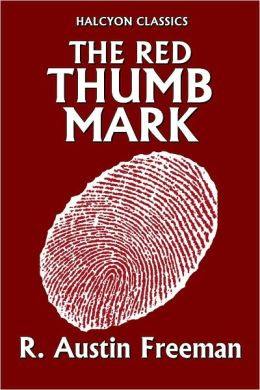
The Red Thumb Mark (1907) is R. Austin Freeman's first novel, and the work that introduced pioneering medical detective John Thorndyke. It spends a bit of time establishing characters, and is inevitably narrated by Thorndyke's Watson, Dr. Jervis. Thorndyke was a very new type of character, really. He used his medical knowledge and all the latest knowledge, and was also written with style and verve. Thorndyke was also a very handsome man; R. Austin Freeman's way of thumbing his nose at the then-current literary habit of having heroes and detectives being unattractive or even rather ugly. (Sapper's Bulldog Drummond was described in the books as a fairly ugly man, although he was played by the dashing Ronald Coleman in film.)
Young Reuben Hornby has been accused of theft form his uncle's gold and silver business; most damning is a bloody thumbprint that is unmistakably Hornby's, even though he claims innocence. It's up to Thorndyke and Jervis to figure out how it happened, and find evidence that the thumbprint is faked....and how?
There are debits in this novel, partly because the crime itself is a bit dull, and really, this is something that could be a longish short story and sometimes feels padded. Problems with plotting aside, it's well-written and with good characterizations, and the final courtroom confrontation, when it's revealed how the thumbprint was faked, is exciting and excellent reading. I definitely want to read more of these.
More coming up....
I came across Frank Tallis' A Death in Vienna in the local library and was intrigued. It's first in a series set in Vienna of the early 1900s, a setting I've always found fascinating. And it didn't disappoint.
Max Liebermann is a psychologist, a student of Freud, and something of a maverick in his focus on talk therapy for patients rather than crude electrotherapy or other discredited treatments. He's friends with Oskar Rheinhardt, a police detective, who calls his friend in to help him when a young medium is found dead. She's posed as if it were a suicide, and shot in the chest...but there's no bullet. And the room is locked from the inside. It's a classic locked-room mystery with a twist in the setting and characters. Which of the medium's regular clients could be responsible?
Lots of cool atmosphere here, and the descriptions of Old Vienna are fun. Oskar applies the latest police methods, and Max applies the latest psychological ideas, and are a great team. The story is great classic detection; the medium is revealed as a fraud, and they dip into the issues of fake mediums of the era. And there's echoes of the quiet firm step of the Nazi party coming down the line, with some characters being openly anti-Semitic. We get a lot of the character's inner lives, with Oskar coping with his anniversary, and Max getting engaged...but by the end appears to be having second thoughts.
My only complaint is that I wish we knew more about how the two became friends...but maybe that comes in a later book. This is a series I definitely want to read more of...this one left me craving strudel and Strauss, so maybe I can whip up some treats and play some waltzes next time I dip into it.
The Red Thumb Mark (1907) is R. Austin Freeman's first novel, and the work that introduced pioneering medical detective John Thorndyke. It spends a bit of time establishing characters, and is inevitably narrated by Thorndyke's Watson, Dr. Jervis. Thorndyke was a very new type of character, really. He used his medical knowledge and all the latest knowledge, and was also written with style and verve. Thorndyke was also a very handsome man; R. Austin Freeman's way of thumbing his nose at the then-current literary habit of having heroes and detectives being unattractive or even rather ugly. (Sapper's Bulldog Drummond was described in the books as a fairly ugly man, although he was played by the dashing Ronald Coleman in film.)
Young Reuben Hornby has been accused of theft form his uncle's gold and silver business; most damning is a bloody thumbprint that is unmistakably Hornby's, even though he claims innocence. It's up to Thorndyke and Jervis to figure out how it happened, and find evidence that the thumbprint is faked....and how?
There are debits in this novel, partly because the crime itself is a bit dull, and really, this is something that could be a longish short story and sometimes feels padded. Problems with plotting aside, it's well-written and with good characterizations, and the final courtroom confrontation, when it's revealed how the thumbprint was faked, is exciting and excellent reading. I definitely want to read more of these.
More coming up....
Saturday, September 15, 2012
Judge Dee: THE WILLOW PATTERN
In The Willow Pattern, Judge Dee is President of the Metropolitan Court, but also has been appointed emergency governor of the capitol city during a drought and plague. He's trying to maintain order and discipline in the city while it's half-deserted (the Emperor and many of the wealthy have left town), and naturally some interesting crimes rise up calling for his attention.
In "The Case of the Steep Staircase," a wealthy philanthropist is found dead after apparently falling down the stairs. But is it all that it seems? In "The Case of the Willow Pattern," a nobleman is found brutally murdered, the only clues being his sadistic, predatory habits, and a smashed vase in the now-familiar willow pattern. "The Case of the Murdered Bondmaid" is a retroactive case; a servant woman was beaten to death a generation ago; how is her death still influencing people today?
Dee is assisted by his lieutenants Ma Joong, Chiao Tai, and Tao Gan, since Hoong Liang was killed in the last book, The Chinese Nail Murders. Dee is much more The Man now; he is Imperial Authority in the city and is not to be questioned or messed with at all. And much of the action takes place in the milieu of the city's "old world," that of decadent noble families with pedigrees that predate the current dynasty...and all the sins that go with it. It's also notable for being the only Dee novel set in the oft-referenced capitol city. (Which is never named, by the way.)
It all ends well, except for one murder that Dee decides to not pursue, stating that he doesn't mind having a few unsolved cases on his record! Ma Joong falls in love and disappears from the series; we find out in the next (and last) book that he's married now. Still, it's a solid, good later work from van Gulik, and worth reading.
Coming soon: the final Dee novel, Murder in Canton.
In "The Case of the Steep Staircase," a wealthy philanthropist is found dead after apparently falling down the stairs. But is it all that it seems? In "The Case of the Willow Pattern," a nobleman is found brutally murdered, the only clues being his sadistic, predatory habits, and a smashed vase in the now-familiar willow pattern. "The Case of the Murdered Bondmaid" is a retroactive case; a servant woman was beaten to death a generation ago; how is her death still influencing people today?
Dee is assisted by his lieutenants Ma Joong, Chiao Tai, and Tao Gan, since Hoong Liang was killed in the last book, The Chinese Nail Murders. Dee is much more The Man now; he is Imperial Authority in the city and is not to be questioned or messed with at all. And much of the action takes place in the milieu of the city's "old world," that of decadent noble families with pedigrees that predate the current dynasty...and all the sins that go with it. It's also notable for being the only Dee novel set in the oft-referenced capitol city. (Which is never named, by the way.)
It all ends well, except for one murder that Dee decides to not pursue, stating that he doesn't mind having a few unsolved cases on his record! Ma Joong falls in love and disappears from the series; we find out in the next (and last) book that he's married now. Still, it's a solid, good later work from van Gulik, and worth reading.
Coming soon: the final Dee novel, Murder in Canton.
Saturday, August 11, 2012
THE DEVIL IN VELVET by John Dickson Carr
This is one of the best Carr works I've ever read. It merges his historical mystery milieu with actual supernatural content, in a fairly satisfying way.
In 1925, historian Nicholas Fenton literally makes a deal with the devil to go back in time to 1675, and inhabit the body of another Nicholas Fenton, who was involved in a murder case. Records are incomplete, and Fenton wants to know who did it and why. His friend Mary is appalled; she's a younger lady, daughter of a friend, but there's an admiration there. Satan himself shows up, cunningly described as banal and cold, with an air of nothingness around him.
When Fenton does go back, he is the older historian's mind and soul in the body of a younger man...but the younger man takes over in times of great passion or anger. Carr deals well with the time-travel elements, of how modern sensibilities are not prepared for the smells and sensations of a different era. And he also tackles the subject of Fenton's personality shifts nicely. Fenton quickly falls in love with the murder victim: Lydia, the first Fenton's wife. He identifies that she's being slowly poisoned and divines how it's done...but something seems wrong. Meanwhile, another time-traveler shows up; it's Mary, having gone back for love of him. Fenton, schooled in fencing, soon becomes a fearsome opponent in a time when swordfighting was hack-and-slash. Carr introduces Charles II, again making a case for him as a cunning master manipulator rather than the shallow "merry monarch" that he's normally known as. (Carr also explored this in the excellent Most Secret.) Fenton is soon caught in a morass, torn between two women, hip-deep in political plotting, and simply trying to survive when Old Nick shows up again, and Fenton must find a way out of the contract. Meanwhile, murder is done, and Fenton must seek the answer to save his own life.
It's a rip-roaring read, and with some genuine surprises. The final solution to the mystery was a real shock for me, but it made absolute sense. I loved the introduction of another time-traveler, something you rarely get in time-travel stories. The supernatural elements are well handled; Satan is given both charm and repellence, and there's hints of the Other Power making Its presence known in the character's lives as well.
The Devil in Velvet was published in 1951 and is disgracefully out of print (other Carr works are available here and there, even in Kindle versions). But for it's combination of mystery, history, and supernatural terrors, this is a must and well worth seeking in your local used book emporium. Good luck!
In 1925, historian Nicholas Fenton literally makes a deal with the devil to go back in time to 1675, and inhabit the body of another Nicholas Fenton, who was involved in a murder case. Records are incomplete, and Fenton wants to know who did it and why. His friend Mary is appalled; she's a younger lady, daughter of a friend, but there's an admiration there. Satan himself shows up, cunningly described as banal and cold, with an air of nothingness around him.
When Fenton does go back, he is the older historian's mind and soul in the body of a younger man...but the younger man takes over in times of great passion or anger. Carr deals well with the time-travel elements, of how modern sensibilities are not prepared for the smells and sensations of a different era. And he also tackles the subject of Fenton's personality shifts nicely. Fenton quickly falls in love with the murder victim: Lydia, the first Fenton's wife. He identifies that she's being slowly poisoned and divines how it's done...but something seems wrong. Meanwhile, another time-traveler shows up; it's Mary, having gone back for love of him. Fenton, schooled in fencing, soon becomes a fearsome opponent in a time when swordfighting was hack-and-slash. Carr introduces Charles II, again making a case for him as a cunning master manipulator rather than the shallow "merry monarch" that he's normally known as. (Carr also explored this in the excellent Most Secret.) Fenton is soon caught in a morass, torn between two women, hip-deep in political plotting, and simply trying to survive when Old Nick shows up again, and Fenton must find a way out of the contract. Meanwhile, murder is done, and Fenton must seek the answer to save his own life.
It's a rip-roaring read, and with some genuine surprises. The final solution to the mystery was a real shock for me, but it made absolute sense. I loved the introduction of another time-traveler, something you rarely get in time-travel stories. The supernatural elements are well handled; Satan is given both charm and repellence, and there's hints of the Other Power making Its presence known in the character's lives as well.
The Devil in Velvet was published in 1951 and is disgracefully out of print (other Carr works are available here and there, even in Kindle versions). But for it's combination of mystery, history, and supernatural terrors, this is a must and well worth seeking in your local used book emporium. Good luck!
Monday, May 14, 2012
MOST SECRET by John Dickson Carr
During my Carr shopping, this was one I picked up at random, knowing nothing about, and having few expectations of. It's not the best-known of his works, rarely gets mentioned at all in articles about Carr. And that's a shame. This is a damn rip-roaring read, the best Carr novel I've ever read.
The year is 1670, and Roderick Kinsmere, known as Rowdy, is up from the country to London to collect an inheritance. He drops by to pay a call on the Duke of Buckingham, but then ends up being challenged to a duel, makes a new friend, and suddenly finds himself plunged into a web of intrigue and murder.
Most Secret isn't part of Carr's oeuvre of locked-room puzzles that he was known for. It's more of an espionage thriller with a historic setting. That said, it's a lot of fun. Carr throws in a duel, a scene in a theater (he loves his theater scenes), and even a part on the high seas with piracy thrown in.
The Restoration setting is a fun touch, and Carr takes his time getting his setting together. The first chapter or so is setting up the character of Rowdy Kinsmere and his home, and I found it rather reminiscent of Henry Fielding and Tom Jones. I wonder if Carr was thinking if Fielding with this book. I've also noticed that Carr frequently has scenes in theaters; I guess theatrical history was one of his big interests.
But the intrigue is the real star. Kinsmere has an heirloom ring that he doesn't realize has a certain significance, and is made a target because of it. And it leaves him in a position where he's taking secret papers to France at the behest of King Charles himself, but still trying to figure out who the main plotter is, and why? Rowdy and his friend Bygones Abraham know WHO is trying to kill them, but the don't know WHY or the identity of the mastermind. And that's all the fun.
Most Secret is a bit on the dense side; it took me a while to read it, but I thoroughly enjoyed it more than I've enjoyed any other Carr work. Highly recommended!
The year is 1670, and Roderick Kinsmere, known as Rowdy, is up from the country to London to collect an inheritance. He drops by to pay a call on the Duke of Buckingham, but then ends up being challenged to a duel, makes a new friend, and suddenly finds himself plunged into a web of intrigue and murder.
Most Secret isn't part of Carr's oeuvre of locked-room puzzles that he was known for. It's more of an espionage thriller with a historic setting. That said, it's a lot of fun. Carr throws in a duel, a scene in a theater (he loves his theater scenes), and even a part on the high seas with piracy thrown in.
The Restoration setting is a fun touch, and Carr takes his time getting his setting together. The first chapter or so is setting up the character of Rowdy Kinsmere and his home, and I found it rather reminiscent of Henry Fielding and Tom Jones. I wonder if Carr was thinking if Fielding with this book. I've also noticed that Carr frequently has scenes in theaters; I guess theatrical history was one of his big interests.
But the intrigue is the real star. Kinsmere has an heirloom ring that he doesn't realize has a certain significance, and is made a target because of it. And it leaves him in a position where he's taking secret papers to France at the behest of King Charles himself, but still trying to figure out who the main plotter is, and why? Rowdy and his friend Bygones Abraham know WHO is trying to kill them, but the don't know WHY or the identity of the mastermind. And that's all the fun.
Most Secret is a bit on the dense side; it took me a while to read it, but I thoroughly enjoyed it more than I've enjoyed any other Carr work. Highly recommended!
Monday, May 7, 2012
Judge Dee: The Night of the Tiger
The second half of The Monkey and the Tiger takes place immediately after the events of The Chinese Nail Murders, while Dee is riding from Pei-Chow to the capitol, and going through a region struck by severe flooding. He's separated from his escort by a collapsing bridge, and then finds himself on an island created by the floods. On it are a gang of bandits called the Flying Tigers, but there's also a fortified country house. Of course, Dee takes shelter there, and ends up investigating a nasty murder.
"The Night of the Tiger" is a sort of T'ang dynasty version of one of those old-dark-house movies from the 30s, but it works well. Dee sleeps in the room of the owner's daughter, Kee-Yu, who was found dead earlier that day. Van Gulik's portrait of the girl is affecting; she's a person of breeding and taste, but also tormented by ill health and possibly morbid brooding. However, Dee discovers that not everything is as it seems, and in the end there's a nasty twist, but the forces of law and justice triumph at last.
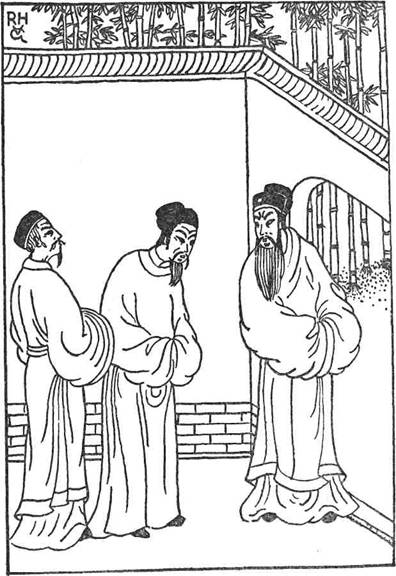
I've always been haunted by Kee-Yu; she's relatable but also sad and pathetic. I find her taste and refinement appealing, even admirable, but she also serves as a warning of too much brooding. She has a love affair that ends badly, and it's sad because she was the object of unrequited yet noble passion by one of her father's trusted aides. In the drawing class I took last summer, we were experimenting with Chinese brushes one night, and instead of doing the usual still lifes, I did this little picture of Kee-Yu, looking at the moon and mountains from her balcony.
(Yeah, I know, hardly spectacular, but I liked it. My teacher was impressed and suggested I get some brushes and experiment on my own. Haven't done that yet, but I should.)
"The Night of the Tiger" is a nice little novella with some bits that I found personally haunting. Like the rest of the Judge Dee series, this is Required Reading.
Next in the Dee series: Dee tackles affairs in the capitol in The Willow Pattern.
"The Night of the Tiger" is a sort of T'ang dynasty version of one of those old-dark-house movies from the 30s, but it works well. Dee sleeps in the room of the owner's daughter, Kee-Yu, who was found dead earlier that day. Van Gulik's portrait of the girl is affecting; she's a person of breeding and taste, but also tormented by ill health and possibly morbid brooding. However, Dee discovers that not everything is as it seems, and in the end there's a nasty twist, but the forces of law and justice triumph at last.
I've always been haunted by Kee-Yu; she's relatable but also sad and pathetic. I find her taste and refinement appealing, even admirable, but she also serves as a warning of too much brooding. She has a love affair that ends badly, and it's sad because she was the object of unrequited yet noble passion by one of her father's trusted aides. In the drawing class I took last summer, we were experimenting with Chinese brushes one night, and instead of doing the usual still lifes, I did this little picture of Kee-Yu, looking at the moon and mountains from her balcony.
(Yeah, I know, hardly spectacular, but I liked it. My teacher was impressed and suggested I get some brushes and experiment on my own. Haven't done that yet, but I should.)
"The Night of the Tiger" is a nice little novella with some bits that I found personally haunting. Like the rest of the Judge Dee series, this is Required Reading.
Next in the Dee series: Dee tackles affairs in the capitol in The Willow Pattern.
Wednesday, March 21, 2012
THE CHINESE NAIL MURDERS by Robert van Gulik
The last of the "Chinese (four-letter-word) Murders" novels of the Judge Dee series, this is also a turning point in the series. Like others in this sequence, there is a supernatural framing story; in this case, an official receives an unexpected visit from his brother, an official assigned to Pei-Chow, who tells him the story contained in the novel. He then leaves...and then next morning a messenger arrives with news of the brother's death in the faraway city.
Dee has been assigned to the desolate, barren district of Pei-Chow, in China's cold north, for only a couple of months. He and his lieutenants are discussing a recent disappearance of a young girl, when a report is made of the discovery of a woman's headless body. As the novel proceeds there is also the death of a noted martial artist from poison, who leaves a clue in the form of a tangram arrangement. Then a chance encounter has Dee looking into a seemingly natural death from five years before, sure that somehow it must have been murder. Thus we have the three mysteries of the book: "The Headless Corpse," "The Paper Cat," and "The Murdered Merchant."
The book's weak point is that it lifts almost completely whole a plot from Dee Goong An, so if you've read that you'll know, pretty much, how the murder was done and how it will end.
It does have its strengths, though. There's some great, memorable bits, especially an eerie scene with a snowman. There's a wonderfully-etched couple in the book, kindly hunchback Coroner Kuo and his beautiful and selfless wife, with whom Dee starts to fall in love. And we have the ruthless Mrs. Loo, of whom we have little doubt is guilty, but the real question is how long can she manipulate matters to her own end? And, most shockingly, is the death of Hoong Liang.
There is also real tension here. Dee's questioning of Mrs. Loo puts his career and life in danger, because if she is truly innocent, Dee's accusations of her will cause him to be executed. (Of course, considering there are more books in the series after this, it's easy to guess that he triumphs. In fact, the book ends with Dee being appointed President of the Metropolitan Court and leaving for the Capitol.)
But as with all the rest of the books in the Judge Dee series, this is Required Reading. (And my Judge Dee series is winding down; there's only a novella and two novels left for me to review...)
Dee has been assigned to the desolate, barren district of Pei-Chow, in China's cold north, for only a couple of months. He and his lieutenants are discussing a recent disappearance of a young girl, when a report is made of the discovery of a woman's headless body. As the novel proceeds there is also the death of a noted martial artist from poison, who leaves a clue in the form of a tangram arrangement. Then a chance encounter has Dee looking into a seemingly natural death from five years before, sure that somehow it must have been murder. Thus we have the three mysteries of the book: "The Headless Corpse," "The Paper Cat," and "The Murdered Merchant."
The book's weak point is that it lifts almost completely whole a plot from Dee Goong An, so if you've read that you'll know, pretty much, how the murder was done and how it will end.
It does have its strengths, though. There's some great, memorable bits, especially an eerie scene with a snowman. There's a wonderfully-etched couple in the book, kindly hunchback Coroner Kuo and his beautiful and selfless wife, with whom Dee starts to fall in love. And we have the ruthless Mrs. Loo, of whom we have little doubt is guilty, but the real question is how long can she manipulate matters to her own end? And, most shockingly, is the death of Hoong Liang.
There is also real tension here. Dee's questioning of Mrs. Loo puts his career and life in danger, because if she is truly innocent, Dee's accusations of her will cause him to be executed. (Of course, considering there are more books in the series after this, it's easy to guess that he triumphs. In fact, the book ends with Dee being appointed President of the Metropolitan Court and leaving for the Capitol.)
But as with all the rest of the books in the Judge Dee series, this is Required Reading. (And my Judge Dee series is winding down; there's only a novella and two novels left for me to review...)
Tuesday, February 7, 2012
SCANDAL AT HIGH CHIMNEYS by John Dickson Carr
Love that cover blurb: "A Modern Masterpiece of Ancient Evil." A woman screaming and running from a sinister house. Ghosts, curses, supernatural stuff, right?
My ass.
Pardon me for being vulgar, but this book cover is a total bait-and-switch, and considering this is a 1968 printing, was probably done to capitalize on the then-current craze for gothic romances. Scandal at High Chimneys is really just a standard historical mystery from Carr.
I picked it up because I'd come across a reference somewhere to it involving ghosts. Well, there's a murder with someone posing as a ghost, but hardly anybody believes for a second it's a real ghost so it's hardly mystifying.
The year is 1865. Young Clive Strickland is visiting the Damon household, proposing to Celia Damon as a favor to her brother Victor, for complex reasons. There's also sister Kate (who does not shimmy) and father Matthew Damon (who was never in Good Will Hunting). But a man's ghost is seen in the house, dressed in bizarre clothes, and suddenly the "ghost" shoots Matt between the eyes and makes a getaway. And that's about the limits of scandal.
Who was it? Unfortunately, the book meanders and is hard to follow at times. Damon has an unfaithful wife, the girls' stepmother, who also turns up dead. We get confrontations with various family members, and a visit to a music hall, and some discussions of theater, before the murder is solved.
I wasn't impressed. Maybe it was just me, but the progression of events often didn't seem logical to me, and sometimes the characters would go to some location just as an excuse for Carr to show off his research. He has postscripts discussing the theater world of the 1860s, and quite honestly I'd love to have an old-style music hall in town, but it just doesn't come together as an organic whole.
Not recommended, except perhaps for some of the commentary on Victorian theater. There's several mentions of a play, It's Never Too Late to Mend, which was made into a film featuring that master melodramaticist Tod Slaughter, which is in my collection. I'll be sure to discuss it later.
My ass.
Pardon me for being vulgar, but this book cover is a total bait-and-switch, and considering this is a 1968 printing, was probably done to capitalize on the then-current craze for gothic romances. Scandal at High Chimneys is really just a standard historical mystery from Carr.
I picked it up because I'd come across a reference somewhere to it involving ghosts. Well, there's a murder with someone posing as a ghost, but hardly anybody believes for a second it's a real ghost so it's hardly mystifying.
The year is 1865. Young Clive Strickland is visiting the Damon household, proposing to Celia Damon as a favor to her brother Victor, for complex reasons. There's also sister Kate (who does not shimmy) and father Matthew Damon (who was never in Good Will Hunting). But a man's ghost is seen in the house, dressed in bizarre clothes, and suddenly the "ghost" shoots Matt between the eyes and makes a getaway. And that's about the limits of scandal.
Who was it? Unfortunately, the book meanders and is hard to follow at times. Damon has an unfaithful wife, the girls' stepmother, who also turns up dead. We get confrontations with various family members, and a visit to a music hall, and some discussions of theater, before the murder is solved.
I wasn't impressed. Maybe it was just me, but the progression of events often didn't seem logical to me, and sometimes the characters would go to some location just as an excuse for Carr to show off his research. He has postscripts discussing the theater world of the 1860s, and quite honestly I'd love to have an old-style music hall in town, but it just doesn't come together as an organic whole.
Not recommended, except perhaps for some of the commentary on Victorian theater. There's several mentions of a play, It's Never Too Late to Mend, which was made into a film featuring that master melodramaticist Tod Slaughter, which is in my collection. I'll be sure to discuss it later.
Sunday, January 29, 2012
Judge Dee: Phantoms, Coffins, and New Year's Eve
It's 670 AD, and Dee is 40 years old and the magistrate of the desolate province of Lan-Fang. His assignment there was engineered by his enemies at court (possibly an indirect attempt at murder) but once again he conquered adversity and brought order to the town. All this was described in The Chinese Maze Murders, and here's some further adventures in that city.
In The Phantom of the Temple, Dee purchases an antique box as a birthday gift for his First Lady. However, inside it is an odd note that sounds as if someone was being held prisoner in a nearby deserted temple. Soon, we have three mysteries to solve again. A local girl is missing; could she be the source of the note in the box? What's going on with a local painter who's behaving oddly? And where are the fifty gold bars, stolen from an Imperial Treasury courier?
This is late van Gulik, published in 1966, but still good. As always, he gives us a good look at Chinese history and culture; in this case, the deserted temple was a haven of Tantric Buddhism, which apparently was not popular among Chinese officials. Also, we get the best glimpse ever of Dee's wives, and the Third Wife gets her moment in the sun, actually doing a bit of detecting work for her husband.
But it's still Dee's show, and he's definitely in charge. He's calm, resourceful, and observant as always, although we're not always given a look into his thought processes until the end of the story.
Two short stories were also set in Lan-Fang. In "The Coffins of the Emperor," Dee is visiting a neighboring district during a military crisis, as a Tartar army is getting ready to invade China. A respected general has accused a respected official of treason, and of hiding armaments in the coffin of a Crown Prince buried in a nearby tomb; can Dee figure out if it's true without actually opening the coffin and committing a high offense himself? Also, there's a case of a captain accused of murder; he claims to be innocent of strangling another officer's wife, but is he really? And who is the culprit? It's decent Dee, and remarkable in my memory for Dee's plea for clemency at the end for a gay murderer, stating that nature directed him one way, but his family forced him into another, and he couldn't cope with the results, and allowing him to commit suicide. Dee's humanity shines in that moment.
The other is a very humane story, "Murder on New Year's Eve," when Dee encounters a young boy wandering the streets, and when trying to return the boy to his family, finds that the parents have quarreled and there's signs of a possible murder. All ends happily, for a change; it's really almost a comedy rather than a mystery.
As with all van Gulik, these are Required Reading. Coming up next, there's another assignment for Dee...and a major life change.
In The Phantom of the Temple, Dee purchases an antique box as a birthday gift for his First Lady. However, inside it is an odd note that sounds as if someone was being held prisoner in a nearby deserted temple. Soon, we have three mysteries to solve again. A local girl is missing; could she be the source of the note in the box? What's going on with a local painter who's behaving oddly? And where are the fifty gold bars, stolen from an Imperial Treasury courier?
This is late van Gulik, published in 1966, but still good. As always, he gives us a good look at Chinese history and culture; in this case, the deserted temple was a haven of Tantric Buddhism, which apparently was not popular among Chinese officials. Also, we get the best glimpse ever of Dee's wives, and the Third Wife gets her moment in the sun, actually doing a bit of detecting work for her husband.
But it's still Dee's show, and he's definitely in charge. He's calm, resourceful, and observant as always, although we're not always given a look into his thought processes until the end of the story.
Two short stories were also set in Lan-Fang. In "The Coffins of the Emperor," Dee is visiting a neighboring district during a military crisis, as a Tartar army is getting ready to invade China. A respected general has accused a respected official of treason, and of hiding armaments in the coffin of a Crown Prince buried in a nearby tomb; can Dee figure out if it's true without actually opening the coffin and committing a high offense himself? Also, there's a case of a captain accused of murder; he claims to be innocent of strangling another officer's wife, but is he really? And who is the culprit? It's decent Dee, and remarkable in my memory for Dee's plea for clemency at the end for a gay murderer, stating that nature directed him one way, but his family forced him into another, and he couldn't cope with the results, and allowing him to commit suicide. Dee's humanity shines in that moment.
The other is a very humane story, "Murder on New Year's Eve," when Dee encounters a young boy wandering the streets, and when trying to return the boy to his family, finds that the parents have quarreled and there's signs of a possible murder. All ends happily, for a change; it's really almost a comedy rather than a mystery.
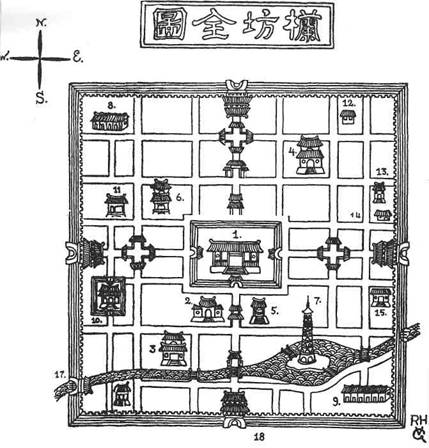
![]() |
| Van Gulik's map of Lan Fang. |
Saturday, December 31, 2011
FIRE, BURN by John Dickson Carr
In the first half of the 20th century, Carr was It. He was a bestselling author. He teamed with Adrian Conan Doyle to write The Exploits of Sherlock Holmes, one of the most notable early post-Doyle pastiches. And he was a popular writer for radio; he wrote a number of episodes for shows like Suspense! and one of his original shows, "Cabin B-13", ended up being spun off into its own series. His works were also the basis of an early TV show, Colonel March of Scotland Yard, with Boris Karloff in the title role. He also wrote a handful of well-received plays. He had a couple of popular series characters, like Dr. Gideon Fell (who was based on G. K. Chesterton) and Sir Henry Merrivale (modeled on Winston Churchill). He also was a pioneer of the full-length historical mystery novel. Carr was noted as the master of the locked-room murder although later critics noted that his plots often strained plausibility and credulity.
I've read some Carr in the past, and he can be a mixed bag. Some works, like the historical novel The Demoniacs, hold up well today, while one of his early works, Castle Skull, I found to be a crashing bore. He could generate all sorts of Gothick atmosphere, but I feel that all too often he used the promise of supernatural terrors to sell a mundane story. (Such was the case of The Demoniacs, which was certainly good enough but utterly lacking in the macabre.) And that's probably part of why Carr has fallen out of favor today. He was great in the 30s and 40s, but after WWII some felt he lost something (although some of his better works came from that period). By the 60s his style of mannered mysteries had fallen out of favor, and while some are still regarded as classics, others have not aged well at all.
Luckily, Fire, Burn is of the former category. It's a meld of mystery with touches of supernatural or sci-fi, as Scotland Yard officer John Cheviot stepped into a cab in 1957 and stepped out in 1829, stunned and bewildered. We're never told how or why he traveled back in time, or even if it's really happening or some sort of hallucination. It just happens.
Everyone recognizes Cheviot, even his lady-love, so he plays along, feigning a sudden illness sometimes to cover up his lapses in knowledge. Luckily, he's an amateur historian so he understands the Regency and its mores, which gives him an occasional advantage.
He ends up investigating some historical crimes using future knowledge and techniques. It starts off with a noblewoman complaining of stolen birdseed, but then leads into a full-throttle murder investigation when a woman is shot to death in front of a group of people, but no one had a gun nor can one be found that actually fired the bullet.
In between there's romance, ruminations on the period, duels, confrontations, and all sorts of fun. And then a surprising return to the present at the end.
One thing that struck me while reading this was how reminiscent this was of the TV show Life on Mars. The time periods are different, of course; LoM featured a detective from the 2000s projected backwards into the 1970s. I wonder if that show's creators were familiar with this novel.
Anyway, it's a fun, zesty read, like Georgette Heyer with testosterone. It should be easy to pick up at your favorite used book emporium. It is out of print but still protected by copyright.
I've read some Carr in the past, and he can be a mixed bag. Some works, like the historical novel The Demoniacs, hold up well today, while one of his early works, Castle Skull, I found to be a crashing bore. He could generate all sorts of Gothick atmosphere, but I feel that all too often he used the promise of supernatural terrors to sell a mundane story. (Such was the case of The Demoniacs, which was certainly good enough but utterly lacking in the macabre.) And that's probably part of why Carr has fallen out of favor today. He was great in the 30s and 40s, but after WWII some felt he lost something (although some of his better works came from that period). By the 60s his style of mannered mysteries had fallen out of favor, and while some are still regarded as classics, others have not aged well at all.
Luckily, Fire, Burn is of the former category. It's a meld of mystery with touches of supernatural or sci-fi, as Scotland Yard officer John Cheviot stepped into a cab in 1957 and stepped out in 1829, stunned and bewildered. We're never told how or why he traveled back in time, or even if it's really happening or some sort of hallucination. It just happens.
Everyone recognizes Cheviot, even his lady-love, so he plays along, feigning a sudden illness sometimes to cover up his lapses in knowledge. Luckily, he's an amateur historian so he understands the Regency and its mores, which gives him an occasional advantage.
He ends up investigating some historical crimes using future knowledge and techniques. It starts off with a noblewoman complaining of stolen birdseed, but then leads into a full-throttle murder investigation when a woman is shot to death in front of a group of people, but no one had a gun nor can one be found that actually fired the bullet.
In between there's romance, ruminations on the period, duels, confrontations, and all sorts of fun. And then a surprising return to the present at the end.
One thing that struck me while reading this was how reminiscent this was of the TV show Life on Mars. The time periods are different, of course; LoM featured a detective from the 2000s projected backwards into the 1970s. I wonder if that show's creators were familiar with this novel.
Anyway, it's a fun, zesty read, like Georgette Heyer with testosterone. It should be easy to pick up at your favorite used book emporium. It is out of print but still protected by copyright.
Judge Dee: Lost in the Maze
Sorry, folks, I was away for the holidays and didn't have much time for blogging. Now I'm back and getting a few things up before 2012 starts breathing down our collective back...
The Chinese Maze Murders was the first Dee book written, but not first in sequence; it's actually mid-way through the series. It opens with the supernatural framing story found in the early novels; in this case, a man who researches old cases has a chance encounter with an old man (the ghost of Dee?) who tells him a lurid story over many pots of wine in a restaurant...but then the next day nobody remembers seeing him.
Dee and his lieutenants are introduced as being on their way to a new post in fictitious district of Lan-Fang, a remote section of the border harried by Uighur tribes. It's said that this is due to his angering two powerful factions, the Buddhist clique and the Cantonese merchants, while at his last posting. (This is recounted in The Chinese Bell Murders.) Things are definitely amiss when he arrives, and he discovers that a local tyrant has set himself up as the power in charge, and has bribed and browbeaten the old magistrate into submission. Dee quickly puts things to rights, although the situation comes into play later in the novel.
Dee is confronted by three mysteries. First off is the death of a retired general, found murdered in his locked study, a bizarre miniature dagger steeped in poison embedded in his throat. And a packet of candied plums is in his sleeve, laced with poison. Who wanted him dead? Was the same person responsible for both?
Secondly, the young widow of another retired official comes to Dee with a problem; her husband left her with nothing but a scroll painting that supposedly was a clue to her real inheritance. However, his adult son by his first marriage maintains that she was disinherited because of infidelity. Does the secret lie in the complicated garden maze of the official's crumbling estate?
Last, what became of beautiful innocent White Orchid? She vanished some time ago and may have been part of the tyrant's harem, but there's no sign of her in his house. Someone who might have been her was seen in an old temple garden...but then later a headless corpse shows up that's identified as her. What happened?
This book has a rawness that clearly indicates it as an early work, but it's still good. Van Gulik's gothic descriptions of the crumbling garden maze are vivid and memorable. He creates a number of good supporting characters, like the feisty Dark Orchid, and the Taoist hermit Master Crane Robe who gives valuable clues while barely seeming to know what's going on. And Mah Joong has a fling with Tulbee, a Uighur girl who shows up later in the series.
As usual, any of Van Gulik's Judge Dee novels are Required Reading.
The Chinese Maze Murders was the first Dee book written, but not first in sequence; it's actually mid-way through the series. It opens with the supernatural framing story found in the early novels; in this case, a man who researches old cases has a chance encounter with an old man (the ghost of Dee?) who tells him a lurid story over many pots of wine in a restaurant...but then the next day nobody remembers seeing him.
Dee and his lieutenants are introduced as being on their way to a new post in fictitious district of Lan-Fang, a remote section of the border harried by Uighur tribes. It's said that this is due to his angering two powerful factions, the Buddhist clique and the Cantonese merchants, while at his last posting. (This is recounted in The Chinese Bell Murders.) Things are definitely amiss when he arrives, and he discovers that a local tyrant has set himself up as the power in charge, and has bribed and browbeaten the old magistrate into submission. Dee quickly puts things to rights, although the situation comes into play later in the novel.
Dee is confronted by three mysteries. First off is the death of a retired general, found murdered in his locked study, a bizarre miniature dagger steeped in poison embedded in his throat. And a packet of candied plums is in his sleeve, laced with poison. Who wanted him dead? Was the same person responsible for both?
Secondly, the young widow of another retired official comes to Dee with a problem; her husband left her with nothing but a scroll painting that supposedly was a clue to her real inheritance. However, his adult son by his first marriage maintains that she was disinherited because of infidelity. Does the secret lie in the complicated garden maze of the official's crumbling estate?
Last, what became of beautiful innocent White Orchid? She vanished some time ago and may have been part of the tyrant's harem, but there's no sign of her in his house. Someone who might have been her was seen in an old temple garden...but then later a headless corpse shows up that's identified as her. What happened?
This book has a rawness that clearly indicates it as an early work, but it's still good. Van Gulik's gothic descriptions of the crumbling garden maze are vivid and memorable. He creates a number of good supporting characters, like the feisty Dark Orchid, and the Taoist hermit Master Crane Robe who gives valuable clues while barely seeming to know what's going on. And Mah Joong has a fling with Tulbee, a Uighur girl who shows up later in the series.
As usual, any of Van Gulik's Judge Dee novels are Required Reading.
Tuesday, November 29, 2011
Judge Dee: Necklaces and Poets
Dee is on vacation after some tough work, and is on a fishing trip in quiet "Rivertown" where he hopes to relax. However, he is contacted by the local authorities, including an Imperial princess who makes her residence at a riverside palace there. The Princess is horrified at the loss of a valuable pearl necklace, a gift from her father, and her camp in the palace is worried that this is part of some scheme to manipulate the Emperor. Also, there's the death of a hotel clerk, and the disappearance of the owner's wife, that complicates things.
This is the next-to-last Dee novel written, and by now van Gulik had abandoned the named three cases and the map of the scene in the beginning. However, it's got some good characters, including the plucky niece of the innkeeper, Fern, whose assistance to Dee is invaluable. There's also a roving Taoist monk, Master Gourd, who proves to be more than he seems. There's also a nice glimpse of palace life, indolent and luxurious on the surface but full of scheming and decadence underneath.
Well, of course they are. But it's fun on the way. We get a good look at Magistrate Lo, a character often depicted as foolish and frivolous, but this time we're allowed to see a shrewd, intelligent side to his character. There's also some side characters, like the poet Sexton Loo, whose beliefs are a precursor of Zen, and the tragic Saffron, a mentally ill girl who lives in a nearby Shrine of the Black Fox.
One interesting aspect is Yoo-lan, who is based on the real Chinese poetess Yu Xuanji, who really was a courtesan who became a respected poet, reportedly had an affair with great poet Wen Tingyun, but whose life ended on the scaffold after being accused of the murder of a servant, a charge that is debated to this day. (According to some sources, that story may be completely false.) One of Yu's poems is reproduced in the book, in a scene set in a pavilion during an autumn banquet, a scene I found very memorable.
There's a few weaknesses in this entry; the plot's a little thin and hurriedly resolved. But van Gulik was writing this while very ill, and it was published a year after his death, so perhaps his talents weren't at their full peak.
For a bit of irony, the next book in the sequence of the series is the first written....
Thursday, September 15, 2011
Judge Dee: Beggars & Swords, Pavilions & Pearls
We're back in China again, in one of Dee's busiest periods of his career. From 668 to 670, he investigated not only the Bell murders but a number of other cases as well, some of which are covered here.
First off are two short stories. The first, "The Two Beggars," has Dee spotting the seeming ghost of a beggar in his house, which inspires him to look closer at the reported death of a beggar nearby. It's got a decent plot, with good info about the Lantern Festival, a well-etched characterization of the victim, and a nice explanation for the ghost. It's kind of a sad story as well, with the theme of hopeless, frustrated yearning that pops up here and there in van Gulik's work. The second, "The Wrong Sword," has Dee's assistants witnessing what at first seems to be the accidental killing of a young boy, who's part of an acting troupe doing acrobatic tricks. (In the Dee works, there's little difference between being an actor and being an acrobat/dancer/juggler.) They look closer, and there's ugliness underneath it all. The ending is nasty but there's a nice look at the lives of traveling actors of the period...although Dee's assurances to the innocent survivors at the end seem almost like rubbing salt in their wounds.
Next up is the novel The Red Pavilion, in which Dee and Ma Joong are passing through the pleasure resort of Paradise Island (no, Wonder Woman does not live there, and they're not in the Bahamas). They're to spend a couple of days relaxing while on their way back from a visit to the Capitol, but then Dee's friend Magistrate Lo is there, and must beat a hasty exit for some reason, and asks Dee to cover a few things for him, while Dee stays in a luxury suite that gives the novel its title.
The Red Pavilion has its three separate cases, but the separation is tenuous at best. "The Callous Courtesan" is about Autumn Moon, the "Queen Flower" or chief courtesan of the island, who is an unpleasant personality, and who is found dead in Dee's locked bedroom. Why? Was she poisoned, or killed somehow? "The Amorous Academician" concerns a mysterious death that happened a week earlier in that same room; in this case, an egotistical young scholar seemingly committed suicide, something quite out of character for him. Was he really murdered? By whom? And "The Unlucky Lovers" concerns itself with an unsolved murder that happened in that room decades before; who was the real culprit?
They're all very well intertwined, but I have to say that the solutions are uninspiring and bland. The real attractions are its looks at the worlds of courtesans and businessmen who run the pleasure resorts of the period. Magistrate Lo is always good company, and there's also two exceptionally good minor characters, enforcers for the local constabulary who are known as the Shrimp and the Crab. They're worth the reading alone.
The Emperor's Pearl takes place in a town near Poo-yang, during the Dragon Boat races. Dee and his wives are enjoying a game of dominoes on the official barge when crime interrupts...
Three cases again! "The Dead Drummer" gives us the mystery of a drummer for one of the boats who suddenly dies during the race, and they realize he was poisoned. Who did it, and why? "The Murdered Slavemaid" has a woman hiring Dee for a service (he's disguised as a wandering martial arts teacher) only to have him be too late to prevent her murder or to catch the criminal. Who was she, and why was she killed? And "The Emperor's Pearl" is the mystery of a treasure, a pearl of exceptional size and beauty, that's supposedly in the area, hidden away for years after it vanished from the Imperial Palace. Is it really there? Where is it? Would someone kill to have it?
The milieu is mostly that of antique dealers, with some weird sexual perversion going on. Sheng Pa, the roguish king of beggars from The Chinese Bell Murders, reappears, and has a romance going on with a frail court lady. (I'm only being partly sarcastic.) And there's other mysteries, of a supposedly haunted house, a woman who suddenly went insane, and others that are finally resolved in a dramatic confrontation.
This one is solid work, never spectacular or terrible, but a good piece of literary craft.
Coming up: two more from Poo-yang...
First off are two short stories. The first, "The Two Beggars," has Dee spotting the seeming ghost of a beggar in his house, which inspires him to look closer at the reported death of a beggar nearby. It's got a decent plot, with good info about the Lantern Festival, a well-etched characterization of the victim, and a nice explanation for the ghost. It's kind of a sad story as well, with the theme of hopeless, frustrated yearning that pops up here and there in van Gulik's work. The second, "The Wrong Sword," has Dee's assistants witnessing what at first seems to be the accidental killing of a young boy, who's part of an acting troupe doing acrobatic tricks. (In the Dee works, there's little difference between being an actor and being an acrobat/dancer/juggler.) They look closer, and there's ugliness underneath it all. The ending is nasty but there's a nice look at the lives of traveling actors of the period...although Dee's assurances to the innocent survivors at the end seem almost like rubbing salt in their wounds.
Next up is the novel The Red Pavilion, in which Dee and Ma Joong are passing through the pleasure resort of Paradise Island (no, Wonder Woman does not live there, and they're not in the Bahamas). They're to spend a couple of days relaxing while on their way back from a visit to the Capitol, but then Dee's friend Magistrate Lo is there, and must beat a hasty exit for some reason, and asks Dee to cover a few things for him, while Dee stays in a luxury suite that gives the novel its title.
The Red Pavilion has its three separate cases, but the separation is tenuous at best. "The Callous Courtesan" is about Autumn Moon, the "Queen Flower" or chief courtesan of the island, who is an unpleasant personality, and who is found dead in Dee's locked bedroom. Why? Was she poisoned, or killed somehow? "The Amorous Academician" concerns a mysterious death that happened a week earlier in that same room; in this case, an egotistical young scholar seemingly committed suicide, something quite out of character for him. Was he really murdered? By whom? And "The Unlucky Lovers" concerns itself with an unsolved murder that happened in that room decades before; who was the real culprit?
They're all very well intertwined, but I have to say that the solutions are uninspiring and bland. The real attractions are its looks at the worlds of courtesans and businessmen who run the pleasure resorts of the period. Magistrate Lo is always good company, and there's also two exceptionally good minor characters, enforcers for the local constabulary who are known as the Shrimp and the Crab. They're worth the reading alone.
Three cases again! "The Dead Drummer" gives us the mystery of a drummer for one of the boats who suddenly dies during the race, and they realize he was poisoned. Who did it, and why? "The Murdered Slavemaid" has a woman hiring Dee for a service (he's disguised as a wandering martial arts teacher) only to have him be too late to prevent her murder or to catch the criminal. Who was she, and why was she killed? And "The Emperor's Pearl" is the mystery of a treasure, a pearl of exceptional size and beauty, that's supposedly in the area, hidden away for years after it vanished from the Imperial Palace. Is it really there? Where is it? Would someone kill to have it?
The milieu is mostly that of antique dealers, with some weird sexual perversion going on. Sheng Pa, the roguish king of beggars from The Chinese Bell Murders, reappears, and has a romance going on with a frail court lady. (I'm only being partly sarcastic.) And there's other mysteries, of a supposedly haunted house, a woman who suddenly went insane, and others that are finally resolved in a dramatic confrontation.
This one is solid work, never spectacular or terrible, but a good piece of literary craft.
Coming up: two more from Poo-yang...
Tuesday, August 30, 2011
Recovering...
It's been a hell of a week. A week ago was the East Coast Earthquake. I was sitting at my desk at work when I heard the windows shake, and at first thought it was a wind gust. Then I felt the floor shake and thought there was blasting going on at the construction site nearby. But then it kept on shaking, and I rose to see if anyone else had any notion of what was going on. My boss was standing in the doorway of his office. "It's an earthquake!" he shouted, and he knows earthquakes after living for a few years in Iceland. I immediately felt myself start to panic, and it only got worse when we realized that the building was starting to sway, and we were on the 9th floor...
Obviously, I came out OK. The office building, and my apartment building, suffered no damage, and aside from being badly rattled I was unscathed. Of course, there's damage here and there in the area, ranging from the Washington Monument and the National Cathedral to my friend Denise's basement. It was a relatively mild earthquake, obviously, but this is a region where buildings are not built for that, people don't have earthquake insurance, and people like me have never experienced a quake and are terrified by a tremor.
And then came Hurricane Irene. Yeesh. Although she was pretty laid-back as well; this past Saturday was merely rainy and windy until late at night when it really got bad. And then I lost power about 2am, and dreaded a long stretch without power like I had with Hurricane Isabel some years ago, when I was 5 days without power. But I got power back at 11pm Sunday, and neighbors were restored about 24 hours later, and a felled tree on the next block was cleared quickly. So we're recovering, bit by bit.
During the downtime, I did finish a book from the library, Silent in the Grave by Deanna Raybourn.
This was diverting. In Victorian London, Lady Julia Grey's husband dies in torment, at first believed to be a heart attack. But she finds out her husband had engaged the services of a private inquiry agent, Nicholas Brisbane, and she ends up engaging him herself because she suspects her husband was murdered. And she ends up digging up all sorts of unsavoury stuff, and being attracted to Brisbane in the bargain, which is expected.
It's a decent plot, and the writing is good, but the characterizations are just a little too much. We're driven home the idea of Julia being unconventional for her time, but she comes across as the perfect open-minded liberal modern woman, totally fine and dandy with her lesbian sister, extremely accommodating with her servants, and objecting to racism and antisemitism in society. (To her credit, Raybourn prevents Julia from being too perfect as she has a temper and sometimes does fall prey to snobbishness.) Brisbane is also almost too perfectly romantic; he's dark and brooding, suffers from migraines, has Gypsy blood, is a talented violinist, suffers from psychic visions, and has that whole menacing/tender thing going on.
Normally, something like this would have me throwing the book across the room, but the story does work, and while the characterizations are often too modern for their milieu, they're otherwise believable and (most importantly) human. They're not an attempt at an accurate or realistic depiction of Victorian times, but a modern projection of an idealized Victorian age, and on that level, they're perfectly fine. I have to admit, despite a certain amount of eye-rolling I did at the improbably modern characters, I am sufficiently intrigued to want to check out Raybourn's next book, and that says something.
So another summer's almost over, and I turn 46 tomorrow. I'm still gonna keep going at this blog, so stay tuned. I'm actually thinking of putting up a calendar of events, which I'm sure readers in the DC area might like, and if folks elsewhere want to me to plug something, I'm open to persuasion.
And yes, you read that right, 46. I'm a damn young 46, if I say so myself. Despite a little creakiness, I still feel like I'm in my 20s, in all the good and bad ways.
Obviously, I came out OK. The office building, and my apartment building, suffered no damage, and aside from being badly rattled I was unscathed. Of course, there's damage here and there in the area, ranging from the Washington Monument and the National Cathedral to my friend Denise's basement. It was a relatively mild earthquake, obviously, but this is a region where buildings are not built for that, people don't have earthquake insurance, and people like me have never experienced a quake and are terrified by a tremor.
And then came Hurricane Irene. Yeesh. Although she was pretty laid-back as well; this past Saturday was merely rainy and windy until late at night when it really got bad. And then I lost power about 2am, and dreaded a long stretch without power like I had with Hurricane Isabel some years ago, when I was 5 days without power. But I got power back at 11pm Sunday, and neighbors were restored about 24 hours later, and a felled tree on the next block was cleared quickly. So we're recovering, bit by bit.
During the downtime, I did finish a book from the library, Silent in the Grave by Deanna Raybourn.
This was diverting. In Victorian London, Lady Julia Grey's husband dies in torment, at first believed to be a heart attack. But she finds out her husband had engaged the services of a private inquiry agent, Nicholas Brisbane, and she ends up engaging him herself because she suspects her husband was murdered. And she ends up digging up all sorts of unsavoury stuff, and being attracted to Brisbane in the bargain, which is expected.
It's a decent plot, and the writing is good, but the characterizations are just a little too much. We're driven home the idea of Julia being unconventional for her time, but she comes across as the perfect open-minded liberal modern woman, totally fine and dandy with her lesbian sister, extremely accommodating with her servants, and objecting to racism and antisemitism in society. (To her credit, Raybourn prevents Julia from being too perfect as she has a temper and sometimes does fall prey to snobbishness.) Brisbane is also almost too perfectly romantic; he's dark and brooding, suffers from migraines, has Gypsy blood, is a talented violinist, suffers from psychic visions, and has that whole menacing/tender thing going on.
Normally, something like this would have me throwing the book across the room, but the story does work, and while the characterizations are often too modern for their milieu, they're otherwise believable and (most importantly) human. They're not an attempt at an accurate or realistic depiction of Victorian times, but a modern projection of an idealized Victorian age, and on that level, they're perfectly fine. I have to admit, despite a certain amount of eye-rolling I did at the improbably modern characters, I am sufficiently intrigued to want to check out Raybourn's next book, and that says something.
So another summer's almost over, and I turn 46 tomorrow. I'm still gonna keep going at this blog, so stay tuned. I'm actually thinking of putting up a calendar of events, which I'm sure readers in the DC area might like, and if folks elsewhere want to me to plug something, I'm open to persuasion.
And yes, you read that right, 46. I'm a damn young 46, if I say so myself. Despite a little creakiness, I still feel like I'm in my 20s, in all the good and bad ways.
Thursday, August 25, 2011
Judge Dee: THE CHINESE BELL MURDERS
Second in the series in publication order (published in 1958), you can tell because van Gulik really works hard at keeping the three cases separate. There's also a sort of rawness palpable in this book; it hasn't quite the polish that the later books had. Yet still there's an obvious verve and enthusiasm for the material that shines through.
It opens with the supernatural framing story found in some of the novels. In this one, a Ming Dynasty collector of criminal memorabilia happens upon one of Judge Dee's old caps, and tries it on, only to be flooded with memories that aren't his own. Of course, he's compelled to write them down...
Dee is the newly-appointed magistrate of the district Poo-yang (stop snickering), in the Kiangsu province. So far things are quiet, save for a vulgar murder in the poor district. But later there arises a few more cases...
In "The Rape Murder in Half Moon Street" there's a simple-sounding case that turns out to be nowhere near as simple as it seems to be, with a great bit of armchair detection as Dee, hearing the details of the case in the courtroom, issues a rough description of an unknown person who is the real killer, based solely on deduction. There's also a supernatural edge to that story, as it involves a pair of purportedly cursed hairpins that were stolen, that bring calamity on the owner...
"The Secret of the Buddhist Temple" has Dee being openly bribed by some Buddhist monks who live in a wealthy temple outside town. They find out it's reputed for a "miraculous" statue of Kwan Yin; if a childless woman sleeps in the temple, she'll be blessed with children. This is a problematic part of the book, as Dee suspects wrongdoing right away, simply because they're Buddhist. (The old Chinese novels van Gulik based these books on had anti-Buddhist material in them, and were also occasionally anti-Taoist as well.) But Dee seeks to get to the bottom of what's going on.
And then there's "The Mysterious Skeleton," in which an elderly widow presents evidence of a long-standing feud between her family (of which she is the last member) and of a wealthy Cantonese merchant residing in town. While her story has inconsistencies, the judge does suspect the merchant right away (because he's Cantonese, it seems) and out of nowhere assumes he's smuggling salt, an Imperial monopoly. The trail of clues lead to an abandoned Taoist monastery near the merchant's compound that had been used by a militant sect (see? distrust of Taoists!), and a huge old bell that covers a grisly secret.
OK, so it's got a few weaknesses, mainly in that Dee's Confucianist prejudice against other religions, and prejudice against Cantonese merchants, doesn't sit well with modern Western sensibilities, even if he's always justified in the end. It's also Dee at his most ruthless and manipulative, and we're not always made privy to what's going on in his head. At one point he purchases two low-class concubines for reasons not readily made apparent, and ends up pissing off his First Lady something fierce. And a the way the Buddhist monks are dispatched struck me as a wild coincidence when I first read it about 30 years ago, but a modern rereading shows that Dee waited until the right moment and manipulated circumstances so things would turn out the way he wanted them.
But there are some good secondary characters introduced in this book. Sheng Pa, the head of the Beggar's Guild of Poo-yang, is a great mix of comic foil and shrewd rogue. Magistrate Lo, the head of the neighboring district of Chin-hwa, will reappear in a number of works; he's a playboy with multiple wives and numerous concubines, loves to entertain, publishes poetry, but is also whip-smart and misses nothing. He's an entertaining character and fun to read about.
So, despite some flaws, this is still Required Reading, so check it out.
It opens with the supernatural framing story found in some of the novels. In this one, a Ming Dynasty collector of criminal memorabilia happens upon one of Judge Dee's old caps, and tries it on, only to be flooded with memories that aren't his own. Of course, he's compelled to write them down...
Dee is the newly-appointed magistrate of the district Poo-yang (stop snickering), in the Kiangsu province. So far things are quiet, save for a vulgar murder in the poor district. But later there arises a few more cases...
In "The Rape Murder in Half Moon Street" there's a simple-sounding case that turns out to be nowhere near as simple as it seems to be, with a great bit of armchair detection as Dee, hearing the details of the case in the courtroom, issues a rough description of an unknown person who is the real killer, based solely on deduction. There's also a supernatural edge to that story, as it involves a pair of purportedly cursed hairpins that were stolen, that bring calamity on the owner...
"The Secret of the Buddhist Temple" has Dee being openly bribed by some Buddhist monks who live in a wealthy temple outside town. They find out it's reputed for a "miraculous" statue of Kwan Yin; if a childless woman sleeps in the temple, she'll be blessed with children. This is a problematic part of the book, as Dee suspects wrongdoing right away, simply because they're Buddhist. (The old Chinese novels van Gulik based these books on had anti-Buddhist material in them, and were also occasionally anti-Taoist as well.) But Dee seeks to get to the bottom of what's going on.
And then there's "The Mysterious Skeleton," in which an elderly widow presents evidence of a long-standing feud between her family (of which she is the last member) and of a wealthy Cantonese merchant residing in town. While her story has inconsistencies, the judge does suspect the merchant right away (because he's Cantonese, it seems) and out of nowhere assumes he's smuggling salt, an Imperial monopoly. The trail of clues lead to an abandoned Taoist monastery near the merchant's compound that had been used by a militant sect (see? distrust of Taoists!), and a huge old bell that covers a grisly secret.
OK, so it's got a few weaknesses, mainly in that Dee's Confucianist prejudice against other religions, and prejudice against Cantonese merchants, doesn't sit well with modern Western sensibilities, even if he's always justified in the end. It's also Dee at his most ruthless and manipulative, and we're not always made privy to what's going on in his head. At one point he purchases two low-class concubines for reasons not readily made apparent, and ends up pissing off his First Lady something fierce. And a the way the Buddhist monks are dispatched struck me as a wild coincidence when I first read it about 30 years ago, but a modern rereading shows that Dee waited until the right moment and manipulated circumstances so things would turn out the way he wanted them.
But there are some good secondary characters introduced in this book. Sheng Pa, the head of the Beggar's Guild of Poo-yang, is a great mix of comic foil and shrewd rogue. Magistrate Lo, the head of the neighboring district of Chin-hwa, will reappear in a number of works; he's a playboy with multiple wives and numerous concubines, loves to entertain, publishes poetry, but is also whip-smart and misses nothing. He's an entertaining character and fun to read about.
So, despite some flaws, this is still Required Reading, so check it out.
Thursday, July 7, 2011
Judge Dee: Monkeys and Monks
| A gibbon, not one who wrote "Decline and Fall of the Roman Empire." |
The first is a novella, "The Morning of the Monkey," contained in a two-part volume, The Monkey and the Tiger.
Judge Dee is taking his morning tea on the back porch of his official residence in Han-Yuan, watching the gibbons sporting in the trees. When he spots that one of the gibbons is carrying a gold ring, he tempts it with other objects until it's dropped. He retrieves the ring, obviously valuable, thinking to return it to its owner...until he spots dried blood on it. It could have an innocent explanation, but when Dee and newly-adopted assistant Tao Gan investigate, they discover the corpse of an old man, with his head bashed in and his fingers cut off.
Then follows a tale of vagabonds, pathetic love, and an ultimately sad and tragic ending. We get glimpses of the lives of criminal-fringe vagabonds and also of druggists and apothecaries of ancient China. There's also smuggling and Tao Gan proving his mettle with sly manipulation. It's a good story if a bit downbeat.
Next in the series' chronology is The Haunted Monastery.
Dee and his wives, accompanied by Tao Gan, are on their way back to Han-Yuan from a visit to the Capitol when a vicious storm in the mountains, and a broken axle on their cart, force them to beg a night's lodging at a the Monastery of the Morning Clouds, a Taoist institution in the mountains overlooking Han-Yuan. It's a big night, the 203rd anniversary of its founding, but also dark deeds are afoot...
Dee overhears ghostly whispers giving his name, and then in a flash, he looks out a window and sees a room across the courtyard where a mutilated woman is defending herself from an attacker dressed in old-style armor. But when he looks out again, there's nothing but a blank wall. Was it a supernatural vision? Or something more mundane? And there's all sorts of interesting folks in the monastery, including a troupe of actors, a snarky poet, a would-be nun, and a former Imperial tutor who lives there in retirement.
Again, there are three cases here. In "The Case of Embalmed Abbot" Dee teams with the poet to investigate the possible murder of the former abbot. In "The Case of the Pious Maid," there's mystery surrounding the identity of the would-be Taoist nun, including a dancer who looks just like her, and soon she vanishes from her room. And "The Case of the Morose Monk" gives us the mystery of an extra monk with a gloomy face who appears here and there in the monastery; who is he and what is his secret?
This was my first exposure to Dee; I picked this up in a used bookstore back in the early 80s, driven by my memories of a TV-movie version of this, Judge Dee and the Monastery Murders, which aired in 1974 and starred Khigh Dhiegh as Dee, with Mako, Soon-Tek Oh, and James Hong. (I've always wondered if they were testing the waters for a Judge Dee series in the U.S.; there had been one on the BBC once upon a time, and Dee's been the subject of a number of movies in Asia that never make it stateside.) And it's a lot of fun; there's the depiction of a Taoist monastery, the lives of the actors and acrobats who are visiting, and the depiction of Dee's home life. This is the first time we're shown Dee's three wives all together and interacting.
One part of it I also really liked was a very appealing character, Miss Ting, one of the acrobat/actors. She's a tough, smart, capable woman who's of genuine aid to Dee and one almost wishes she would stick on as a permanent Watson. There's a nice scene, too, where she confesses to Dee that she feels an odd attraction to another woman in the troupe, but isn't sure exactly how she feels about the situation. Although it is given a too-tidy resolution, Dee's advice to her is good; he tells her to not do anything until she's absolutely sure of her feelings and of the other woman's intentions. Although it may seem a bit hetero-centric, I have to admit it's advice I would give someone in a similar situation.
There's also good character stuff about Tao Gan, including how he seldom sleeps but just sits by candlelight at night, thinking "of this and that." Although Tao has a good sense of humor and all that, you get glimpses of a lonely and sad person who's kept well at bay.
There are a few flaws, including a few too many convenient love stories (although van Gulik seemed aware of this; at one point Dee reflects that perhaps he should quit being a magistrate and become a matchmaker instead), and too many people wanting to find out what happened to their sisters. But that said, it's still a lot of fun and required reading.
Tuesday, May 31, 2011
Judge Dee: THE CHINESE LAKE MURDERS
It's 666 CE (or AD, depending on your viewpoint), and Judge Dee has been assigned to a new post, as magistrate of Han-Yuan, a city in the mountains on the shore of a lake, without walls but close to the Capitol. Dee is unsure of being in a city without walls, but so far things seem quiet enough.
Until the city's leading citizens honor him with a banquet on a flower boat (a sort of floating restaurant/brothel), and the beautiful dancer Almond Blossom grasps a chance to whisper to Dee that she must speak to him later, and that a dangerous conspiracy was being plotted in that town. But before she can give Dee any information, she is drowned in the lake...
And then we're thrown into another full-blooded mystery/adventure with Dee and his retinue. Again, it's three cases, all connected in some way. "The Case of the Drowned Courtesan" is central; who killed Almond Blossom? Who could have overheard her whispering to Dee? And exactly what is the dangerous conspiracy? In "The Case of the Vanished Bride," a young bride is found dead the morning after her wedding, apparently from hemorrhage after having her hymen broken (rare, but as far as I can tell, not unheard of). Both are children of prominent citizens, and the kerfuffle is made worse when her coffin is opened at the Buddhist temple and is found to contain an unidentified man! And the groom? He vanished as well. Where are they? Finally, "The Case of the Spendthrift Councilor" centers on a former Imperial Councilor living in retirement in the city. He's quite old, seemingly becoming senile, but is also engaging in strange business deals where he's selling off lots of property at a loss. What's going on?
Also, there's something you find in a few of van Gulik's other works, a framing story involving the supernatural. In this case, an official who's involved in a fiendish conspiracy, and plagued with uncontrollable incestuous desires for his own daughter, goes to Han-Yuan and meets a beautiful courtesan who seems to be the answer to his problems...until she tells him a story that forms the story's narrative. Then she becomes a drowned corpse, and her spirit forces him to write everything down before his life ends. It's chilling. (And all of that is in the first chapter, so it's not much of a spoiler.)
Dee's retinue becomes complete in this novel; about halfway through, during an inspection tour of outlying villages, he and his assistants meet an itinerant swindler, Tao Gan, and save him from a pack of angry villagers. Out of gratitude, Tao reforms and pledges his loyalty to Dee, and plays an important role in resolving the mystery.
There's fights, plots, counterplots, passion, secret doors, hidden tunnels, crooked monks, and hints of fearsome supernatural creatures living in the lake. It all ends well, of course, although Dee barely escapes with his job and/or life.
This has always one of my favorite Dee novels; the setting is well-drawn and atmospheric, from the lake to the "Willow Quarter" where the brothels are, to the tribunal and the huge mansions where the wealthy live. And the menace that hangs over all of them.
Required reading, of course.
Until the city's leading citizens honor him with a banquet on a flower boat (a sort of floating restaurant/brothel), and the beautiful dancer Almond Blossom grasps a chance to whisper to Dee that she must speak to him later, and that a dangerous conspiracy was being plotted in that town. But before she can give Dee any information, she is drowned in the lake...
And then we're thrown into another full-blooded mystery/adventure with Dee and his retinue. Again, it's three cases, all connected in some way. "The Case of the Drowned Courtesan" is central; who killed Almond Blossom? Who could have overheard her whispering to Dee? And exactly what is the dangerous conspiracy? In "The Case of the Vanished Bride," a young bride is found dead the morning after her wedding, apparently from hemorrhage after having her hymen broken (rare, but as far as I can tell, not unheard of). Both are children of prominent citizens, and the kerfuffle is made worse when her coffin is opened at the Buddhist temple and is found to contain an unidentified man! And the groom? He vanished as well. Where are they? Finally, "The Case of the Spendthrift Councilor" centers on a former Imperial Councilor living in retirement in the city. He's quite old, seemingly becoming senile, but is also engaging in strange business deals where he's selling off lots of property at a loss. What's going on?
Also, there's something you find in a few of van Gulik's other works, a framing story involving the supernatural. In this case, an official who's involved in a fiendish conspiracy, and plagued with uncontrollable incestuous desires for his own daughter, goes to Han-Yuan and meets a beautiful courtesan who seems to be the answer to his problems...until she tells him a story that forms the story's narrative. Then she becomes a drowned corpse, and her spirit forces him to write everything down before his life ends. It's chilling. (And all of that is in the first chapter, so it's not much of a spoiler.)
Dee's retinue becomes complete in this novel; about halfway through, during an inspection tour of outlying villages, he and his assistants meet an itinerant swindler, Tao Gan, and save him from a pack of angry villagers. Out of gratitude, Tao reforms and pledges his loyalty to Dee, and plays an important role in resolving the mystery.
There's fights, plots, counterplots, passion, secret doors, hidden tunnels, crooked monks, and hints of fearsome supernatural creatures living in the lake. It all ends well, of course, although Dee barely escapes with his job and/or life.
This has always one of my favorite Dee novels; the setting is well-drawn and atmospheric, from the lake to the "Willow Quarter" where the brothels are, to the tribunal and the huge mansions where the wealthy live. And the menace that hangs over all of them.
Required reading, of course.
Monday, May 9, 2011
Judge Dee: THE LACQUER SCREEN
The last case from Dee's sojourn in Peng-lai, only this time he's in a neighboring district.
Dee and his stalwart lieutenant Chiao Tai are on their way home after a conference in the capitol, and stop off in the city of Wei-ping for a week's vacation, incognito. He stops to pay a call on the district's magistrate, Teng, a famed poet who's also noted for his devotion to his beautiful wife, Silver Lotus. Only Dee finds Teng to be irritable and rude, and after he leaves and he and Chiao Tai are supping in a restaurant, a local criminal mistakes them for fellow lawbreakers and takes them to the headquarters of the local underworld, where they get a rare glimpse of the comings and goings of the city's criminals.
Like other books in the series, there's three mysteries going on here, but they're very intertwined and one is barely a mystery at all. In "The Case of the Lacquer Screen," it's revealed that Teng's wife, Silver Lotus, has been murdered in her bed, and Dee ends up simultaneously assisting in a cover-up and trying to uncover what was going on her life that could have possibly led to her death. He also hears a weird story from Teng, of how his life has paralleled a lacquered screen standing in his home, and how now he fears he murdered his wife in a fit of madness. "The Case of the Credulous Merchant" concerns the mysterious suicide of a local merchant, and disappearance of his body. In "The Case of the Faked Accounts" one of the local thieves has a book of strangely altered accounts that links to another mystery in the book.
The separation between the stories is slim; the cases of the Credulous Merchant and the Faked Accounts are really pretty much one and the same, and figures in the other two play roles in the case of the Lacquer Screen. But it's still a good read. There are elements of film noir in the cases of the merchant and the accounts, and the murder of Silver Lotus is overflowing with gothicism and twisted emotions. (There's a great scene where Dee goes with a local thug to where her corpse is lying, in the swamps; he terrifies the man with stories of evil spirits, then casts a mumbo-jumbo spell to keep him in one spot until he's finished.)
There are also a lot of good characterizations. There's the Corporal, the head of the local underworld, an essentially decent man fallen on hard times but who does his best to keep the thugs in line and won't stand for murder. And there's psychotic burglar Kun-Shan, and the Student, a wannabe thief who's not much better. Golden-hearted prostitute Carnation is a valuable ally (and there's a nice scene between her and Dee when they go undercover at a house of assignation).
As always, the reader gets the cast list with the three cases, and an array of illustrations. There's no map of the city, disappointingly, but there is a cool illustration of the four panels of the screen that gives the book its title. And the glimpses into Chinese culture are always good fun. I just loved the bed in the house of assignation, where illicit lovers leave poems, composed on the spot, pinned to the wall all around. Imagine that in a modern motel room...
This isn't the best of the series, but as with all the Dee novels, it's highly recommended.
Dee and his stalwart lieutenant Chiao Tai are on their way home after a conference in the capitol, and stop off in the city of Wei-ping for a week's vacation, incognito. He stops to pay a call on the district's magistrate, Teng, a famed poet who's also noted for his devotion to his beautiful wife, Silver Lotus. Only Dee finds Teng to be irritable and rude, and after he leaves and he and Chiao Tai are supping in a restaurant, a local criminal mistakes them for fellow lawbreakers and takes them to the headquarters of the local underworld, where they get a rare glimpse of the comings and goings of the city's criminals.
Like other books in the series, there's three mysteries going on here, but they're very intertwined and one is barely a mystery at all. In "The Case of the Lacquer Screen," it's revealed that Teng's wife, Silver Lotus, has been murdered in her bed, and Dee ends up simultaneously assisting in a cover-up and trying to uncover what was going on her life that could have possibly led to her death. He also hears a weird story from Teng, of how his life has paralleled a lacquered screen standing in his home, and how now he fears he murdered his wife in a fit of madness. "The Case of the Credulous Merchant" concerns the mysterious suicide of a local merchant, and disappearance of his body. In "The Case of the Faked Accounts" one of the local thieves has a book of strangely altered accounts that links to another mystery in the book.
The separation between the stories is slim; the cases of the Credulous Merchant and the Faked Accounts are really pretty much one and the same, and figures in the other two play roles in the case of the Lacquer Screen. But it's still a good read. There are elements of film noir in the cases of the merchant and the accounts, and the murder of Silver Lotus is overflowing with gothicism and twisted emotions. (There's a great scene where Dee goes with a local thug to where her corpse is lying, in the swamps; he terrifies the man with stories of evil spirits, then casts a mumbo-jumbo spell to keep him in one spot until he's finished.)
There are also a lot of good characterizations. There's the Corporal, the head of the local underworld, an essentially decent man fallen on hard times but who does his best to keep the thugs in line and won't stand for murder. And there's psychotic burglar Kun-Shan, and the Student, a wannabe thief who's not much better. Golden-hearted prostitute Carnation is a valuable ally (and there's a nice scene between her and Dee when they go undercover at a house of assignation).
As always, the reader gets the cast list with the three cases, and an array of illustrations. There's no map of the city, disappointingly, but there is a cool illustration of the four panels of the screen that gives the book its title. And the glimpses into Chinese culture are always good fun. I just loved the bed in the house of assignation, where illicit lovers leave poems, composed on the spot, pinned to the wall all around. Imagine that in a modern motel room...
This isn't the best of the series, but as with all the Dee novels, it's highly recommended.
Subscribe to:
Posts (Atom)